Potassium for Lawns: Boost Cold Tolerance and Drought
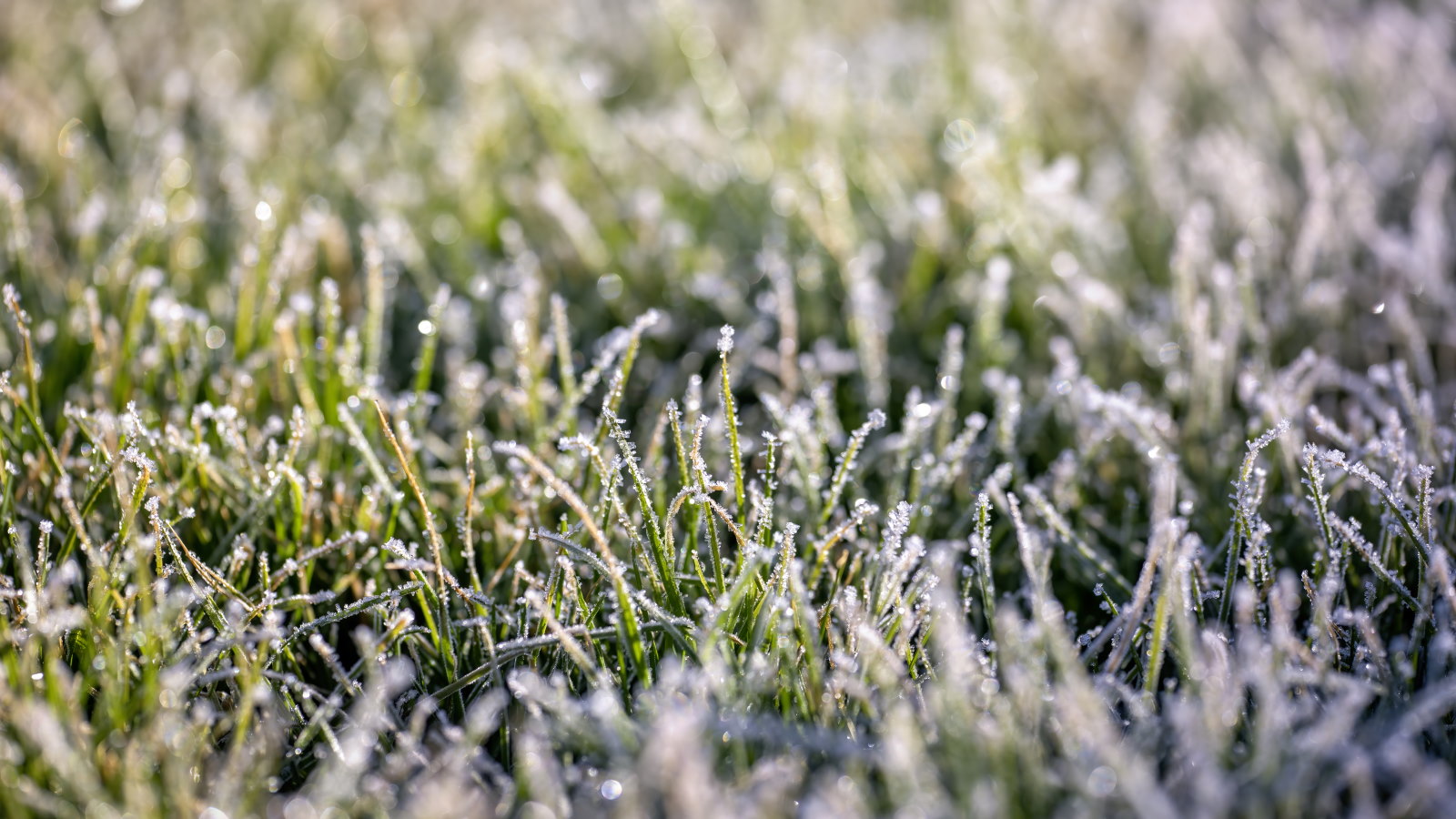
Why potassium is essential for lawn cold tolerance and drought comes down to how this single nutrient controls water inside every grass plant. Most homeowners load up on nitrogen and hope for the best, then watch their lawn struggle through a cold snap or a dry August. Potassium is the piece that ties everything together when stress hits.
It's also one of the three macronutrients grass actually pulls from the soil in large amounts. University extension research from programs like Penn State's Center for Turfgrass Science and others routinely targets soil test potassium between 100 and 160 ppm on a Mehlich-3 extraction for cool-season turf. Hit that range, and your lawn is in a far better position to handle both a hard freeze and a week without rain.
Image source: Bing (Web (fair-use with source credit))
Quick Answer
Potassium regulates water movement inside grass cells. It strengthens cell walls, lowers the freezing point of crown tissue, and helps roots pull moisture deeper. Lawns with adequate potassium tolerate cold snaps and dry spells far better than nitrogen-only programs.
Why Potassium Matters More Than Most Homeowners Realize
If you've ever looked at a fertilizer bag, you've seen three numbers. Most folks focus on the first one (nitrogen) because it greens things up fast. The last number, potassium, gets ignored.
That's a real problem, because potassium is the nutrient that does the heavy lifting when conditions turn rough.
Cold snaps, dry weeks, and sudden temperature swings all stress turf in similar ways. Water inside plant cells either freezes, evaporates, or becomes unavailable. Potassium acts like a built-in defense system against all three.
It regulates how water moves in and out of cells, which is why turfgrass agronomists call it the "stress nutrient."
Here's the part most homeowners miss: grass uses roughly as much potassium as nitrogen over a full growing season. Yet most fertilizer programs pile on nitrogen and treat potassium as an afterthought. Soil test data across university extension labs routinely shows potassium levels dropping below the recommended 100 to 160 ppm range, especially in sandy soils and heavily irrigated lawns where potassium leaches away.
The practical payoff matters in three real situations:
- A late-spring cold snap after warm weather has pushed grass out of dormancy
- A two-week dry stretch with watering restrictions
- Winter desiccation on turf that stays green through cold months
In all three cases, a potassium-deficient lawn suffers more damage and recovers slower. A well-fed lawn shrugs off the same stress with minor discoloration at worst.
| Stress Event | Potassium's Role | Visible Result in K-Deficient Lawn |
|---|---|---|
| Hard freeze | Lowers cellular freezing point, protects crowns | Crown death, thin spring regrowth |
| Drought | Reduces water loss through leaves, deepens roots | Wilting, brown patches, slow recovery |
| Winter desiccation | Maintains cell turgor during dry cold winds | Tip burn, patchy dieback in exposed areas |
| Disease pressure | Strengthens cell walls against fungal invasion | Higher snow mold and dollar spot incidence |
How Potassium Actually Works Inside Grass
Let's talk about what potassium actually does at the cellular level, because the mechanism is what separates real answers from marketing copy.
Grass cells live in a watery environment. Water flows in and out through the cell membrane, and that flow is controlled largely by potassium ions. Potassium is the most abundant positively charged ion inside plant cells, and it creates the osmotic pressure that holds water in place.
When potassium levels drop, cells lose their ability to retain water. They go limp, freeze more easily, and dry out faster.
Three specific mechanisms matter for cold and drought tolerance:
Osmotic regulation. Potassium builds up inside cells and draws water in. Well-fed turfgrass maintains turgor pressure even when soil moisture drops. Drought-stressed turf with adequate potassium wilts later and recovers faster because the cells can hold onto water longer.
Carbohydrate translocation. Potassium activates enzymes that move sugars from leaves down to roots and crowns. Those stored carbohydrates feed the plant through winter and fuel spring green-up. Without enough potassium, sugars pile up in leaves instead of reaching the storage organs that need them most.
Cell wall strength. Potassium supports the synthesis of proteins and structural compounds that thicken cell walls. Thicker walls resist both ice crystal damage and pest pressure. A grass plant with weak cell walls is more vulnerable to mechanical damage from frost heaving and from fungal pathogens that exploit stressed tissue.
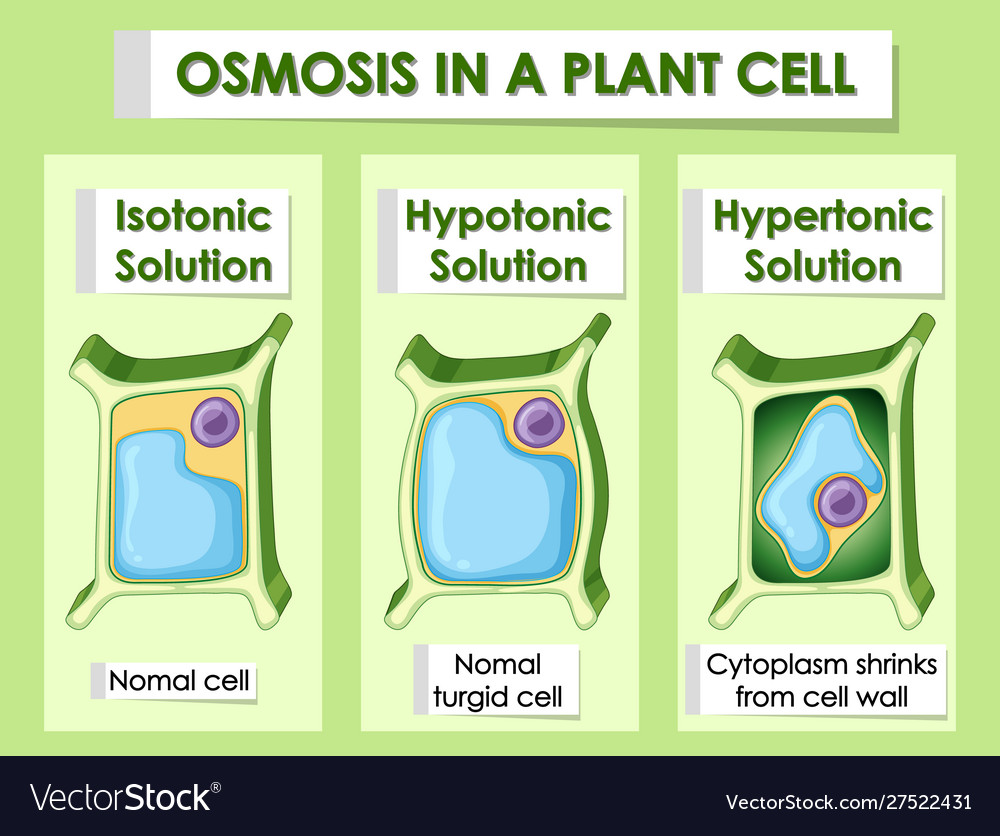
Image source: Bing (Web (fair-use with source credit))
The third mechanism is often overlooked. Cold tolerance isn't just about surviving a freeze. It's about how the plant manages water during freeze-thaw cycles.
When soil freezes and thaws repeatedly, roots get torn, and cells lose water to extracellular ice. Potassium reduces that water loss and helps the plant rehydrate during thaw periods.
For drought specifically, potassium's role in stomatal control is the key factor. Stomata are the tiny pores on grass blades that open and close to regulate gas exchange and water vapor. Potassium ions drive the opening and closing mechanism.
When potassium is abundant, stomata close faster during heat and dry wind, cutting water loss by a meaningful margin. When potassium is scarce, stomata stay open longer, and the plant bleeds moisture it can't afford to lose.
Research from university turf programs has shown that turf with adequate potassium uses water more efficiently throughout the growing season. The effect isn't subtle. We're talking about a measurable difference in irrigation needs, not a marginal benefit.
When and Where Potassium Makes the Biggest Difference
Not every lawn needs the same potassium program. Soil type, climate, grass species, and irrigation practices all change the equation.
Sandy soils (CEC below 5). Potassium leaches fast. Sandy soils in the Southeast, coastal areas, and many newly built subdivisions can't hold potassium the way clay-rich soils do. Homeowners with sandy lawns often need split applications, smaller doses applied more frequently, to keep potassium available without losing it to deep percolation.
Clay and loam soils (CEC above 15). These soils hold potassium well. A single fall application at the recommended rate usually carries turf through winter and into spring. Over-application on heavy soils can build up to luxury consumption levels, where the plant takes up more than it needs without any added benefit.
Cool-season turf (Kentucky bluegrass, tall fescue, perennial ryegrass). These grasses go into winter dormancy or semi-dormancy. Adequate potassium in late fall is critical for winter survival. The grass is still photosynthesizing at low levels during warm spells in October and November, and the potassium taken up then gets stored in the crown for winter.
Warm-season turf (Bermudagrass, Zoysiagrass, St. Augustinegrass). These grasses go fully dormant in winter. Potassium supports the dormancy transition and helps the plant store energy for spring green-up.
Bermudagrass and Zoysiagrass respond especially well to fall potassium. Centipedegrass is sensitive to chloride, so potassium sulfate is the better source for that species.
Drought-prone regions (Southwest, Texas, Southern California). Here potassium's water-use efficiency benefit matters year-round. Lawns under water restrictions or in areas with high evapotranspiration rates benefit from aggressive potassium programs in spring and early summer before peak stress hits.
Northern climates (USDA zones 3, 5). Fall potassium is non-negotiable. Winterkill and ice encasement damage kill more turf in these zones than any other single cause, and adequate potassium meaningfully reduces the risk.
The takeaway: the more stress your lawn faces (extreme cold, prolonged drought, sandy soil, heavy traffic), the more potassium matters. Lush, low-stress lawns in mild climates can get by on less, but even there, a balanced program outperforms nitrogen-only fertility.
Mistakes That Wreck Potassium Programs
Even homeowners who know potassium matters often apply it wrong. Here are the errors we see most often in soil test interpretations and lawn care failures.
Applying potassium in peak summer heat. Many people see summer stress and reach for potassium. But applying high rates of potassium fertilizer (especially potassium chloride) during heat waves can burn already-stressed turf. The salt index of KCl is high.
Late fall and early spring are safer windows.
Ignoring the source. Muriate of potash (potassium chloride) is cheaper and more common, but the chloride can damage sensitive species like centipedegrass and can contribute to salt buildup in arid soils. Potassium sulfate is the safer choice for most residential lawns, especially in the Southeast.
Skipping the soil test. Guessing on potassium rate is the single most common mistake. Without a soil test, you're either under-applying (wasting the effort) or over-applying (wasting money and risking runoff). A basic soil test from your state extension service costs $15 to $25 and tells you exactly how much potassium your lawn needs.
Confusing potassium with phosphorus. Phosphorus supports root growth early in the season. Potassium supports stress tolerance year-round. A "root builder" fertilizer high in phosphorus won't substitute for potassium.
Read the label and check the third number.
Assuming nitrogen alone will solve thin turf. If your lawn is thin and struggling, adding more nitrogen often makes it worse. Nitrogen pushes top growth at the expense of roots and storage organs. A balanced N-P-K with adequate potassium builds a more resilient plant.
Watering potassium off the lawn. Granular potassium needs to be watered in lightly after application. Otherwise it sits on the soil surface and doesn't reach the root zone. A quarter-inch of irrigation or a steady rain within 24 hours moves it down where roots can access it.
Fertilizing frozen ground. In northern climates, late-fall applications should go down before the ground freezes solid. Once the soil is frozen, the potassium can't move into the root zone. Aim for applications 4 to 6 weeks before your average first hard frost.
These mistakes don't just waste fertilizer. They can actively harm your lawn. The good news is that all of them are easy to avoid once you know what to look for.
Seasonal Timing and Application Strategy
Timing is where most potassium programs succeed or fail. Apply it right, and your lawn builds a strong reserve for the stress months ahead. Apply it wrong, and the nutrient either burns the turf or leaches away before it can help.
For cool-season lawns, the sweet spot is late fall, roughly 4 to 6 weeks before your average first hard frost. At that point, top growth has slowed, but roots are still active. The grass takes up potassium, moves it to the crown, and stores it for winter.
Soil temperatures above 40°F (4°C) are enough to keep uptake going.
For warm-season lawns, the timing shifts earlier. Apply potassium in early to mid-fall, before the grass goes fully dormant. Bermudagrass and Zoysiagrass benefit from a late-summer application followed by a lighter fall boost.
This sequence supports the dormancy transition and builds reserves for spring green-up.
If you're in a drought-prone region, don't wait for fall. A late-spring application, right before peak summer heat, gives the turf the potassium it needs to regulate water use during the hottest weeks. The strategy looks different by region:
| Region / Climate | Best Timing | Application Rate (K2O) |
|---|---|---|
| Northern cool-season (zones 3–5) | Late September to mid-October | 1.5–2 lbs / 1,000 sq ft |
| Transition zone (zones 6–7) | Mid-October to early November | 1–1.5 lbs / 1,000 sq ft |
| Warm-season (zones 8–9) | Early to mid-fall | 1–1.5 lbs / 1,000 sq ft |
| Drought-prone West/Southwest | Late spring + early fall split | 0.5–1 lb / 1,000 sq ft each |
For sandy soils, split the total into two smaller applications spaced 4 to 6 weeks apart. A single heavy dose on sand leaches fast and wastes product. On clay or loam, a single application is usually enough.
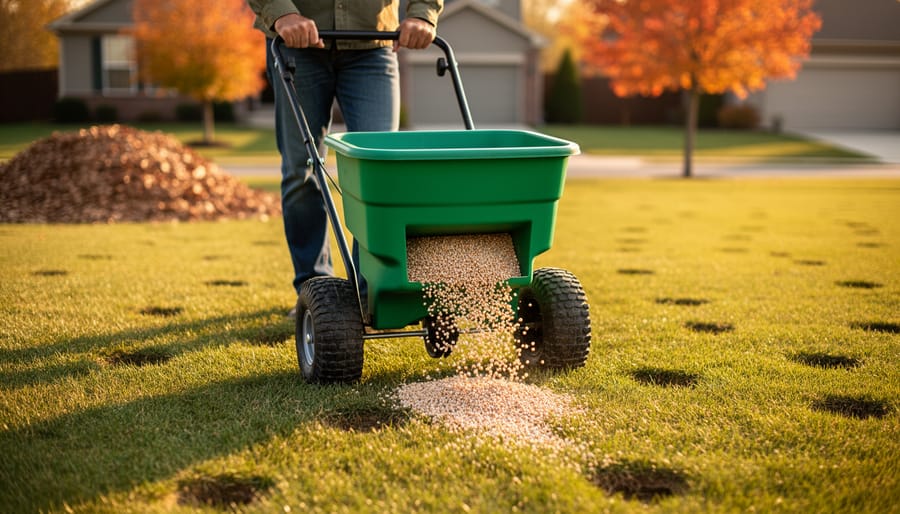
Image source: Bing (Web (fair-use with source credit))
Always water in granular applications with about a quarter-inch of irrigation. This moves potassium off the leaf surface and into the root zone. It also reduces the risk of foliar burn, especially with muriate of potash products.
Can You Apply Potassium in Summer?
You can, but be careful. High rates of potassium chloride during peak heat can stress already-warm turf. If a summer application is necessary, use potassium sulfate (lower salt index) and apply at the low end of the rate range.
Water it in immediately. Early morning is the safest window.
FAQs
How do I know if my lawn is low on potassium?
The most reliable way is a soil test. Most state extension labs offer tests for $15 to $25. Visual signs include yellowing or scorching along leaf tips, weak recovery from stress, and thin turf that struggles in summer or winter.
But visual symptoms often don't show up until deficiency is severe, so don't wait for them.
Is potassium the same as potash?
Basically, yes. "Potash" is the traditional agricultural term for potassium chloride and related potassium salts. On fertilizer labels, potassium is listed as K2O (potash equivalent).
A bag labeled "0-0-60" contains 60% K2O by weight.
Can I use a regular lawn fertilizer instead of buying straight potassium?
Often, yes. Many fall and winterizer fertilizers include potassium in the blend. A typical 24-0-12 or 22-0-14 formula provides meaningful potassium along with nitrogen.
Check the third number on the bag. If it's below 8, you may need a supplemental potassium source.
How long does potassium stay in the soil?
It depends on soil type. In clay and loam, potassium can remain available for months or even years. In sandy soils, it can leach within weeks.
That's why sandy soils need split applications. Regular soil testing (every 2 to 3 years on clay, annually on sand) keeps you ahead of depletion.
Will potassium help my lawn use less water?
Yes, meaningfully. Adequate potassium improves stomatal control, so grass loses less water through its leaves. Well-fertilized turf can use 20 to 30% less irrigation during peak summer stress.
Over a full season, that's a real difference on the water bill and during drought restrictions.
