When to Apply Late Fall Winterizer Before Ground Freezes
Most homeowners ask when to apply late fall winterizer fertilizer before ground freezes and get handed a fuzzy answer: "About a month before the first frost." That's not wrong, but it skips what actually matters. Your lawn doesn't care about the calendar. It cares about soil temperature, grass type, and the next two weeks of weather.
The real trigger is when soil drops to about 50°F (10°C) and keeps falling. At that point, top growth has stopped, roots are still drinking, and the grass shifts from making leaves to storing energy. Drop your winterizer while the ground is still unfrozen but cool enough that the plant isn't pushing new top growth.
As of 2026, university extension guidance from services like Purdue Extension and Penn State Extension still points to this same soil-temperature window, not a hard date.
Quick Answer
Apply late fall winterizer fertilizer when soil temperature hits 50°F and falling. Wait until top growth has stopped, usually 2 to 4 weeks before the ground freezes solid. Target a dry day with rain or watering within 24 to 48 hours after spreading.
Skip the application if the ground is already frozen or snow-covered.

Image source: Bing (Web (fair-use with source credit))
The Winterizer Timing Problem (and Why Most People Get It Wrong)
Here's the thing. "Late fall winterizer" is one of the most misused terms in lawn care, and that confusion is exactly why people torch their turf (or waste a perfectly good bag of fertilizer) every November.
A winterizer isn't just "the last fertilizer of the year." It's a specific type of feeding, usually higher in potassium (the "K" in NPK), designed to help cool-season grasses like Kentucky bluegrass, tall fescue, and perennial ryegrass build carbohydrate reserves and harden off before winter stress. The traditional "fall fertilizer" you put down in September is for recovery. The late-fall winterizer is for prep.
And the timing problem? Three things go wrong:
- Too early. Grass is still growing up. Nitrogen pushes tender top growth that gets zapped by the first hard frost, wasting the feed and stressing the plant.
- Too late. Soil is already frozen or saturated. Granules sit on the surface, wash away with snowmelt, or never break down. No uptake, no benefit, and you risk nutrient runoff into storm drains.
- Wrong product. A balanced 10-10-10 in late fall isn't a winterizer. It's just a meal. The K-rich blend is what does the cold-hardiness work.
If you've been treating "winterizer" as a generic term for "whatever's left in the spreader in November," that's your first mistake. The second is reading the calendar instead of the soil.
The Two Signals That Actually Decide When to Apply
Forget the frost-date calculators for a minute. Two measurable conditions tell you when your lawn is ready, and once you know them, you'll never second-guess the timing again.
Soil Temperature at 2 to 4 Inches Deep
This is the gold-standard trigger. Stick a soil thermometer (a basic $10 probe works fine) about 2 to 4 inches into the ground, in a shaded spot, mid-morning. Check it for three to five days in a row.
- 55°F and falling: Grass is starting to slow down but still actively growing. Hold off another week.
- 50°F and falling: This is your window. Top growth has effectively stopped. Roots are still active and pulling nutrients.
- Below 45°F: The plant is nearly dormant. Uptake is minimal. You've missed the window.
The key word is "and falling." A single 50°F reading after a warm spell doesn't count. You want a sustained downward trend.
Air Temperature Pattern Over 7 to 10 Days
Soil lags behind air temperature, so air gives you the early signal. Once your forecast shows daytime highs consistently in the 50s°F (10, 15°C) and overnight lows dipping into the 30s, 40s°F (0, 5°C), soil temps will follow within a week.
If the 10-day forecast shows a hard freeze (below 28°F / -2°C) coming, you want the winterizer down before that hits, not after. Once the top inch of soil freezes solid, you're done for the year.
| Signal | What to Watch | Target Reading | Action |
|---|---|---|---|
| Soil temp (2–4 in) | Mid-morning, shaded spot | 50°F and falling | Apply within 7–10 days |
| Air temp (daytime) | 7–10 day forecast | 50–65°F highs | Get ready, soil will follow |
| Air temp (overnight) | 7–10 day forecast | 30s–40s°F | Apply before hard freeze |
| Ground state | Visual check | Not frozen, not saturated | Good to spread |

Image source: Bing (Web (fair-use with source credit))
How to Read Your Local Conditions (Decision Branches)
National advice is fine for national audiences, but your zip code changes everything. Here's how to adjust the timing based on what you're actually dealing with.
Cool-Season Lawns (Northern US, Transition Zone, Pacific Northwest)
If you're growing Kentucky bluegrass, tall fescue, or perennial ryegrass, the late-fall winterizer is the most important feeding of your year. These grasses hit their peak root growth in fall, and the K-rich winterizer fuels that.
- Northern climates (USDA Zones 3, 5): Soil hits 50°F typically in mid- to late October, sometimes early November. Apply between Halloween and your first hard freeze.
- Transition zone (Zones 6, 7): The trickiest spot. Soil might hit 50°F in November, but warm spells can bounce it back up. Wait for a sustained downward trend, not a single cool week.
- Pacific Northwest: Wet, mild falls push the window into late November or even early December. Watch the forecast closely, but don't rush it.
Warm-Season Lawns (Southern US, Gulf Coast, California)
Here's where the "winterizer" conversation flips. Bermudagrass, zoysiagrass, and St. Augustinegrass go fully dormant when soil temps drop below 55°F.
Feeding them with a high-N winterizer before dormancy is wasted money and can actually push weak late-season growth that invites disease.
- For warm-season lawns, the last feeding should happen 4 to 6 weeks before expected dormancy, usually in early to mid-fall, not late fall.
- If you do a winterizer in the true "late fall" sense, it should be a low-N, higher-K product, and only in the southernmost zones where dormancy is short or incomplete.
If You Live in a "No-Winter" Zone (South Florida, Southern California, Gulf Coast)
Skip the winterizer entirely. Your lawn never truly stops growing. A balanced fall feeding in October or November is plenty.
Putting down a winterizer in San Diego in December is like throwing fertilizer at a lawn that's still photosynthesizing at 70°F.
| Grass Type | When Soil Hits 50°F | Winterizer Yes/No | What to Use |
|---|---|---|---|
| Kentucky bluegrass | Mid–late Oct (Zones 3–5) | Yes | High-K, low-N |
| Tall fescue | Late Oct–Nov (Zones 4–7) | Yes | High-K, low-N |
| Perennial ryegrass | Late Oct–Nov (Zones 4–7) | Yes | High-K, low-N |
| Bermudagrass | Below 55°F = dormant | Skip or light K only | Low-N, K-leaning |
| Zoysiagrass | Below 55°F = dormant | Skip or light K only | Low-N, K-leaning |
| St. Augustinegrass | Below 60°F = slowing | Skip in deep South | Light balanced feed |
Step-by-Step: Applying Late Fall Winterizer the Right Way
Once you've nailed the timing, the actual application is straightforward. The mistakes here aren't about skill. They're about skipping the prep work.
Step 1: Check Soil Temperature (Again, the Day Before)
Soil temps can swing 5, 10°F in a week during fall. Recheck the day before you plan to spread. If it's still 50°F and falling, you're good.
Step 2: Mow the Lawn (Slightly Shorter Than Normal)
Drop your mower one notch below your regular summer height. For most cool-season grasses, that means around 2.5 inches. Don't scalp it, but don't leave it long either.
Shorter grass prevents matting, snow mold, and gives the fertilizer direct soil contact.
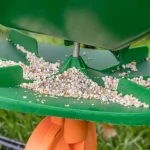
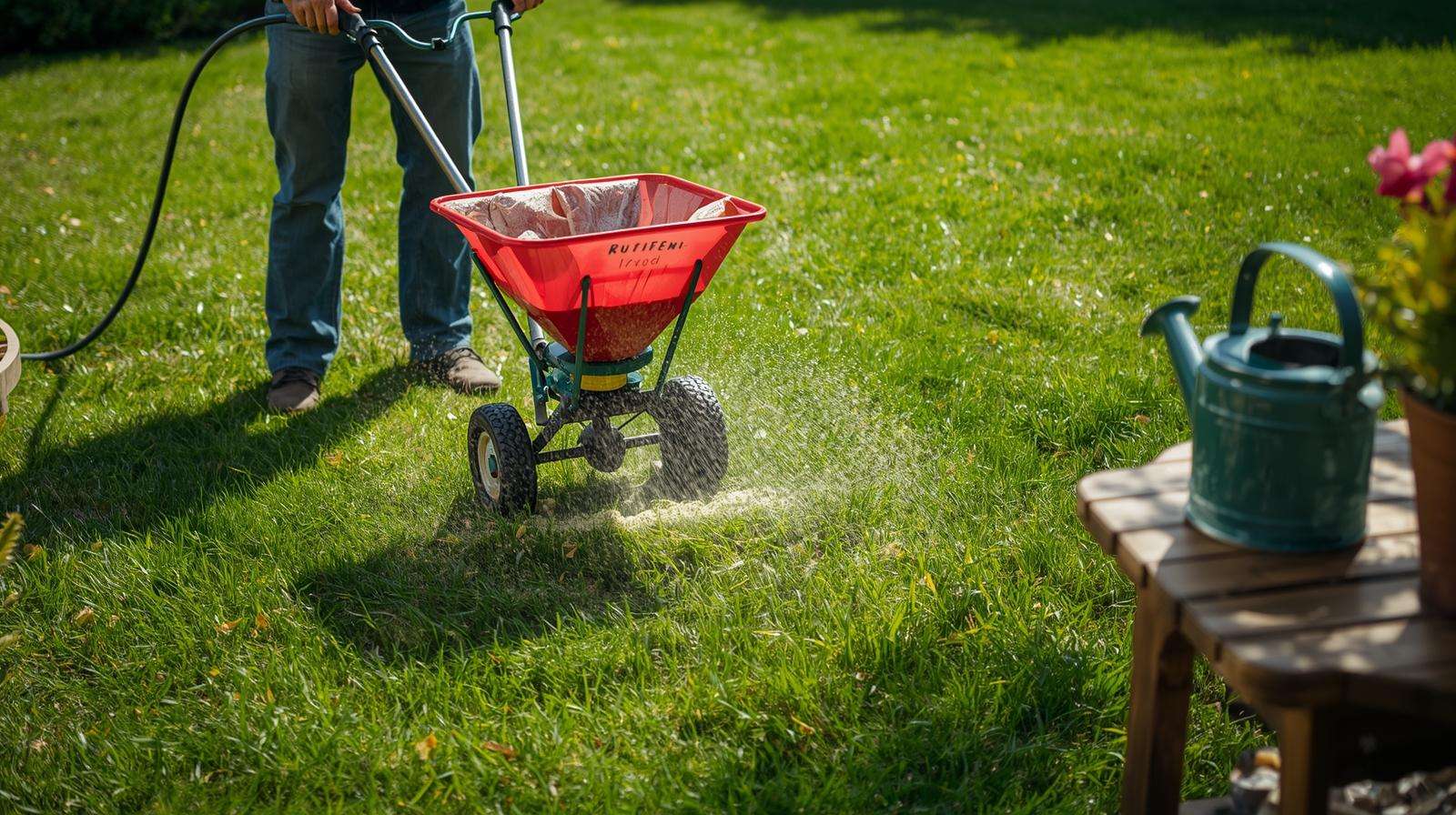
Step 3: Calibrate Your Spreader
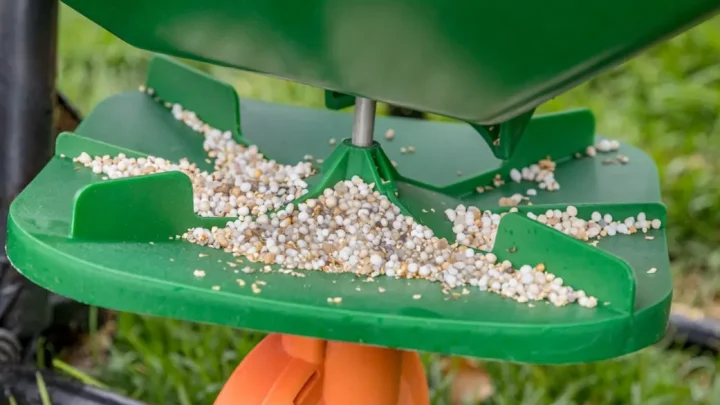
This is where most homeowners blow it. A typical winterizer application rate is 0.5 to 1.0 pounds of actual nitrogen per 1,000 square feet. Check the bag's NPK and coverage chart, then set your spreader accordingly.
A quick calibration trick: measure 1,000 sq ft (a 20×50 ft rectangle works), fill the spreader with a known weight of product, and walk the area at your normal pace. If you run out too early, you're over-applying. If you have a quarter left, you're under.
Step 4: Apply to Dry Grass, Before Rain or Watering
Spread the winterizer when the blades are dry. Wet grass causes granules to stick to leaves instead of falling to the soil. Then, water it in within 24 to 48 hours.
A quarter to a half inch of water is enough. If rain is in the forecast within that window, let nature handle it. If not, drag out the sprinkler.
Step 5: Clean Your Spreader and Store the Bag
Fertilizer left in a spreader absorbs moisture and clumps. Dump it out, rinse the hopper, and store the bag in a dry spot. Damp fertilizer is useless next spring.
Image source: Bing (Web (fair-use with source credit))
| Step | What to Do | Why It Matters |
|---|---|---|
| 1 | Recheck soil temp (2–4 in) | Confirms you're still in the 50°F-and-falling window |
| 2 | Mow to ~2.5 inches | Prevents matting and improves soil contact |
| 3 | Calibrate spreader at 0.5–1.0 lb N / 1,000 sq ft | Prevents burn and waste |
| 4 | Spread on dry grass, water in within 48 hrs | Activates the product, prevents leaf burn |
| 5 | Clean spreader, store bag dry | Protects equipment and leftover product |
Winterizer vs. Other Fall Fertilizers: Which Do You Need?
The word "winterizer" gets thrown around like it means the same thing as any fall fertilizer. It doesn't. And picking the wrong one is the easiest way to waste money or feed your lawn at the wrong time.
The September "Recovery" Feed
This is your early-fall application, usually 4 to 6 weeks before the winterizer. It's higher in nitrogen (N) to push recovery from summer stress. Think of it as the meal after the workout.
A typical ratio is 20-0-10 or 24-0-12.
The October "Build" Feed
This is your mid-fall application, balanced or slightly K-leaning. It supports root growth as top growth slows. Something like 13-0-13 or 15-0-15.
The Late-Fall Winterizer
This is the final feed, the one this whole article is about. Lower nitrogen, higher potassium. Common ratios: 10-0-20, 13-0-25, or even 5-0-30 depending on the brand.
The K does the cold-hardiness work. The small amount of N just keeps the plant ticking over without pushing top growth.
| Feed Type | Timing | NPK Lean | Purpose |
|---|---|---|---|
| Early fall (recovery) | Sept, early Oct | High-N | Summer recovery, top growth |
| Mid fall (build) | Mid Oct | Balanced | Root development |
| Late fall (winterizer) | Nov, soil 50°F | High-K, low-N | Cold hardiness, energy storage |
| Dormant feed (warm-season only) | Dec–Jan (mild zones) | Very low-N | Minimal root support |
If you skipped the September and October feeds, you can still apply a winterizer, but don't try to cram all three feedings into one November application. You'll burn the lawn or trigger a flush of weak growth right before dormancy.
Mistakes That Waste Your Fertilizer (or Worse, Hurt the Lawn)
Most winterizer failures aren't about product choice. They're about timing and prep. Here are the errors our research shows crop up again and again.
Mistake 1: Trusting the Frost Date Alone
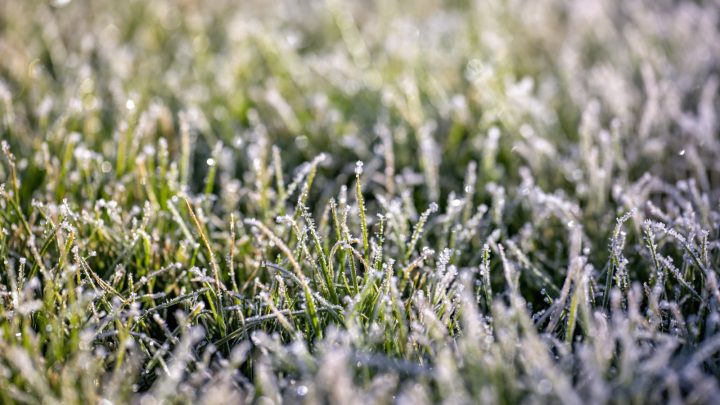
"First frost" is an air temperature event. Soil takes 1 to 3 weeks to follow. If you wait until the first frost hits, the soil is often still warm enough that grass resumes top growth, and your winterizer becomes a regular fertilizer with the wrong NPK for the season.
Mistake 2: Spreading on Wet Grass or Right Before a Downpour
Wet blades cause granules to clump and stick. A heavy rain right after application washes the product into storm drains before it can break down. You want dry grass at spread time and a gentle 0.25 to 0.5 inches of water within 48 hours to activate.
Mistake 3: Over-Applying Because "More Is Better"
A heavy winterizer doesn't mean a healthier lawn. It means runoff, possible burn, and a flush of growth that gets nipped by frost. Stick to 0.5 to 1.0 pounds of actual nitrogen per 1,000 square feet.
The bag's coverage chart is your friend.
Mistake 4: Ignoring State Phosphorus Rules
If your winterizer contains phosphorus (the "P" in NPK), check your state's rules. States like Florida, Michigan, Minnesota, New York, and several others restrict P on established lawns because of runoff into waterways. A 10-10-10 winterizer is illegal to spread on many established lawns.
Mistake 5: Fertilizing Frozen or Snow-Covered Ground
Once the ground is frozen solid, the product can't penetrate. It sits on top until snowmelt carries it into storm drains. This is the single most common winterizer mistake, and the one most likely to get you fined if you live in a municipality with fertilizer blackout dates.
Mistake 6: Forgetting to Water It In
Granular fertilizer needs moisture to break down and reach the root zone. If you spread and walk away without watering (and no rain falls within 48 hours), you're feeding the thatch layer, not the soil.
Quick Answers to the Questions Homeowners Ask Most
Can I apply winterizer after the first frost?
Yes, as long as the ground isn't frozen. The first frost hits the air, but soil stays workable for 1 to 3 weeks after. That's still your window.
What if I missed the window and the ground is already frozen?
Skip it. Wait until early spring. A late-fall missed application won't hurt your lawn.
A frozen-ground application just wastes product and risks runoff.
Should I mow before or after applying?
Before. Mow to about 2.5 inches the day before, then apply to dry grass. Don't mow for 2 to 3 days after spreading to let the granules settle into the soil.
Can I use a regular fall fertilizer instead of a winterizer?
You can, but you'll miss the potassium boost that drives cold hardiness. If your fall fertilizer is high-K (last number is the highest), it'll do the job. If it's balanced or N-heavy, it's not a winterizer.
How long does it take to see results in spring?
You won't see visible results in fall. The winterizer works underground, building carbohydrate reserves in the crown and roots. You'll notice the payoff in early spring green-up, usually 2 to 3 weeks earlier than untreated lawns.
Is there a pet or kid re-entry period after applying?
Most granular winterizers are safe once the granules have been watered in and the lawn is dry. That's typically 24 to 48 hours. Check the bag label for the specific re-entry interval.
Your Winterizer Timing Cheat Sheet
Tape this to the inside of your shed door and you'll never second-guess the timing again.
| Step | Action | Trigger |
|---|---|---|
| 1 | Stop regular fall feeding | Soil hits 55°F |
| 2 | Recheck soil temp daily | 7–10 day forecast shows highs in 50s°F |
| 3 | Mow to 2.5 inches | Day before application |
| 4 | Apply winterizer | Soil at 50°F and falling, ground unfrozen |
| 5 | Water in 0.25–0.5 inches | Within 24–48 hours |
| 6 | Stop for the season | Ground freezes solid or heavy snow |
The whole winterizer decision boils down to one question: is the soil still drinking? If yes, and air temps are trending down, you've got a window. If the ground is frozen or the forecast shows a hard freeze within 48 hours, you've missed it.
There's always next year, and next year's lawn will thank you for getting the timing right.

Similar Posts