Do Aerator Shoes Work or Just Compact Your Soil?
Lead Turfgrass & Lawn Care Specialist at Totally Green Lawn · Certified Turfgrass Specialist (CTS), Master Gardener, B.S. in Agronomy & Turf Science · 14+ years in residential turf management, organic fertilization, and weed science
Do aerator shoes actually work or do they compact soil? That's the honest question every homeowner asks before strapping spiked sandals onto their feet and marching across the lawn. The short answer is that spike-style aerator shoes can make compaction worse on heavy or clay soils because the spikes press soil sideways as they punch in.
They can help on sandy or already-loose soils where penetration is easy.
Research from university turfgrass programs shows core (plug) aerators remove soil cores about 2 to 3 inches deep and roughly 0.5 to 0.75 inches wide, while spike shoes typically only penetrate 1 to 2 inches depending on your body weight. As of 2026, most extension services still recommend core aeration as the primary method, with spike shoes reserved for light maintenance. Let's dig into the mechanics so you can decide what's right for your yard.
Quick Answer
Aerator shoes work on sandy or loose soil with mild compaction.
On clay or heavy soil, the spikes compress surrounding soil into a denser sidewall.
Core (plug) aerators are more effective for real compaction problems.
Use aerator shoes only when the ground is moist and the soil is already soft.
If your lawn feels rock-hard, spike shoes will not fix it.
The Honest Answer on Aerator Shoes and Soil Compaction
Let's get one thing clear right away. Aerator shoes are not useless, but they're also not the miracle product the infomercials suggest. Their effectiveness depends almost entirely on your soil type, your body weight, and how moist the ground is when you walk.
On a lawn with sandy or loamy soil that's only mildly compacted, aerator shoes can create small channels that allow air, water, and nutrients to reach the root zone. The spikes go in relatively easily, and the surrounding soil stays loose enough to benefit from the holes.
On clay-heavy or severely compacted soil, the physics work against you. When you step down on a spike, it has to displace the soil somewhere. With soft ground, that soil moves gently aside.
With hard ground, the spike compresses everything around it into a tighter, denser wall. Turfgrass researchers call this "sidewall compaction," and it's the main reason extension offices push core aerators instead.
So do aerator shoes actually work or do they compact soil? The honest answer is both, depending on conditions. They work when soil is soft, sandy, and only slightly compacted.
They compact when soil is heavy, dry, or already stressed.

Image source: Web (Bing) / amazon.co.uk (Web image (fair-use with source credit))
How Spike Aerators Actually Affect Your Soil

Image source: Bing (Web (fair-use with source credit))
Understanding the physics of what happens when a spike enters the ground will help you decide whether shoes make sense for your lawn.
What a spike actually does
A spike is a solid metal or plastic point. When you press it into soil, it pushes dirt aside to make room for itself. In loose soil, that displaced dirt settles loosely around the hole.
In dense soil, the displaced dirt gets compressed into a thin, hard wall right next to the hole.
That compacted sidewall defeats the purpose. Water and air have a harder time moving through compressed soil than through loose soil. So the very hole you created to improve flow gets surrounded by a barrier that restricts flow.
Manufacturer specifications indicate most consumer-grade aerator shoes have spikes between 1 and 2 inches long. That penetration depth is often too shallow to reach the root zone where compaction actually matters. The USDA Natural Resources Conservation Service notes that serious soil compaction usually occurs in the top 3 to 6 inches of a lawn profile, well below where shoes typically reach.
Why penetration depth matters
If a spike only goes in an inch, it's punching through the thatch layer and maybe the topsoil. The real compaction problem usually starts 2 inches down and gets worse from there. Shallow holes close back up within days as the soil rebounds, especially in clay.
This rebound effect is well documented in turfgrass management literature. Hollow-tine core aerators avoid it because they physically remove a plug of soil. That hole stays open longer, and the surrounding soil actually expands slightly into the gap, relieving pressure in the root zone.
When soil moisture changes everything
Soil moisture is the variable that makes or breaks spike aeration. When soil is too dry, the spike can't penetrate deeply and causes more compression than channeling. When soil is too wet, the spike creates a slimy, smeared hole that seals itself shut as it dries.
The sweet spot is soil that's moist but not soggy. Aim for ground that gives slightly when you walk on it, not ground that squelches or ground that's rock hard. Pre-watering 24 to 48 hours before aerating usually gets you into that window on most soils.
Image source: Bing (Web (fair-use with source credit))
When Aerator Shoes Work (and When They Make Things Worse)
Here's a practical breakdown based on soil type and lawn conditions. Use this to decide whether shoes are worth your time.
Conditions where aerator shoes actually help
Sandy or loamy soil with mild compaction responds reasonably well to spike shoes. The soil is loose enough to accept the spike without major sidewall compression. The homeowner gets some air and water movement into the root zone, and the lawn perks up.
Lawns that were core-aerated the previous season also benefit from spike touch-ups. The deep channels from core work are still open, and shallow spike holes add extra surface relief without much risk of new compaction.
Cool-season grasses like fescue and Kentucky bluegrass in well-drained soils are good candidates. Their root systems are dense but not deep, so shallow spike holes reach meaningful root activity.
Conditions where aerator shoes will hurt your lawn
Clay-heavy soils are the worst case for spike shoes. Clay particles lock together under pressure, so every spike stroke creates a tiny compacted brick wall. If your lawn sits in a region with high clay content (much of the Midwest, Southeast US, and central England), shoes will likely do more harm than good.
Severely compacted lawns feel like concrete underfoot. No amount of walking in spikes will fix this. The spikes simply cannot penetrate deep enough, and the pressure you apply with your body weight compresses the top layer further.
Drought-stressed or dormant lawns should never be spiked. The grass is already struggling, and any root damage from spikes plus sidewall compaction can push it past recovery.
Newly seeded or sodded lawns (less than one year old) have shallow, fragile roots. Spike shoes can tear those roots and undo establishment work. Wait at least a full growing season before any aeration.
Aerator Shoes vs. Core Aeration vs. Liquid Aeration
Comparing these three methods side by side makes the tradeoffs obvious. None is perfect for every situation, but each has a clear best-use case.
| Method | How It Works | Best For | Limitations |
|---|---|---|---|
| Spike aerator shoes | Strap-on spikes punch narrow holes as you walk | Light maintenance on sandy/loamy soil | Shallow depth, sidewall compaction on clay |
| Core (plug) aerator | Removes soil cores 2–3" deep | Severely compacted lawns, clay soils | More effort, leaves plugs on lawn surface |
| Liquid aeration | Soil surfactants and humic acids loosen structure | Supplementing mechanical aeration, large areas | Slower results, not a substitute for severe compaction |
Core aeration explained
Core aerators use hollow tines to pull small plugs of soil out of the ground. Those cores sit on the lawn surface and break down naturally within a couple of weeks. The holes left behind stay open longer because there's no compressed sidewall.
Air, water, and fertilizer reach deep into the root zone where they matter.
The University of Maryland Extension recommends core aeration as the gold standard for home lawn compaction relief, especially for cool-season grasses grown in transitional climates. Most extension offices across the country echo this guidance.
The main downside is equipment. Manual core aerators work for small lawns but are physically demanding. Walk-behind or tow-behind core aerators can be rented from most home improvement stores for around $50 to $80 per day as of 2026.
Liquid aeration explained
Liquid aeration products use surfactants (wetting agents) and sometimes humic or fulvic acid to break down soil tension. They don't remove material or punch holes. Instead, they help water penetrate compacted layers and encourage microbial activity that loosens soil over time.
These products work best as a supplement, not a replacement. If your lawn is severely compacted, liquid aeration alone won't solve the problem. If your soil is only mildly tight and you want a low-effort option, liquid products are worth considering.
Aggregate user reviews indicate liquid aeration results show up over weeks to months, not days. Patience is required.
Which method should you pick
If your lawn is severely compacted or built on clay, rent or hire a core aerator. The upfront cost or effort pays off in actual relief.
If your lawn is in decent shape and you want light maintenance between core aerations, shoes can work. Just confirm your soil is sandy or loamy and pre-water the lawn.
If you're unsure of your soil type or compaction level, do a simple test. Push a screwdriver 4 inches into the ground. If it slides in easily, your soil is loose enough for shoes.
If you struggle, you need core work first.
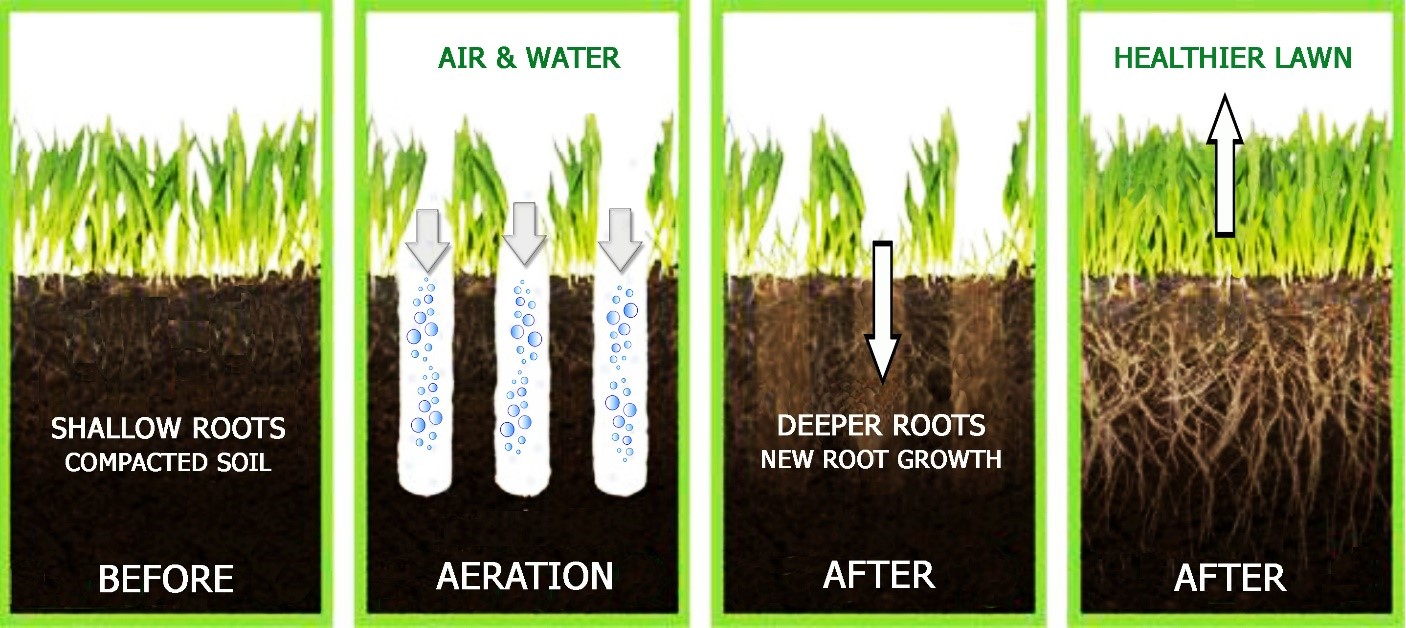
Image source: Web (Bing) / manuallawnaerator.blogspot.com (Web image (fair-use with source credit))
How to Use Aerator Shoes the Right Way
If you've decided shoes fit your situation, follow this process to get the best results and minimize compaction risk.
Step 1: Test your soil moisture
Two days before you plan to aerate, water the lawn deeply. You want the top 4 to 6 inches of soil moist but not saturated. A simple check: walk on the grass.
If your footprint leaves a slight impression that fades in a few seconds, you're in the right zone. If water pools or the ground feels spongy, wait a day.
Step 2: Mow short
Cut the lawn to about 1.5 inches the day before aerating. Short grass gives spikes cleaner access to the soil and reduces the amount of organic debris that gets pushed into the holes.
Step 3: Mark obstacles
Note sprinkler heads, shallow irrigation lines, landscape lighting, and any buried cables. Most spikes are only 1 to 2 inches long, but stepping wrong on a hidden object can hurt you or damage equipment. A quick walk-through with flags or markers saves headaches.
Step 4: Walk in an overlapping pattern
Strap the shoes on snugly over sturdy closed-toe footwear. Walk the lawn in straight lines, then make a second pass perpendicular to the first. This grid pattern gives roughly 8 to 10 spike strikes per square foot, comparable to light core aeration density.
Step 5: Water and feed after aerating
Right after you finish, water the lawn again to help the soil settle around the new holes. This is also the ideal time to overseed or apply fertilizer. The holes create direct channels to the root zone, so anything you put down now reaches the grass faster.
Step 6: Clean and dry the shoes
Remove soil and grass clippings from the spikes with a stiff brush. Dry the shoes completely before storing to prevent rust on metal spikes and mildew on straps.
| Step | Action | Timing |
|---|---|---|
| 1 | Deep water lawn | 48 hours before |
| 2 | Mow to 1.5 inches | 24 hours before |
| 3 | Mark obstacles | Day of aeration |
| 4 | Walk grid pattern | Day of aeration |
| 5 | Water and fertilize | Immediately after |
| 6 | Clean shoes | Immediately after |
Mistakes That Compact Your Soil Even More
Most spike-shoe failures aren't the shoes' fault. They're the result of technique errors that create compaction instead of relief.
Aerating when the soil is too dry
Dry soil resists penetration. When you force a spike into bone-dry ground, you're basically hammering a wedge into concrete. The spike compresses everything around it instead of sliding cleanly in.
Always pre-water if the lawn hasn't seen rain in over a week. Skip the shoes entirely during summer droughts unless you've irrigated deeply.
Wearing the shoes without enough body weight
Here's a counterintuitive problem. Aerator shoes rely on your body weight to push spikes into the ground. If you're light, the spikes barely penetrate.
If you weigh under 130 pounds, you may only get half an inch of depth, which is worse than no aeration because you've created surface disruption without meaningful channels.
If you're on the lighter side, add a weighted vest or skip shoes for core aeration. The physics don't lie.
Skipping the grid pattern
One pass in one direction creates holes only along those lines. Most of the lawn stays compacted. Always make a second perpendicular pass to get full coverage.
This roughly doubles your work but quadruples the effective coverage area.
Walking too fast
Slow, deliberate steps let the spikes penetrate fully. Quick steps mean partial penetration and more surface smearing. Treat it like mowing, not jogging.
Aerating during peak summer heat
Summer is when most homeowners notice compaction problems and reach for the shoes. Unfortunately, summer is also when cool-season grasses are weakest. Aerating during heat stress damages roots and invites weed invasion.
The Penn State Extension recommends core aeration in early fall or early spring for cool-season lawns, and late spring through early summer for warm-season grasses like Bermuda and Zoysia.
Expert Tips for Real Lawn Improvement
A few pro-level insights can save you money and effort. These come straight from turfgrass research and aggregate extension guidance.
Get a soil test before aerating
A basic soil test from your local extension office costs $15 to $30 and tells you pH, nutrient levels, and organic matter content. Compacted soil often correlates with low organic matter, and aeration alone won't fix that. Topdressing with compost after aeration gives much better results than aeration by itself.
Topdress after spiking
Spike holes are shallow, but they're still holes. Spreading a thin layer (about a quarter inch) of compost or screened topsoil after aerating fills those channels with rich material. The compost works its way deeper over time, improving soil structure without further compaction.
Overseed at the same time
Fall aeration plus overseeding is the single most effective renovation for thin lawns. Seed falls into the spike holes, germinates faster, and establishes deeper roots than seed scattered on the surface. This is where shoes can earn their keep, even on borderline soils.
Don't expect instant results
Aeration is a process, not an event. Most lawns need annual aeration for two to three years before compaction fully resolves. Shoes can be part of that cycle, but they're a supplement, not a cure.
Watch the weather
Aerate when you have a mild forecast for the next few days. Extreme heat, heavy rain, or cold snaps right after aeration stress the lawn. Aim for a window where grass can recover actively.
| Tip | Why It Matters |
|---|---|
| Soil test first | Identifies root causes beyond compaction |
| Topdress after | Fills holes with organic matter |
| Overseed at the same time | Maximizes seed-to-soil contact |
| Be patient | Compaction relief takes multiple seasons |
| Watch the weather | Reduces recovery stress on grass |
Aerator Shoes FAQ
How deep do aerator shoes penetrate?
Most consumer aerator shoes penetrate 1 to 2 inches depending on your body weight and soil moisture. That's shallower than core aerators, which reach 2 to 3 inches. For meaningful compaction relief, deeper is better.
Can aerator shoes damage grass roots?
Yes, if used during drought stress or on dormant lawns. Spikes can sever shallow roots and create entry points for disease. Always aerate during active growth and moist soil conditions.
How often should I use aerator shoes?
Once per year is typical for maintenance on healthy lawns. Severely compacted lawns may need two passes per year for the first couple of seasons, ideally combined with core aeration.
Are aerator shoes better than a manual core aerator?
For most lawns, no. Manual core aerators remove actual soil plugs, which relieves compaction more effectively. Shoes are cheaper and easier but deliver less impact.
Use shoes as a supplement, not a replacement.
Do aerator shoes work on clay soil?
Generally poorly. Clay particles bind together under pressure, so spike penetration often creates compacted sidewalls instead of relief. Clay lawns need core aeration or liquid soil conditioners instead.
Should I water after using aerator shoes?
Yes, water lightly right after aerating. Moisture helps the soil settle around the new holes and reduces smearing. Then resume your normal watering schedule based on grass type and weather.

Similar Posts