Fertilizing Lawn in 90 Degree Heat: Avoid Burn Damage
Lead Turfgrass & Lawn Care Specialist at Totally Green Lawn · Certified Turfgrass Specialist (CTS), Master Gardener, B.S. in Agronomy & Turf Science · 14+ years in residential turf management, organic fertilization, and weed science
If you've watched your thermostat climb into the 90s and wondered whether it's safe to put down fertilizer, here's the short version. Yes, you can fertilize a lawn in 90 degree weather without burning it, but only when you control three things: the fertilizer type, the soil moisture, and the timing. Get any of those wrong, and the same product that feeds your lawn can scorch it in a single afternoon.
The real risk isn't heat alone. It's heat plus dry soil plus fast-release nitrogen. University extension research on turfgrass stress shows that soil temperatures above 85°F slow root growth in cool-season grasses, which makes them far more vulnerable to salt damage from soluble fertilizer.
Pick a slow-release product, water the lawn deeply the day before, and apply in the early morning, and 90-degree weather becomes a non-issue.
Quick Answer
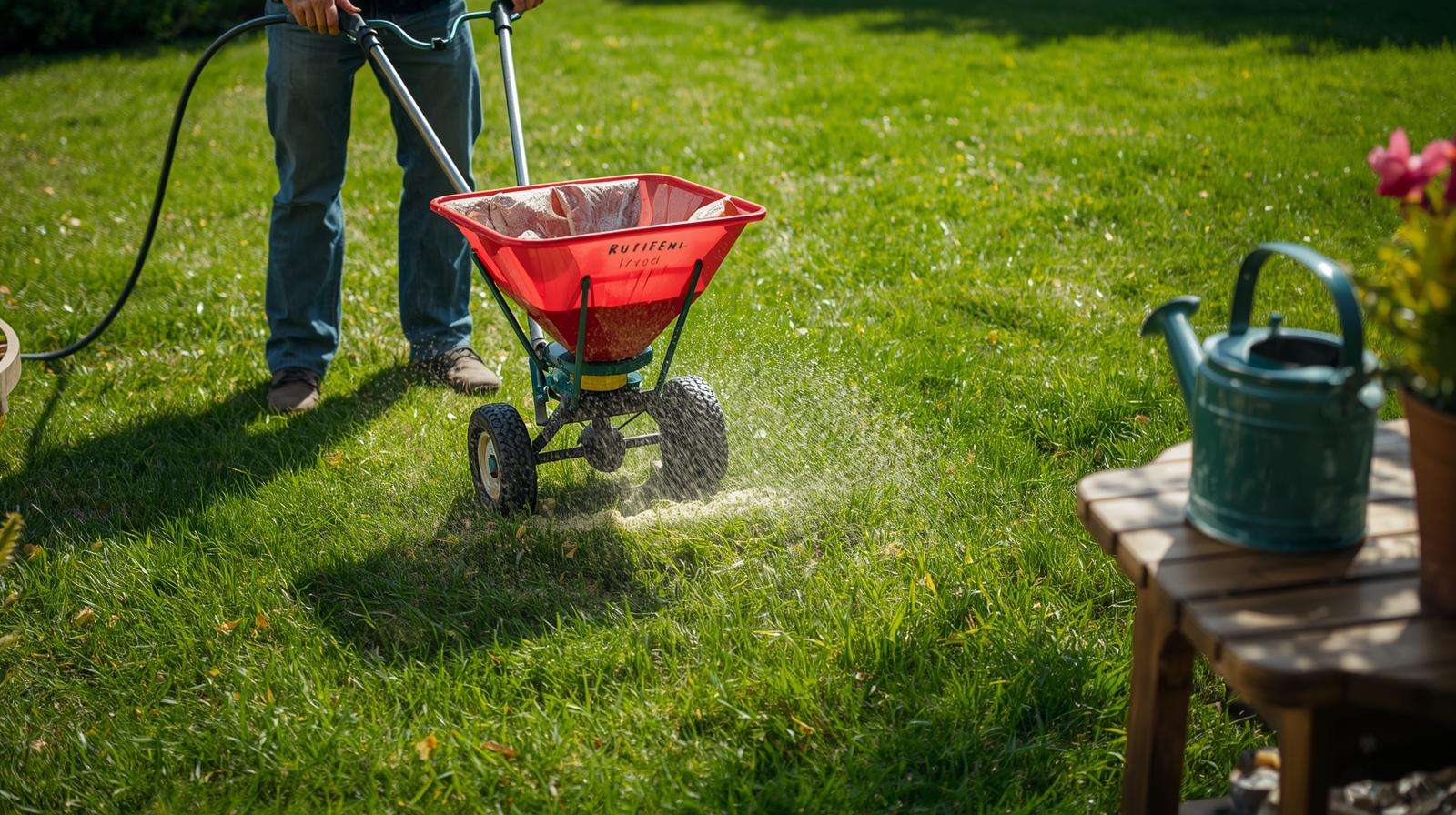
Yes, you can fertilize a lawn in 90 degree weather without burning it. Use a slow-release or organic fertilizer with at least 50% slow-release nitrogen. Water the lawn deeply 24 hours before application.
Apply at half the normal rate in the early morning. Water it in immediately with a quarter inch of irrigation. Skip quick-release synthetic fertilizers entirely when temperatures stay above 90°F.
What 90 Degree Weather Actually Does to Fertilizer and Grass
Heat changes how grass handles nitrogen. Once soil temps push past 85°F, cool-season grasses like Kentucky bluegrass, fescue, and ryegrass start to back off root growth and focus on surviving. Warm-season grasses like Bermuda and Zoysia are the opposite, and they're actually in peak growth mode in 90-degree weather.
Fertilizer behaves differently too. Urea-based products lose nitrogen to volatilization when surface temps climb above 85°F, meaning some of the nitrogen literally evaporates into the air before it ever reaches the roots. Quick-release sources also raise the salt concentration in the root zone fast, and hot, dry roots can't dilute that salt the way well-watered roots can.
The result is osmotic stress, which is what we call fertilizer burn.
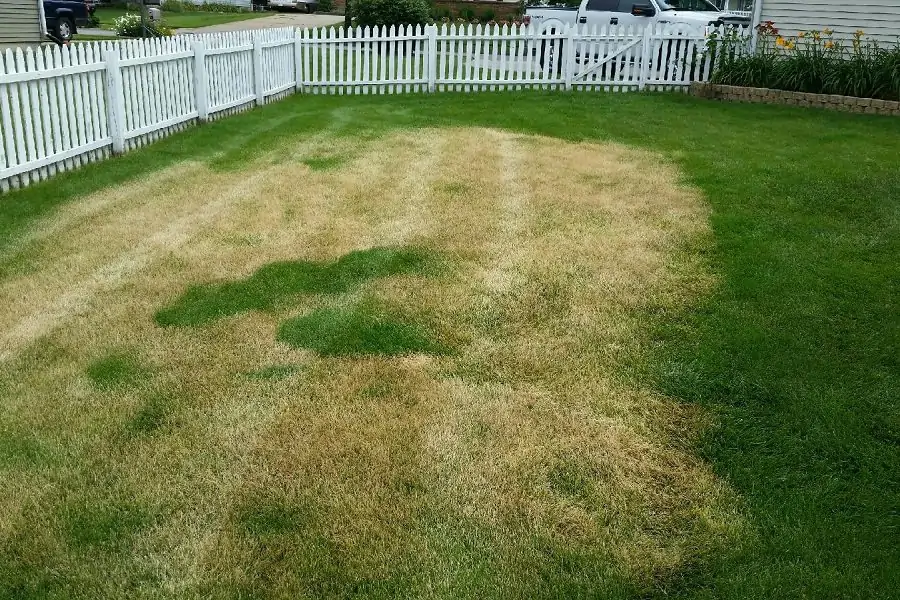
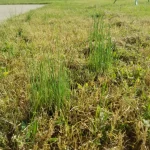
Burn shows up as yellow or brown stripes that follow your spreader pattern. Heat stress shows up as a more uniform wilting across the whole lawn. If you see stripes or patches that line up with where you spread product, that's burn.
If the whole yard is uniformly tan and crunchy, that's dormancy or drought.
The Three Conditions That Decide If You Can Safely Fertilize
Here's the decision tree. Answer these three questions before you open the bag.
What Type of Grass Do You Have?
Cool-season grasses (fescue, bluegrass, rye) are already struggling at 90°F. They don't need a nitrogen push in summer. If you must feed them, use iron-only or a very light organic feeding to keep color without forcing growth.
Warm-season grasses (Bermuda, Zoysia, St. Augustine, Centipede) are actively growing and benefit from summer feeding. They handle nitrogen far better at 90°F, and skipping the summer feeding actually weakens them going into fall.
What Type of Fertilizer Are You Using?
| Fertilizer Type | Safe Above 90°F? | Why |
|---|---|---|
| Quick-release synthetic (urea, ammonium nitrate) | No | High salt index, fast burn risk, volatilizes above 85°F soil temp |
| Slow-release synthetic (polymer-coated urea, IBDU, methylene urea) | Yes | Releases nitrogen over 6-10 weeks, low salt index |
| Organic (compost, milorganite, bone meal) | Yes | Very low salt index, slow biological release |
| Liquid foliar feed | Cautiously | Low burn risk but very short-lived; good for quick green-up |
| Iron-only (no nitrogen) | Yes | Greens the lawn without pushing growth; safest summer option |
How Wet Is the Soil?
Dry soil plus fertilizer equals burn. Always. Check soil moisture by pushing a screwdriver 4 inches into the ground.
If it goes in easily, you're fine. If you have to force it, water first, wait 24 hours, then fertilize. The Penn State Extension turfgrass program recommends irrigating to field capacity the day before any summer fertilizer application.
How to Fertilize in 90 Degree Heat Without Burning: Step by Step
Step 1: Check the Forecast
Don't fertilize if the next 3 days are all 92°F or higher. Look for a break in the heat, ideally a day where the high stays under 88°F. Light cloud cover and low wind are bonus points.
A rain forecast within 24 hours of application is fine, but skip it if you're expecting a downpour that could wash product into the storm drain.
Step 2: Water Deeply the Day Before
Run your sprinklers or irrigation long enough to soak the top 4 to 6 inches of soil. Early morning is the best time to do this so the grass blades dry before nightfall, which prevents fungal issues. You want the soil moist, not soggy, going into application day.
Step 3: Pick the Right Product
For cool-season lawns in heat, choose a product with 50% or more slow-release nitrogen. Look on the label for "polymer-coated," "methylene urea," "IBDU," or "organic" in the nitrogen source list. For warm-season lawns, a standard summer blend with at least 30% slow-release works well.

Step 4: Cut the Rate in Half
Manufacturer bag rates assume ideal spring or fall conditions. In summer heat, apply at half the recommended rate. For most lawns, that means 0.5 pounds of nitrogen per 1,000 square feet instead of 1 pound.
You can always add more in 4 weeks. You can't undo a burn.
Step 5: Apply in the Early Morning
The 6 AM to 9 AM window is your friend. The grass is cool, dew is minimal, and the product has all day to move into the root zone before the next heat cycle hits. Avoid evening applications since overnight moisture on fresh granules can trigger fungal growth.
Step 6: Calibrate Your Spreader
Close the spreader gate to the half-rate setting. Test it on your driveway first with no product to check the spread pattern. Overlap the previous wheel track by about 50% to avoid stripes.
Sweep any granules off hard surfaces back onto the lawn or into a trash bag.
Step 7: Water It In Right Away
Apply a quarter inch of water within 15 to 30 minutes of spreading. This pushes the nitrogen off the blades and into the soil where roots can use it. Without this step, you risk foliar burn and volatilization losses.
Don't flood the lawn. A gentle, even quarter inch is all you need.
Step 8: Hold Off on the Next Application
Wait at least 6 to 8 weeks before any follow-up feeding. In summer heat, the lawn uses nitrogen more slowly, and the slow-release product is still feeding it weeks after application. Reapplying too soon is one of the top causes of summer burn we see in homeowner lawns.
Mistakes That Cause Lawn Burn in Hot Weather
Using Quick-Release Fertilizer Because It's Cheaper
The cheap stuff at the big box store is almost always fast-release. In spring, that means fast green-up. In July at 92°F, it means burn.
The cost difference is usually $5 to $10 per bag. A re-sodding job after a bad burn costs $1,000 or more.
Applying to Dry Soil
This is the single most common error. Even slow-release fertilizer can burn if the soil is bone-dry. The salts concentrate in a tiny water film around each root and pull moisture out of the root itself.
Always, always water first.
Fertilizing During a Heat Wave
If your area is under a heat advisory, wait. Even slow-release products work better when soil temps are under 90°F. A 5-day stretch of 95°F+ is a signal to put the bag back in the garage.
Not Watering In the Product
Leaving granules on the blade surface in full sun is a guaranteed way to scorch the leaf tissue. That quarter inch of post-application water isn't optional in summer. It's the step that makes the whole process work.
Bagging Clippings Right After Application
If you mow within 24 hours of fertilizing, leave the clippings on the lawn. They contain nitrogen that's still working its way down into the soil. Bagging throws away free fertilizer and concentrates the rest on the lawn unevenly.
Ignoring State and Local Blackout Dates
Several states restrict summer fertilizer applications to protect waterways. Florida, New Jersey, Maryland, and Virginia all have summer blackout windows, usually June through September, where phosphorus and sometimes nitrogen are restricted. Check your local state Department of Agriculture rules before you spread anything.
Safer Alternatives When Temperatures Stay Above 90
Switch to an Iron-Only Application
If your lawn is more cool-season than warm-season, nitrogen isn't what it needs in a 90°F stretch. Iron delivers the dark green color without forcing blade growth the plant can't sustain. Chelated iron sprays or granular iron supplements work well and carry near-zero burn risk, even in extreme heat.
Topdress with Compost
A quarter-inch layer of finished compost feeds the soil biology and slowly releases nutrients over weeks. It also holds moisture, which buffers roots against heat stress. This is the lowest-risk summer feeding option and works on both cool-season and warm-season lawns.
Hold Off Until Fall
Sometimes the best move is no move at all. Cool-season lawns naturally slow down in summer heat. Forcing growth with fertilizer stresses the plant and invites disease.
A September or early October feeding will do far more for fall color and root reserves than any summer application.
Quick Answers to Common Summer Fertilizing Questions
Is 90 Degrees Too Hot for Scotts Turf Builder?
Scotts Turf Builder is a broad product line, and the answer depends on the specific formulation. Their standard Turf Builder uses mostly quick-release nitrogen, which we don't recommend above 90°F. Their Southern or halts crabgrass products often include slow-release sources that handle heat better.
Read the bag and look for "slow-release" or "polymer-coated" on the label.
Can I Fertilize at 91 Degrees in the Morning?
Yes, if the rest of your conditions are right. A 91°F day with a 7 AM application, deep pre-watering, and slow-release fertilizer at half rate is safe. The morning window matters more than the peak temperature.
Will Fertilizer Burn My Lawn at 88 Degrees?
Much less risk at 88 than at 95. Most turf research places the danger zone above 90°F for cool-season grasses and above 95°F for warm-season. If your forecast shows 88 as the high, a half-rate slow-release application is generally safe with proper watering.
How Long Should I Wait to Fertilize After a Heat Wave?
Give the lawn at least 3 to 5 days of temperatures below 88°F before you apply anything. Water deeply during the cool-down to rehydrate the root zone. Then follow the standard process for a normal-temperature application.
What Does Fertilizer Burn Look Like vs Heat Stress?
Burn follows a pattern. You'll see yellow or brown stripes that match your spreader passes, or patches where granules piled up. Heat stress is uniform across the whole lawn, with all blades wilting the same way at the same time.
Can I Water Burned Grass Back to Life?
Not really. Burned tissue is dead. You'll need to wait for the grass to regrow from the roots and crown, which takes 3 to 6 weeks.
Severely burned spots may need overseeding in fall. The lesson is prevention, which is much cheaper than recovery.
Your Summer Fertilizing Game Plan
Here's the short version. Check your grass type first, since cool-season and warm-season lawns need different summer strategies. Pick a slow-release or organic product with at least 50% slow-release nitrogen.
Water the lawn deeply the day before, then apply at half the bag rate in the early morning. Water it in within 30 minutes using a quarter inch of irrigation. Wait 6 to 8 weeks before any follow-up feeding.
If the forecast shows 95°F or higher for multiple days, skip the application entirely. Iron supplements, compost topdressing, and patience are your best friends during peak summer heat. Follow these rules and your lawn will make it through August without a single brown stripe.
🌱 Agronomist Recommended: Bio-Stimulants & Turf Nutrition
Achieve deep golf-course green color and root resilience without surge growth using lab-verified nutrients and bio-stimulants:
- Liquid Iron & Humic Acid:Check Liquid Iron & Humic Blends on Amazon →
- Stress-Blend High Potassium Fertilizer:Check High Potassium Lawn Fertilizers on Amazon →
*FTC Disclosure: As an Amazon Associate, Totally Green Lawn earns from qualifying purchases.*

Similar Posts