Topdress Your Lawn With Biochar and Compost: A Complete
Lead Turfgrass & Lawn Care Specialist at Totally Green Lawn · Certified Turfgrass Specialist (CTS), Master Gardener, B.S. in Agronomy & Turf Science · 14+ years in residential turf management, organic fertilization, and weed science
If your lawn feels compacted, drains poorly, or dries out faster than it should, learning how to topdress lawn with biochar and compost can turn things around without a full renovation. Both materials feed the soil biology your turf depends on, and combined, they fix structure, retain moisture, and build long-term carbon reserves.
The real win comes from the pairing. Biochar's porous structure holds water and nutrients like a sponge, while compost supplies the microbial life and slow-release nitrogen that charge it. Per International Biochar Initiative (IBI) guidelines, horticultural-grade biochar should be pre-mixed (or "charged") with compost before soil application, typically at a 1:4 to 1:9 biochar-to-compost volume ratio, to avoid temporary nitrogen lock-up in the root zone.
Done right, the process takes a single afternoon, and the soil benefits compound for years.
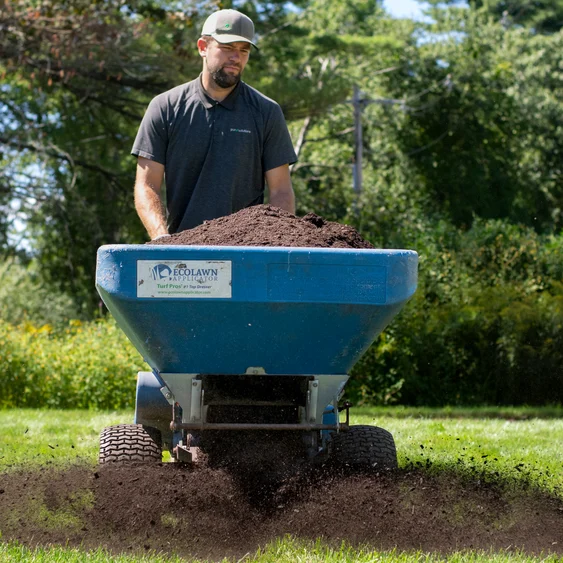
Image source: Web (Bing) / puresolutions.com (Web image (fair-use with source credit))
Quick Answer
Topdress your lawn by mowing low, dethatching if needed, and core aerating. Mix horticultural biochar with finished compost at a 1:4 to 1:9 volume ratio. Spread a ¼ to ½ inch layer evenly across the lawn.
Work it into the soil with a rake or drag mat. Water deeply within 24 hours. Apply during active growth for your grass type.
What Topdressing with Biochar and Compost Actually Does to Your Lawn
Topdressing is the practice of spreading a thin layer of soil-building material across the turf surface and working it down into the existing root zone. Compost on its own adds organic matter, beneficial microbes, and slow-release nutrients. Biochar, a charcoal-like product made from heated biomass in a low-oxygen process called pyrolysis, adds a permanent structural upgrade.
It's loaded with micropores that hold water, air, and nutrients that would otherwise wash or leach away.
When you combine the two, compost charges the biochar with biology and nitrogen, and biochar holds those nutrients in place instead of letting them drain past the roots. Research from university extension programs, including Cornell University Cooperative Extension, shows biochar-amended soils retain 5 to 20% more water, depending on native soil texture, and that the effect persists for decades because biochar breaks down so slowly. Compost, by contrast, feeds the system for one to three seasons before it's used up.
Together, they cover short-term feeding and long-term soil structure.
The results homeowners actually see: thicker turf, fewer dry patches in summer, better response to fertilizer (because less of it runs off), and soil that crumbles in your hand instead of forming a hard slab. As of 2026, this combination is gaining ground with homeowners moving off synthetic fertilizer programs, partly because it builds soil rather than just feeding the grass blade.
Before You Start: Test Your Soil and Know Your Grass
Skipping a soil test is the single most common reason topdressing underperforms. You can spread the most expensive biochar in the world, but if your pH is off or you're missing a key nutrient, the grass won't respond the way you expect.
A basic soil test tells you three things that drive every decision in this process:
- pH level. Most turfgrasses prefer 6.0 to 7.0. If you're below 5.5, lime first; topdressing won't fix acidity on its own.
- Existing organic matter. Anything under 3% means your soil is hungry. Anything over 6% means you can skip compost and focus on biochar alone.
- NPK baseline. Knowing your phosphorus and potassium levels prevents over-application and protects local waterways.
You can grab a DIY kit at any garden center, but a lab test through your state's cooperative extension service runs $15 to $40 and gives you region-specific recommendations. Most state extensions accept samples by mail and post results online within two weeks.
Grass type matters just as much. Cool-season grasses (Kentucky bluegrass, tall fescue, perennial rye) hit their growth peak in fall and early spring, so topdressing in those windows gives roots time to recover. Warm-season grasses (Bermuda, Zoysia, St.
Augustine, centipede) ramp up in late spring and summer, so that's your window there. Topdressing dormant grass is wasted work because the roots aren't active enough to integrate the material.
Quick condition check before you spread anything:
| Lawn Condition | What It Tells You | Topdressing Adjustment |
|---|---|---|
| Water pools after rain | Compaction or clay-heavy soil | Core aerate first, then apply thicker ½ inch layer |
| Grass wilts within hours of watering | Sandy or low-organic soil | Boost compost ratio, add biochar for water retention |
| Spongy or bouncy feel underfoot | Thatch layer over ½ inch | Dethatch before topdressing or amendments get trapped |
| Bare or thin patches | Poor soil contact or low nutrients | Topdress before overseeding for better seed-to-soil contact |
If your lawn passes the test (good pH, decent organic matter, no major thatch), a light ¼ inch pass once a year is plenty. If it's struggling, plan for a ½ inch pass and consider repeating next season.
How to Topdress Your Lawn with Biochar and Compost (Step-by-Step)
Here's the workflow that gets it right the first time. Total time: 3 to 5 hours for a typical residential lawn, plus watering.
Step 1: Mow low and bag the clippings. Cut to about 1.5 inches for cool-season grass, or scalp warm-season grass at the start of its growing season. Bag or rake up everything so amendments contact the soil directly.
Step 2: Dethatch if the layer is over ½ inch. Use a dethatching rake or a power dethatcher. Thatch blocks amendments from reaching the root zone, and skipping this step is a top reason topdressing fails.
Step 3: Core aerate the lawn. Run a core aerator across the entire lawn in two perpendicular passes. Leave the plugs on the surface; they'll break down and feed the soil. The holes give the biochar-compost mix a direct path into the root zone.
Step 4: Pre-mix (charge) the biochar with compost. Combine horticultural biochar (1 to 6 mm particle size) with finished, screened compost in a wheelbarrow or on a tarp. Use a 1:4 biochar-to-compost ratio for most lawns, or push to 1:9 if you're applying a thicker layer. Add water until the mix is evenly moist, like a wrung-out sponge, and let it sit 24 to 48 hours.
This step prevents the temporary nitrogen lock-up that happens when dry biochar hits soil.
Step 5: Calculate your volume. One cubic yard of mix covers roughly 1,000 square feet at a ⅓ inch depth. Measure your lawn's square footage (length × width for rectangles, or use an online mapping tool for odd shapes) and divide by 1,000 to get the cubic yards needed at that depth.
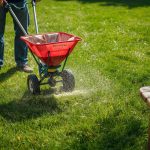
Step 6: Spread the mix evenly. Use a shovel and a stiff rake, or load a broadcast spreader for larger lawns. Drop the mix in piles across the lawn, then rake it out to a uniform ¼ to ½ inch layer. Avoid burying the grass completely; you should still see green blades through the material.
Step 7: Work it into the soil. Drag a rake (upside down), a drag mat, or the back of a landscaping rake across the surface to push the mix down into the aeration holes and across the soil surface. This is where the magic happens: direct contact between amendments and root zone.
Step 8: Water deeply within 24 hours. Soak the lawn until the top 4 to 6 inches of soil are wet. This activates the compost's microbial life, settles the biochar into pore spaces, and prevents the mix from drying out and blowing away.
Step 9: Hold off on fertilizer for 2 to 4 weeks. The compost is feeding the soil, and adding synthetic nitrogen on top can disrupt the microbial colonization you just paid for. After a month, resume your normal fertility program if a soil test indicates it's needed.
Tools and materials checklist:
| Item | What to Look For | Approximate Quantity |
|---|---|---|
| Horticultural biochar | IBI-certified, 1 to 6 mm particle size | 2 to 5 lbs per 100 sq ft |
| Finished compost | Screened, fully cured, no weed killers | 0.25 to 0.5 cu yd per 1,000 sq ft |
| Core aerator | Rental from local equipment shop | 1 day rental |
| Dethatching rake | Or power dethatcher for large lawns | As needed |
| Broadcast spreader | For even distribution on big lawns | 1 |
| Wheelbarrow and tarp | For mixing biochar and compost | 1 each |
Biochar-to-Compost Ratios: Getting the Mix Right for Your Situation
The ratio between biochar and compost is the most adjustable variable in this process, and getting it right depends on what you're trying to fix. A 1:4 ratio (one part biochar to four parts compost by volume) is the standard starting point for most home lawns. It delivers enough biochar to make a structural difference without overwhelming the biology.
Push toward 1:9 (more compost, less biochar) if your lawn is in decent shape and you mainly want to add organic matter and biology. The biochar still has an effect at this ratio, but compost is doing the heavy lifting. Use a 1:4 ratio if your soil is sandy, compacted, or drought-stressed.
The higher biochar content boosts water and nutrient retention more aggressively.
A few ratios worth knowing for specific situations:
- 1:4 (biochar: compost), Standard ratio for tired, compacted, or drought-prone lawns
- 1:9, Maintenance ratio for healthy lawns; mostly compost benefits with a biochar boost
- Pure compost, no biochar, Fine if your soil already has decent structure; biochar adds cost without proportional benefit
- Pure biochar, no compost, Almost never recommended; risks nitrogen lock-up and lacks biology
Image source: Bing (Web (fair-use with source credit))
Particle size matters too. Biochar under 1 mm can become dusty and hard to spread evenly. Biochar over 6 mm stays on the surface and gets picked up by mowers.
The 1 to 6 mm range is the sweet spot, and most IBI-certified products fall in that range. If you're buying in bulk, ask the supplier for the sieve analysis before you commit.
One more detail that catches people off guard: biochar that's been "charged" with compost and water for 24 to 48 hours before application performs noticeably better than dry biochar spread on top of compost. The pre-charging step lets the biochar pores fill with compost tea and microbes, so it goes into the soil pre-loaded rather than blank. Skipping this step is one of the most common errors, and it leads to the nitrogen tie-up issue we mentioned earlier.
Timing It Right: When to Apply Based on Your Grass Type and Climate
Timing makes or breaks the whole project. Apply at the wrong time, and the amendments sit on the surface without integrating, or worse, stress already-struggling grass. Apply at the right time, and the root zone pulls the material down within days.
Cool-season grasses (KBG, fescue, rye) have two solid windows:
- Early fall (mid-August through mid-October in most of the northern US). Soil is still warm, air is cooling, and grass is putting energy into roots. This is the top choice for topdressing because roots stay active through early winter.
- Early spring (late March through early May). Works, but weed pressure is higher, and you're competing with crabgrass germination in many regions.
Warm-season grasses (Bermuda, Zoysia, St. Augustine, centipede, Bahia) have their own calendar:
- Late spring (mid-April through early June). Grass is greening up, soil temps are above 65°F, and roots are active.
- Early summer (June through early July). Still workable, but watch for heat stress. Water heavily if you're topdressing in July.
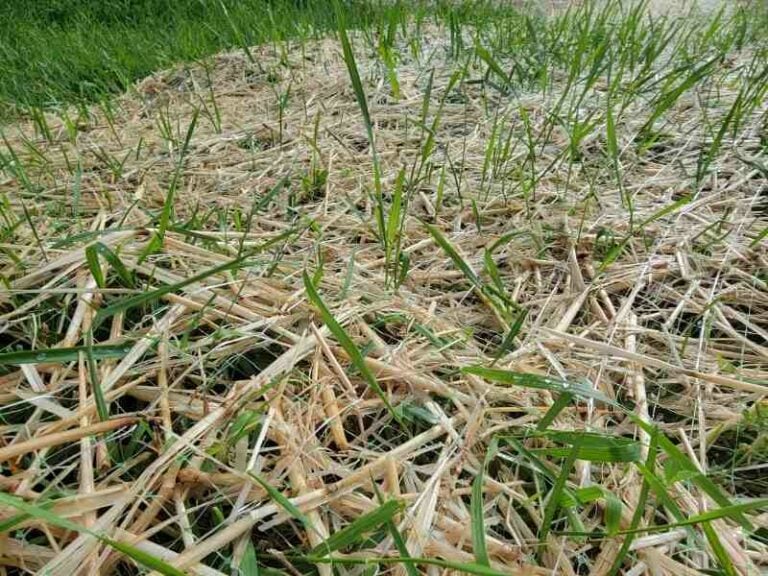
Image source: Web (Bing) / lawnlove.com (Web image (fair-use with source credit))
Climate zones shift these windows. In the transition zone (middle Tennessee, northern Georgia, parts of Virginia, the Ozarks), cool-season grass struggles in summer and warm-season grass struggles in winter, so timing gets tight. Early fall topdressing works for fescue here, and late spring for Bermuda and Zoysia.
Avoid these timing traps:
- Mid-summer in the South. Topdressing Bermuda or Zoysia in July heat adds stress. Wait for September if you missed spring.
- Winter anywhere. Dormant grass can't integrate amendments. The material just sits and can wash off in heavy rain.
- Right before a downpour. A gentle rain after application is great. A gully-washer the next day can wash your mix into the street. Check the 48-hour forecast.
- During a drought declaration. Watering restrictions may limit your post-application soak. Plan ahead or wait.
If you overseed, topdress first and then seed into the amended layer. The compost-biochar mix gives seeds a perfect germination bed, with moisture held right at the surface where seeds need it. Many homeowners see noticeably better germination rates when they combine overseeding with a topdressing pass.
Mistakes That Can Burn Your Lawn or Waste Your Money
Most topdressing failures trace back to a handful of avoidable errors. Knowing these ahead of time saves you a season of wasted effort.
Spreading dry, uncharged biochar. This is the big one. Dry biochar pulls nitrogen from the surrounding soil for 2 to 4 weeks as it absorbs whatever it can find. Your grass yellows, growth stalls, and you'll blame the biochar when the real culprit was skipping the pre-charging step.
Always mix biochar with moist compost and let it sit at least 24 hours before spreading.
Using unfinished or "hot" compost. Compost that's still actively breaking down generates heat and releases ammonia. Spread that on your lawn and you'll scorch the grass, especially in warm weather. Finished compost smells earthy, crumbles easily, and stays at ambient temperature.
If it's steaming or smells sour, it's not ready.
Topdressing over thick thatch. Thatch acts like a raincoat, repelling amendments before they reach the soil. If your thatch layer exceeds half an inch, dethatch first or you'll be feeding the thatch instead of the roots.
Applying too thick. More is not better. A layer over half an inch smothers the grass, blocks sunlight, and creates a habitat for fungal disease. Stick to a quarter to half inch maximum, even on rough lawns.
Ignoring the herbicide residue risk. Compost made from manure or yard waste can carry aminopyralid or clopyralid, persistent herbicides that survive composting. These chemicals don't hurt the lawn directly, but they wipe out tomatoes, beans, and other broadleaf crops if you use the compost in a vegetable garden later. Source compost carefully and ask the supplier about herbicide testing.
Topdressing at the wrong time. Spreading on dormant grass, during a heat wave, or right before a heavy storm all lead to poor results. Match the timing to your grass type's active growth window.
Cost Breakdown and How Much You'll Actually Need
Costs vary by region and source, but a realistic range helps you budget before you commit. Here's what most homeowners spend on a 5,000 square foot lawn (a typical suburban lot):
| Material | Quantity Needed | Cost Range (USD, as of 2026) |
|---|---|---|
| Horticultural biochar (IBI-certified) | 100 to 250 lbs | $150 to $400 |
| Finished, screened compost | 1 to 1.5 cubic yards | $40 to $90 |
| Core aerator rental | 1 day | $50 to $80 |
| Dethatching rake (purchase) | 1 | $30 to $50 |
| Wheelbarrow, rake, tarp (if not owned) | 1 set | $50 to $100 |
Total for a one-time topdressing on a 5,000 sq ft lawn: roughly $300 to $700. If you already own basic tools and rent only the aerator, you're looking at the lower half of that range.
Buying biochar in bulk (by the pallet or cubic yard) drops the per-pound cost significantly. A 1-ton tote of horticultural biochar runs $400 to $800 delivered, which works out to $0.20 to $0.40 per pound. That's a meaningful savings if you're topdressing a large property or planning to repeat the process over several seasons.
Compost is cheaper and easier to source. Most municipalities sell screened compost by the cubic yard for $20 to $40, and it's often higher quality than bagged retail products. Bagged compost at garden centers runs $5 to $8 per cubic foot, which adds up fast for a full-lawn application.
Here's the math shortcut for figuring out what to buy:
- Calculate lawn square footage. Length × width for rectangles, or use a free online tool like Google Earth's measuring feature.
- Decide on depth. Quarter inch for maintenance, half inch for renovation.
- Convert depth to cubic yards. Multiply square footage × depth in feet × 27 to get cubic feet, then divide by 27 for cubic yards.
- Split the volume. Roughly 80% compost, 20% biochar by volume for a 1:4 ratio.
For a 5,000 sq ft lawn at a quarter inch depth, you need about 1.25 cubic yards of total mix. That works out to 1 cubic yard of compost and roughly 8 to 10 cubic feet (200 to 250 lbs) of biochar. At a half inch depth, double everything.
The cost per square foot lands between $0.06 and $0.14 for most homeowners. That's a one-time expense with effects that last years, especially on the biochar side, which persists in the soil for decades. Compared to annual synthetic fertilizer programs running $0.05 to $0.10 per sq ft, this stacks up well, and you're building soil rather than just feeding the grass blade.
Frequently Asked Questions
How often should I topdress my lawn with biochar and compost?
Once per year is plenty for most lawns, applied during peak active growth. The biochar component persists for decades, so you don't need to reapply it annually. After the first 2 to 3 applications, you can shift to compost-only maintenance topdressing every other year, saving the biochar boost for when the lawn genuinely needs it.
Can I topdress with biochar and compost without aerating first?
Yes, but expect weaker results. Without aeration holes, the mix sits on top of compacted soil and integrates slowly. Core aeration opens direct channels to the root zone, which is where you want the amendments to land.
If you skip aeration, double the rate of compost in the mix to push more biology into the thatch layer and surface roots.
Will biochar change my soil pH?
It can, depending on the source material and production temperature. Most horticultural biochars run slightly alkaline (pH 7 to 10). On acidic soils, this is a benefit.
On already-alkaline soils (pH above 7.5), the effect is minimal because compost buffers it. Run a soil test before applying if pH is a known concern, and skip biochar on highly alkaline soils in the arid Southwest.
Can I use biochar from a hardware store fireplace section?
No. Hardware store charcoal and fireplace wood contain additives, lighter fluid residues, and incomplete combustion byproducts that can harm soil biology. Buy only IBI-certified horticultural biochar from a reputable supplier.
The certification confirms it was tested for heavy metals, polycyclic aromatic hydrocarbons (PAHs), and other contaminants.
Is it safe for pets and kids to walk on the lawn after topdressing?
Yes, once you water the amendments in. Dry biochar dust can irritate lungs if inhaled in large amounts, so wear a dust mask during application. After a deep watering, the material settles into the soil and poses no risk.
Keep pets and kids off the lawn during application and for about an hour after watering.
Will topdressing with biochar and compost get rid of weeds?
Not directly. Topdressing improves soil health, which favors dense turf growth, and dense turf crowds out weeds over time. But topdressing won't kill existing weeds, and some weed seeds can hitch a ride in compost.
Plan to address weeds separately through proper mowing height, targeted herbicide, or hand pulling. The long-term weed suppression comes from a thicker, healthier lawn, not from the amendments themselves.

Similar Posts