Brown Patch vs Chinch Bug: How to Tell the Difference
Lead Turfgrass & Lawn Care Specialist at Totally Green Lawn · Certified Turfgrass Specialist (CTS), Master Gardener, B.S. in Agronomy & Turf Science · 14+ years in residential turf management, organic fertilization, and weed science
If your lawn is suddenly turning brown in patches and you're trying to figure out how to identify brown patch fungus vs chinch bug damage, you're not alone. These two problems look almost identical from the driveway, but they need completely different treatments. Getting the call right saves your grass, your wallet, and weeks of frustration.
Brown patch is a fungal disease caused by Rhizoctonia solani that thrives in humid 70 to 90°F weather. Chinch bugs are turf-damaging insects, mainly Blissus insularis, that hit hardest in hot, dry conditions above 85°F. As of 2026, extension services in the Southeast still flag misdiagnosis as the single most common reason homeowners waste fungicide on an insect problem, or spray insecticide on a fungal one.
Let's walk through how to tell which one you're actually fighting.
Quick Answer
Brown patch usually shows a smoky gray ring at the patch edge in early morning. Chinch bug damage spreads from hot, sunny edges inward and has no fungal ring. If grass pulls up easily, suspect chinch bugs.
If you spot cobwebby mycelium on wet blades, suspect brown patch.
What Brown Patch and Chinch Bug Damage Actually Look Like Side by Side
Before you run any test, train your eye on what each problem actually looks like in real turf. The patterns differ more than most homeowners expect.
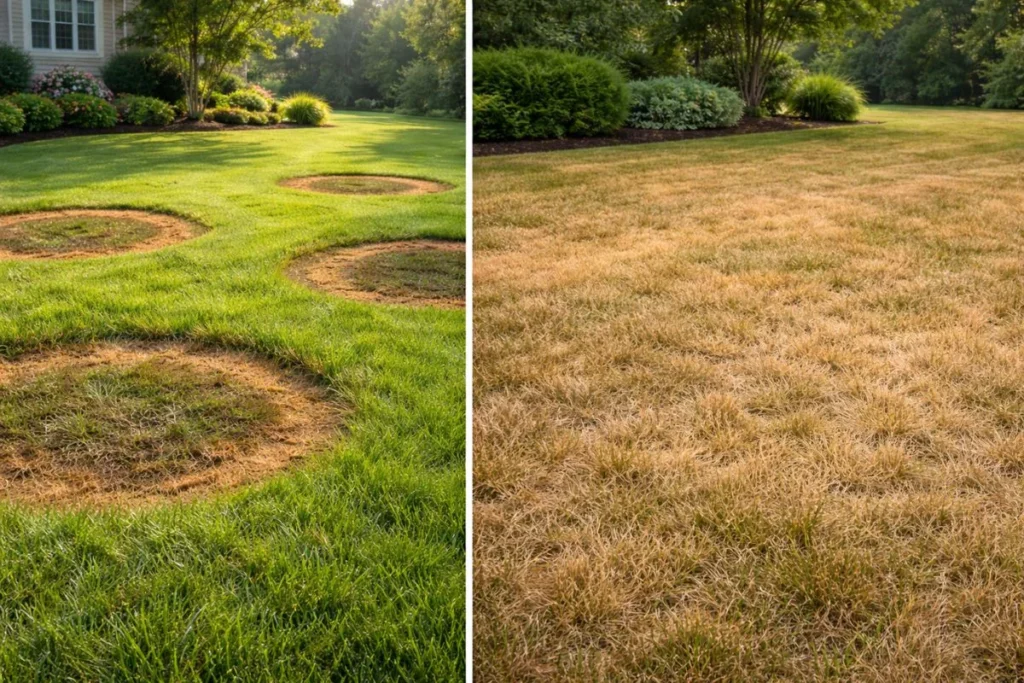
Brown patch (the fungal disease) shows up as roughly circular patches that can range from a few inches to several feet across. University extension guides describe a classic "smoke ring" at the outer edge, a thin grayish-brown band of fuzzy mycelium you can only see when dew is on the grass. Inside the ring, blades turn yellow, then tan, and the lesion on each leaf has a dark brown border with a tan center.
Damage usually starts in low, damp spots or where irrigation overlaps.
Chinch bug damage looks different at the edges. Patches start small in the hottest, sunniest part of the lawn, often along driveways, sidewalks, or south-facing slopes. Grass turns yellow first, then straw-brown, and the damage expands outward in irregular, ragged shapes rather than clean circles.
There is no smoke ring. Blades stay attached to the plant, but the whole stem dies because the bugs have sucked the sap from the crown.
Here's the at-a-glance visual breakdown:
| Clue | Brown Patch Fungus | Chinch Bug Damage |
|---|---|---|
| Patch shape | Roughly circular | Irregular, spreading |
| Edge mark | Gray "smoke ring" in morning dew | No ring, just yellow-to-brown fade |
| Favorite spot | Wet, humid, low areas | Hot, dry, sunny edges |
| Affected grass | Tall fescue, ryegrass, St. Augustine | Mostly St. Augustine, some zoysia |
| Blade feel | Slimy or wet in morning | Dry, brittle |
| Pull test | Blade pulls free, roots intact | Whole plant lifts, crown sucked dry |
If your damage pattern matches the right column, lean toward chinch bugs. If it matches the left, lean toward brown patch. When it's not obvious, the next section gives you a fast yes/no test.
The Quick Diagnostic: 5 Clues That Tell You Which One You're Dealing With
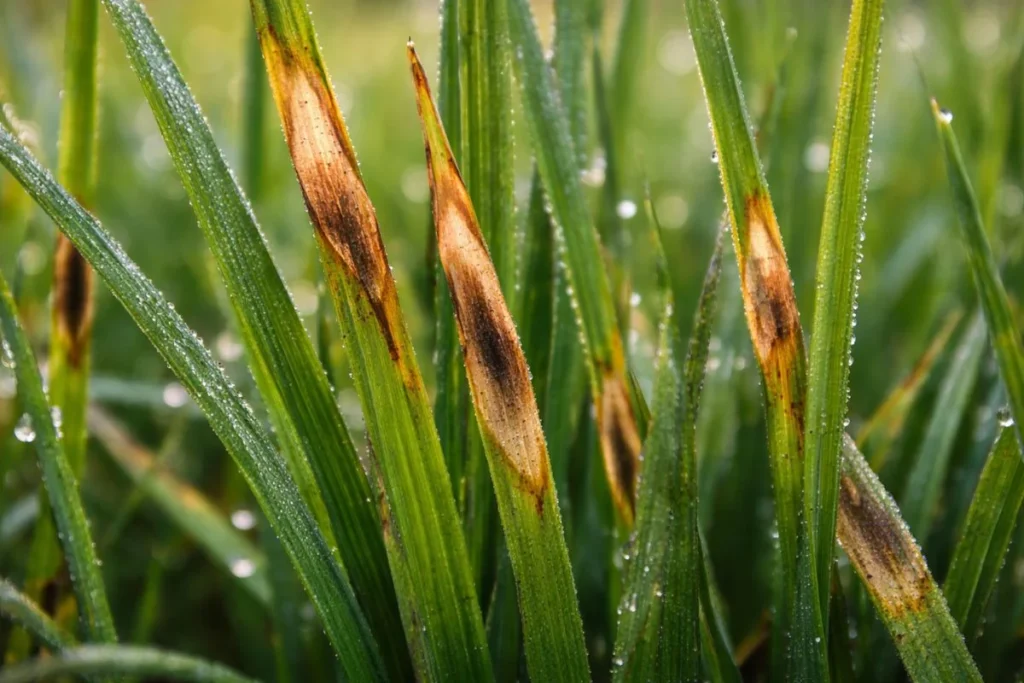
Image source: Bing (Web (fair-use with source credit))
You don't need lab gear. You need five minutes, a watering can, and a cheap magnifier. Walk through these five checks in order, and you'll have a confident answer.
1. Check the timing and weather. Brown patch peaks in warm, humid stretches, think 70 to 90°F with overnight leaf wetness. Chinch bug damage spikes during the hottest, driest weeks of summer, often above 85°F with no rain for a stretch.
If your browning showed up after a wet spell, it's more likely fungal. If it showed up during a drought, think insects.
2. Look at the damage edges at sunrise. Go out before the dew dries. Brown patch will show a faint gray-white cobwebby ring at the patch edge.
Chinch bug damage has no ring at all. The transition is just yellow grass grading into brown grass.
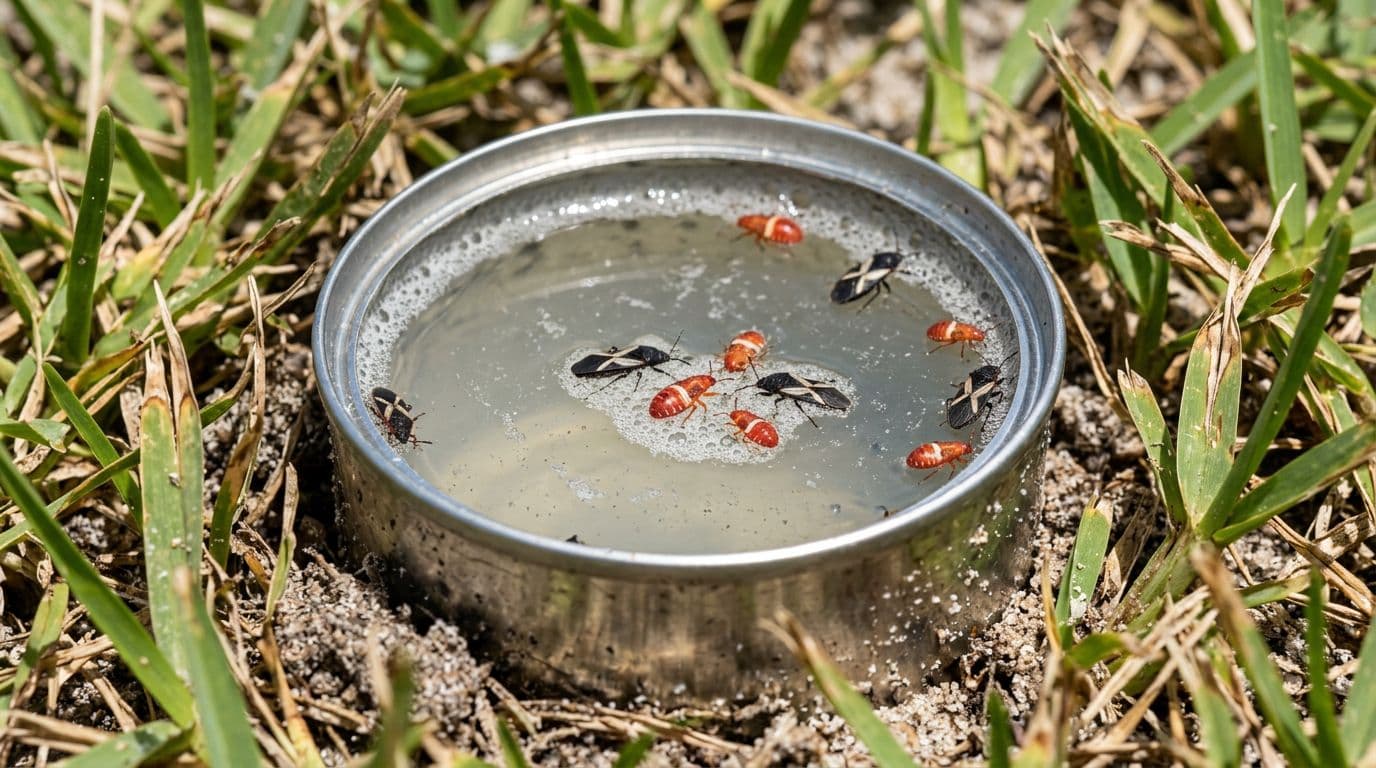
3. Try the float test for chinch bugs. Cut the bottom out of a metal coffee can or use a sturdy trowel to cut a turf plug about 4 inches deep. Push the can or a section of PVC pipe 2 to 3 inches into the soil at the edge of the damage, where brown meets yellow grass.
Fill it with water. Wait 5 minutes. Chinch bugs (and especially their reddish nymphs with a white band across the back) will float up.
If you see 5 or more bugs, you've got a problem worth treating.
4. Inspect the leaf blades with a magnifier. Brown patch leaves show distinct lesions, tan centers with a dark brown halo, often irregular in shape. Chinch-damaged blades look more uniformly straw-colored, wilted, and twisted, with no clear lesion.
5. Do the tug test. Grab a handful of damaged grass and pull. If blades snap off but the crown and roots stay anchored, the plant is still alive, classic fungal damage.
If the whole plant lifts easily with no resistance, chinch bugs have killed the crown. Dead crowns don't recover, even with treatment, so you'll need to reseed or resod those spots.
If at least three of those five point the same way, you've got your answer. If the result is still murky, move to the formal field tests.
Step-by-Step Field Tests to Confirm Brown Patch vs. Chinch Bugs
The quick checks above will solve 80% of cases. The remaining 20% need a more controlled test to be sure, especially if you're staring at St. Augustine grass in a hot, humid coastal yard where both threats overlap.
Test 1: The drench test (best for chinch bugs). Mix 2 tablespoons of liquid dish soap into a gallon of water. Pour it slowly over a 1-square-foot area right at the edge of the damage, where the brown meets the still-green grass. Wait 3 to 5 minutes.
Chinch bugs will crawl up to the surface trying to escape the soap. Count them.
- 0 to 4 bugs: below treatment threshold, look for another cause.
- 5 to 20 bugs: light infestation, spot treat.
- 20+ bugs: heavy infestation, treat the whole affected zone and a buffer around it.
Test 2: The jar flush test. Cut a 6-inch-deep turf plug, drop it in a bucket of water, and stir. Bugs and larvae float to the top within a couple of minutes. This is more accurate than the drench because you're testing the whole thatch layer, not just the surface.
Test 3: The mycelium bag test (for brown patch). Early in the morning, place a clear plastic bag over a suspect patch and seal it at the base. Leave it for 1 to 2 hours. If the fungus is active, you'll see fine, white, cobwebby threads on the inside of the bag and on the grass blades when you lift it.
No threads after a humid night usually means no active brown patch.
Test 4: The spread test. Mark the edge of a damaged patch with stakes or flags. Wait 48 hours. Brown patch in active conditions can double in size in a day or two.
Chinch bug damage spreads slower, usually a few inches per day, and follows the hot, dry edge of the lawn rather than rolling outward in all directions.
Test 5: The thatch inspection. Peel back a section of turf. If the thatch layer is over half an inch thick and dry underneath, you've got ideal chinch bug habitat. If the thatch is spongy and damp, that points more toward fungal problems, since fungi love trapped moisture.
| Test | Best For | Time Needed | What a Positive Looks Like |
|---|---|---|---|
| Drench test | Chinch bugs | 5 minutes | Bugs surface within 5 min |
| Jar flush | Chinch bugs | 5 minutes | Bugs and nymphs float up |
| Mycelium bag | Brown patch | 1 to 2 hours | White threads on bag interior |
| 48-hour spread | Both | 2 days | Patch doubles = active disease |
| Thatch inspection | Habitat clue | 2 minutes | Dry thick thatch = chinch risk |
For deeper guidance on regional pest thresholds, the Texas A&M AgriLife Extension Service publishes regularly updated chinch bug and brown patch fact sheets. The University of Florida IFAS Extension is the go-to for St. Augustine grass problems and southern chinch bug identification, since the pest was first documented as a serious turf threat in Florida.
When It's Brown Patch: Treatment and Recovery Plan
If the tests point to fungal disease, your job is to stop the spread, save the surviving grass, and fix the conditions that let it start.
Step 1: Stop the leaf wetness. Brown patch needs 10+ hours of continuous moisture on the blade to germinate. Change your irrigation schedule to water early morning (4 to 7 a.m.) so blades dry by mid-morning. If you have an automatic system, split the runtime into two shorter cycles instead of one long one.
Never water in the evening.
Step 2: Improve air flow. Mow at the right height for your grass, but don't scalp. Bag clippings during active outbreaks. If the problem keeps coming back in the same spot, consider pruning back nearby shrubs or trees to increase sunlight and air movement.
Step 3: Apply the right fungicide. Active ingredients with strong university trial data include azoxystrobin, propiconazole, fluazinam, and triadimefon. For a curative treatment on active disease, most extension guides recommend applying at the label rate and repeating in 14 to 28 days. Rotate between FRAC groups to slow resistance.
Step 4: Dethatch and aerate in the off-season. Brown patch thrives in thatch over half an inch thick. Core aerate in fall for cool-season lawns or late spring for warm-season lawns, then dethatch if needed. Topdress with a thin layer of compost to speed recovery.
Step 5: Reseed or resod dead patches. Once the disease is under control and the heat breaks, rake out the dead material, add a little topsoil, and reseed with a resistant cultivar. For St. Augustine, use 'Floratam' or 'Palmetto'.
For tall fescue, look for brown patch-resistant blends.
Realistic recovery timeline: visible improvement in 2 to 3 weeks after treatment, full recovery in 6 to 10 weeks if conditions are managed. Fungicide doesn't bring dead blades back, so patience matters.
When It's Chinch Bugs: Treatment and Recovery Plan
If the float tests showed bugs above threshold, switch from fungicide to insecticide and move fast, chinch bug populations can double in 30 to 40 days during peak summer heat.
Step 1: Choose the right active ingredient. Per university extension recommendations, the most reliable synthetic options for residential turf include bifenthrin, clothianidin, imidacloprid, and cyfluthrin. Bifenthrin works as a fast contact kill, while clothianidin and imidacloprid offer longer residual control. Spot-treat first, then expand if you see more than 20 bugs per square foot.
Step 2: Treat the buffer, not just the dead zone. Chinch bugs spread from the hot edges inward. Spray 3 to 5 feet past the visible damage line, especially into full-sun areas and along hardscape edges where the bugs thrive.
Step 3: Water before, not after. For contact insecticides like bifenthrin, water lightly the day before to bring bugs up into the thatch. For systemic neonicotinoids, water in immediately after application to move the product into the root zone.
Step 4: Recheck in 7 to 10 days. Pull new drench tests in the same spots. If you're still finding 5+ bugs per square foot, rotate to a different active ingredient group. Don't apply the same chemistry twice in a row.
Step 5: Repair dead areas. Chinch bugs kill the crown, so dead patches won't fill in on their own. Cut out the dead sod, loosen the soil, and lay new pieces. For St.
Augustine, use plugs or solid sod, not seed, since most St. Augustine cultivars are sterile and only available vegetatively.
Step 6: Fix the underlying conditions. Chinch bugs love dry, compacted, sandy soil. Core aerate in late spring, topdress with compost, water deeply but less often to encourage deeper roots, and don't mow shorter than 3 inches on St. Augustine.
Healthy, dense turf is the best long-term defense.
Mistakes That Make the Problem Worse (or the Wrong Problem)
Most lawn failures in this category aren't from the disease or the bugs. They're from well-meaning fixes that backfire. Here are the missteps we see over and over in extension service call logs.
Spraying fungicide "just in case." If chinch bugs are the real culprit, fungicide does nothing except waste money and stress the grass. Always confirm with a test before treating.
Watering more to "help the brown grass recover." Extra water helps chinch bugs and brown patch alike. More moisture means more fungal growth and more bug-friendly thatch.
Mowing too short. Scalping the lawn exposes the crowns, stresses the plant, and lets both pests and fungi hit harder. Keep St. Augustine at 3 to 4 inches.
Keep tall fescue at 3 to 3.5 inches.
Treating only the dead spot. Brown patch spreads from the lesion outward. Chinch bugs spread from the hot edge inward. Either way, treat a 3 to 5 foot buffer past the visible damage, or you'll see the same problem in two weeks.
Reusing the same fungicide or insecticide every year. Resistance builds fast. Rotate between FRAC groups for fungicides and between pyrethroid and neonicotinoid classes for chinch bugs.
Ignoring thatch. A half-inch of thatch is a five-star hotel for chinch bugs and a sponge for fungal spores. Core aerate once a year. Dethatch when the layer exceeds half an inch.
Assuming all browning is one or the other. Drought stress, grubs, dollar spot, take-all root rot, and Pythium blight can all mimic these two. When the tests come back negative but the grass is still dying, look at grubs, irrigation coverage, or take-all root rot.
If you've already made one of these calls, don't beat yourself up. Just stop the practice, re-run the diagnostic from the field tests above, and adjust.
Brown Patch vs. Chinch Bugs: At-a-Glance Comparison
Here's a side-by-side reference you can bookmark for next summer. Use it the moment a new brown patch shows up.
| Factor | Brown Patch Fungus | Chinch Bugs |
|---|---|---|
| Causal agent | Rhizoctonia solani (fungus) | Blissus insularis (insect) |
| Peak season | Warm, humid 70 to 90°F | Hot, dry, above 85°F |
| Damage pattern | Circular patches with smoke ring | Irregular patches from hot edges inward |
| Best diagnostic test | Mycelium bag test at dawn | Drench or jar flush test |
| Threshold for treatment | Active lesions present | 20+ bugs per square foot |
| Best prevention | Reduce leaf wetness, improve airflow | Reduce thatch, water deeply |
| Recovery time | 6 to 10 weeks | 4 to 8 weeks for surviving grass |
| Reseeding needed? | Only on dead spots | Yes, on any patch with dead crowns |
| Repeat risk | High in same irrigation zones | High in same dry, sandy zones |
If you're in the Southeast with St. Augustine grass, both threats can hit in the same season. The damage that shows up in late spring with humid nights is almost always brown patch.
The damage that explodes in July and August after a dry spell is almost always chinch bugs.
Frequently Asked Questions
Can brown patch and chinch bugs happen at the same time?
Yes, especially in St. Augustine lawns across the Gulf Coast. Treat the fungal problem first if humidity is high, then recheck for chinch bugs once conditions dry out.
Skipping either one leaves the door open for the other.
How fast does chinch bug damage spread in summer?
In peak heat, an untreated infestation can expand 6 to 12 inches per day. A patch the size of a dinner plate can reach several square feet within a week. This is why the drench test and fast treatment matter so much.
Will a brown patch fungicide kill chinch bugs?
No. Fungicides target fungi, not insects. Applying fungicide to a chinch bug problem wastes the product and delays real treatment.
Confirm the cause with a test before opening any bottle.
Can I treat chinch bugs without chemicals?
Partially. Reduce thatch through core aeration, water deeply but less often, and encourage beneficial insects by limiting broad-spectrum sprays. For active outbreaks above 20 bugs per square foot, most extension services still recommend a targeted insecticide as the fastest path to control.
How do I tell brown patch from dollar spot?
Dollar spot patches are smaller, usually 2 to 6 inches across, and produce cobwebby mycelium only in the very early morning. Brown patch patches are larger and develop a darker, more defined smoke ring. The size and the ring are usually the giveaway.
Should I water the lawn after applying fungicide or insecticide?
For most contact fungicides, hold off on watering for 12 to 24 hours so the product stays on the blade. For systemic insecticides like clothianidin or imidacloprid, water in within 24 hours to move the active ingredient into the root zone. Always read the label, since timings vary by product.

Similar Posts