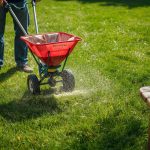
How to Calculate Split Application of Prodiamine 65 WDG
Lead Turfgrass & Lawn Care Specialist at Totally Green Lawn · Certified Turfgrass Specialist (CTS), Master Gardener, B.S. in Agronomy & Turf Science · 14+ years in residential turf management, organic fertilization, and weed science
How to calculate split application of prodiamine 65 WDG trips people up because the math is simple, but the rules around it aren't. The product is 65% active ingredient by weight, which means the rate you see on the bag is granular weight, not the actual herbicide working in the soil. If you treat those numbers the same, you'll either under-apply and lose control or stack two windows and blow past the annual cap.
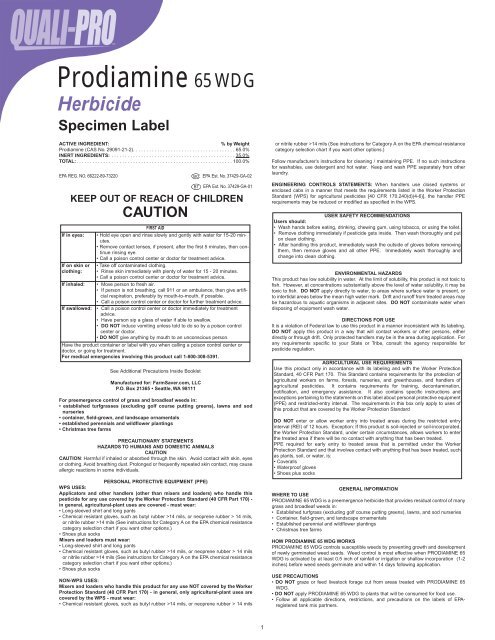
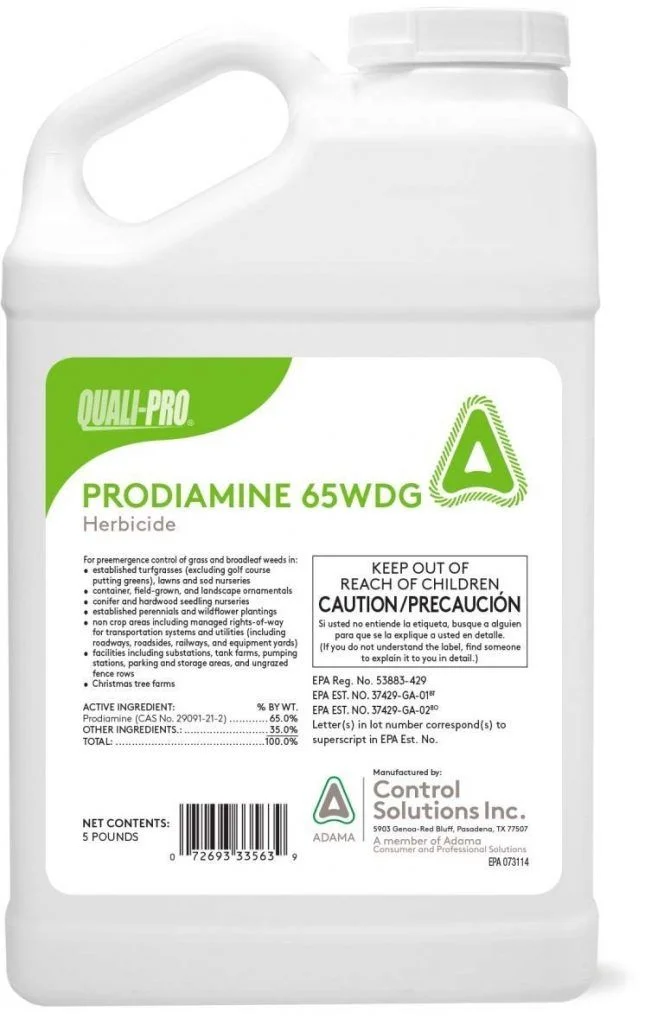
Manufacturer specifications indicate the standard single-rate band runs from 0.36 oz to 0.73 oz of product per 1,000 sq ft, which converts to roughly 0.25 to 0.50 lb of active ingredient per acre. The annual ceiling is 1.5 lb of active ingredient per acre per year, and that's the line a split program has to respect. Get that ceiling right, and the rest of the math is just splitting it into two timed windows.
We'll walk through the variables, the rate table, and the steps to land both halves under the cap.
Quick Answer
To calculate a prodiamine 65 WDG split application, first find your total annual active ingredient budget. The cap is 1.5 lb ai/A per year. Divide that total into two windows timed to your target weed flush.
Convert pounds of ai to ounces of WDG product. Use 0.036 oz of WDG per 1,000 sq ft for every 0.025 lb ai/A. Stay at or under 1.5 lb ai/A across both applications combined.
The Prodiamine 65 WDG Split Application Decision: What Changes the Rate
A split program is just two applications that share one annual budget. The reason it works is residual half-life. Prodiamine stays active in the top inch or two of soil for roughly 60 to 120 days, depending on microbial activity, and microbial activity rises with soil temperature.
Put all your budget in one spring shot and the back half of summer is unprotected. Split it and each window covers a different weed germination peak.
The first decision is whether your situation actually calls for a split. A single full-rate application is fine if you're managing a property with one dominant weed flush, a short growing season, or a tight budget. A split pays off when the season is long enough that the first window runs out before the second germination peak arrives.
When a split actually beats a single shot
If you're in the transition zone or anywhere south of it, crabgrass starts germinating around 55°F soil temp and goosegrass follows around 60°F. That gap is roughly three to five weeks, and a single shot at 0.5 lb ai/A typically fades by late July. A split gives you fresh barrier right when the second flush hits.
Same logic applies if you're chasing poa annua in a fall overseed program, where you want a clean seedbed but also need protection once the rye establishes.
North of the transition zone, a single spring application often covers the whole season. The crabgrass window closes earlier, and most cool-season lawns don't face a second summer flush worth chasing. So before you split, ask whether your weed pressure actually has two peaks or just one.
The 1.5 lb ai/A cap and why it anchors everything
The annual ceiling is the hard number that decides whether your split is legal and safe. As of 2026, every prodiamine 65 WDG label we've reviewed (Quali-Pro, Anderson's, Control Solutions, Nufarm) carries the same 1.5 lb ai/A per year maximum. Cross that line and you risk turf injury, root pruning, and label violation.
Everything below is a math problem inside that ceiling.
| Term | What it means | Prodiamine 65 WDG value |
|---|---|---|
| Active ingredient (ai) | The actual herbicide doing the work | 65% of bag weight |
| WDG product | The full granular weight you measure | 100% of bag weight |
| Annual cap | Total ai allowed per acre per year | 1.5 lb ai/A |
| Single low rate | Light pre-emergent on low-pressure sites | 0.25 lb ai/A (~0.36 oz WDG per 1,000 sq ft) |
| Single standard rate | Most common cool-season program | 0.33 lb ai/A (~0.48 oz WDG per 1,000 sq ft) |
| Single upper rate | Heavy pressure, southern zones, long residual | 0.50 lb ai/A (~0.73 oz WDG per 1,000 sq ft) |
Variables That Actually Change Your Split Rate
Four inputs drive the rate. Get any of them wrong and the math breaks. Soil type controls how long the barrier holds.
Turf species controls whether prodiamine is even safe at the timing you want. Target weed spectrum controls which window matters more. And geography controls when each window actually opens.
Soil type and residual half-life
Sandy soils lose prodiamine faster. Microbial breakdown accelerates, and the active ingredient leaches more readily into the root zone, so the half-life compresses toward 60 days. On a loam or clay loam, you can stretch the residual closer to 120 days.
If your site is sandy, the second split matters more. If it's heavy clay, the first split can carry you further into summer.
Cool-season vs. warm-season turf
Prodiamine is labeled on most cool-season species (TTTF, KBG, fescue, perennial rye) and on most warm-season species (bermuda, zoysia). Centipede and St. Augustine sit on the cautious side of the label.
If you're managing a cool-season lawn, the spring window targets crabgrass. If you're managing warm-season turf, the spring window also has to dodge spring transition. Apply too early and you can slow bermuda green-up.
Apply too late and you miss the goosegrass window.
Target weed spectrum
Crabgrass alone is a one-peak problem. Goosegrass adds a second peak. Poa annua in a fall overseed program adds a third timing option.
If your pressure is just crabgrass, the split is simple: early spring plus late spring. If you also fight goosegrass, push the second split into early summer. If poa annua is in play, you may be running a spring + fall program, which is technically two separate annual cycles, not a single split.
Geography and soil temperature triggers
Soil temperature drives the calendar. For crabgrass, wait for 50 to 55°F at the 2-inch depth for three consecutive days before the first split. For goosegrass, the trigger is closer to 60°F.
The University of Florida IFAS Extension publishes soil temperature data that matches these triggers for southern zones. Northern applicators can use the same rule with local extension reporting.
Step-by-Step: Calculating a Prodiamine 65 WDG Split Program
The math is the same every time. The inputs change. Here's the workflow we use when calculating a split for a client site.
Step 1: Measure the area in square feet
Walk the property or use a satellite measuring tool. Round to the nearest 1,000 sq ft. For a 7,200 sq ft lawn, treat it as 7,000 sq ft for the math.
For anything over 43,560 sq ft, work in acres. 1 acre = 43,560 sq ft.
Step 2: Pick a target total ai for the year
Most split programs use 0.58 to 0.83 lb ai/A total across the year. That's a moderate-pressure program. Light pressure can drop to 0.50 lb ai/A.
Heavy southern pressure with goosegrass can push to 1.00 lb ai/A, still well under the 1.5 lb cap. Whatever you pick, write it down. This is your budget.
Step 3: Split the budget between windows
A common split is 40% on the first window and 60% on the second. That gives the second half of the season a stronger barrier when weed pressure peaks. So if your annual target is 0.65 lb ai/A, your first split is 0.26 lb ai/A and your second is 0.39 lb ai/A.
Reverse it (60/40) only if your first window is the heavier pressure, which is rare.
Step 4: Convert pounds of ai to ounces of WDG
The WDG product is 65% ai by weight. That means 1 lb of WDG contains 0.65 lb of ai. To get the WDG weight from an ai target, divide the ai by 0.65.
- 0.26 lb ai ÷ 0.65 = 0.40 lb WDG per acre
- 0.40 lb × 16 = 6.4 oz WDG per acre
- 6.4 oz ÷ 43.56 = 0.147 oz WDG per 1,000 sq ft
For 1,000 sq ft, the shortcut is 0.036 oz of WDG per 0.025 lb ai/A. So 0.25 lb ai/A = 0.36 oz WDG per 1,000 sq ft.
Step 5: Verify the total against the annual cap
Add both splits. In the example above, 0.26 + 0.39 = 0.65 lb ai/A, which sits comfortably under 1.5 lb ai/A. If your math crosses 1.5, you need to lower one or both splits.
The label does not allow exceptions.
Step 6: Calibrate the spreader and apply
For a WDG product, you're typically using a broadcast or drop spreader. Set the spreader to deliver the calculated oz per 1,000 sq ft, then walk the pattern. Water in within 24 hours with 0.25 to 0.5 inches of irrigation.
Prodiamine needs to move off the leaf and into the top layer of soil to lock in.
Step 7: Log the application
Record the date, rate in oz per 1,000 sq ft, total product used, and the soil temperature at application. This log is what keeps you under the cap next year and what tells you whether the program worked.
Prodiamine 65 WDG Split Application Rates by Situation
Here's where the variables turn into a number you can actually spray. The table below maps the most common situations to a working split. Adjust within the bands based on your own pressure history.
| Situation | First split (lb ai/A) | Second split (lb ai/A) | Total (lb ai/A) | Timing |
|---|---|---|---|---|
| Cool-season lawn, crabgrass only, light pressure | 0.20 | 0.25 | 0.45 | Early spring + 60 days later |
| Cool-season lawn, crabgrass only, standard pressure | 0.25 | 0.33 | 0.58 | Early spring + 60 to 75 days later |
| Transition zone, crabgrass + goosegrass | 0.33 | 0.40 | 0.73 | 55°F soil temp + 60 to 75 days later |
| Warm-season (bermuda/zoysia), heavy southern pressure | 0.40 | 0.50 | 0.90 | Soil temp 55°F + 60 days later |
| Golf/sports turf, season-long program | 0.50 | 0.50 | 1.00 | Spring + early summer |
| Spring + fall program (poa annua) | 0.33 spring | 0.50 fall | 0.83 | Spring window + fall window |
Anything past 1.0 lb ai/A in a single year is high. Reserve it for documented heavy pressure and only after you've rotated modes of action in prior years. Prodiamine is HRAC Group 3.
Using it at max rate, every year, on the same site, builds resistance fast, especially in goosegrass populations.
Reading the table for your own site
Pick the row that matches your geography and weed pressure. If your pressure is somewhere between two rows, average the rates. Don't just pick the heavier row because it feels safer.
Over-applying doesn't add control, it just shortens your budget for next year and stresses the turf.
When the math doesn't work
If the total you need for control exceeds 1.5 lb ai/A, you don't have a prodiamine problem. You have a rotation problem. Switch one of the windows to dithiopyr (Dimension) or pendimethalin.
Rotation is how the pre-emergent class stays useful for more than a few years on the same site.
Mistakes That Push You Over the Annual Cap (and How to Avoid Them)
The cap catches people in three ways. The first is forgetting a fall application. If you ran a spring split at 0.73 lb ai/A total, then applied a fall prodiamine for poa annua at 0.5 lb ai/A, you've crossed 1.2 lb ai/A.
Add a spot treatment or a missed cleanup pass and you're past 1.5. Keep a written log by site. Don't trust memory across seasons.
The second is misreading the bag. WDG weight is not active ingredient weight. A 0.73 oz per 1,000 sq ft application of product is 0.50 lb ai/A, not 0.73.
If you've been treating the bag weight as the ai weight, you've actually been underdressing every application, and you'll be tempted to "fix" it by doubling up, which puts you straight over the cap.
The third is overlapping windows. If the first split was 0.40 lb ai/A and the residual held longer than expected, the second split at 0.40 lb ai/A might land while the first is still active. Total exposure to roots goes past 1.5 even if the calendar says you're fine.
Drop the second rate or push the date back.
How to audit an existing program
Pull last year's records. Add every prodiamine application, spring and fall, in lb ai/A. If the total sits above 1.0 lb ai/A, plan to rotate the chemistry next year.
If it's above 1.5, you've already violated the label and need to extend the interval before any future prodiamine use. Manufacturer labels, including those published through the EPA pesticide product label database, are the legal source on this ceiling.
A quick log template
A single line per application is enough. Site, date, oz WDG per 1,000 sq ft, total product used, soil temp at application, and target weed. That log becomes the basis for next year's split math and the proof you stayed under the cap if a customer or auditor ever asks.
Prodiamine 65 WDG vs. Single App vs. Other Pre-Emergents
A single application is cheaper and faster. It also leaves a coverage gap in long-season zones. A split costs more in product and labor, but the gap closes.
The third option, rotating to a different pre-emergent, fixes resistance pressure that prodiamine alone can't solve.
When a single application is the right call
Short-season cool sites, low-pressure lawns, and budget-driven programs all do fine with a single shot. If your soil temp hits 55°F in mid-May and crabgrass pressure is light, a single 0.33 lb ai/A application covers the season without splitting.
When rotation beats more prodiamine
If goosegrass or crabgrass is breaking through despite a solid split program, the issue is resistance, not rate. Switch to dithiopyr (Dimension) for a season, which offers early post-emergent activity on crabgrass up to the 3-leaf stage. Pendimethalin (Pendulum) is another HRAC Group 3 option with similar timing.
Oxadiazon (Ronstar) is a different group entirely and is one of the few options labeled for use on golf course putting greens, where prodiamine is restricted.
| Option | Best fit | Watch out for |
|---|---|---|
| Prodiamine 65 WDG split | Long-season southern or transition zone turf | Annual cap, resistance if used solo |
| Single prodiamine | Short-season or low-pressure cool sites | Coverage gap in long seasons |
| Dithiopyr (Dimension) | Sites with early crabgrass breakthrough | Shorter residual, costs more |
| Pendimethalin | Alternative rotation partner | Similar group 3 resistance profile |
| Oxadiazon (Ronstar) | Greens and high-resistance sites | Limited fertilizer compatibility |
The Decision Guide: When Splitting Actually Pays Off
Splitting pays off when the season is long enough that a single application fades before the second weed peak. It also pays off when you're managing high-value turf where breakthrough is unacceptable. It does not pay off when the season is short, the pressure is light, or your budget can't cover the second pass.
Use the checklist below
If you answer yes to three or more, run the split. If you answer yes to two or fewer, save the budget and run a single shot.
- Is your growing season longer than 150 days?
- Do you fight both crabgrass and goosegrass?
- Are you south of the transition zone?
- Is this a sports field, golf course, or high-visibility lawn?
- Has single-app prodiamine broken through in prior years?
- Are you rotating to a different pre-emergent next year anyway?
If the checklist points to a split, work the math from the rate table. Stay under 1.5 lb ai/A total. Log every application.
Rotate chemistry every two to three years to keep prodiamine effective. The split itself is simple. The discipline around the cap and the rotation is what makes the program last.
🌾 Agronomist Recommended: Pre-Emergent & Weed Control Supplies
To prevent weed breakthroughs and protect desirable turfgrass from foliar injury, our agronomy field trials recommend calibrated pre-emergents and non-ionic surfactants:
- Professional Pre-Emergent:Check Prodiamine 65 WDG Pre-Emergent on Amazon →
- Non-Ionic Spray Surfactant:Check Non-Ionic Foliar Surfactants on Amazon →
*FTC Disclosure: As an Amazon Associate, Totally Green Lawn earns from qualifying purchases.*

Similar Posts