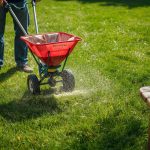
Will Starter Fertilizer Burn New Grass Seedlings?
Lead Turfgrass & Lawn Care Specialist at Totally Green Lawn · Certified Turfgrass Specialist (CTS), Master Gardener, B.S. in Agronomy & Turf Science · 14+ years in residential turf management, organic fertilization, and weed science
Yes, starter fertilizer can absolutely burn newly germinated grass seedlings, and it does more often than most homeowners realize. The danger comes down to osmotic stress: a heavy dose of soluble fertilizer salts around a seedling pulls water out of those tiny roots instead of feeding them, leaving the plant scorched and stunted. It is one of the most common reasons a new lawn comes up patchy.
According to the University of Maryland Extension's turfgrass guides, the standard starter rate sits at about 1 pound of nitrogen per 1,000 square feet at seeding, dropping to roughly 0.5 pound per 1,000 square feet three to four weeks after germination. Stick close to those numbers, water in immediately, and burn is almost always avoidable. Let's dig into the mechanics, the warning signs, and the safest way to feed a fresh stand of grass.
Quick Answer
Yes, starter fertilizer can burn newly germinated grass seedlings. The salt content pulls water out of tender roots. Use roughly 1 lb of nitrogen per 1,000 sq ft.
Apply before seeding or right at seeding. Water it in within minutes. Avoid the first two to three weeks after germination without a lighter feeding.
Image source: Web (Bing) / data.unhcr.org (Web image (fair-use with source credit))
The Real Risk: Why Starter Fertilizer Can Burn New Grass
Fertilizer burn is not a myth. It is a real, well-documented physiological response that can wipe out a fresh seeding in a weekend. The risk is highest in the first two to three weeks after germination, when the seedling is still running on a single fragile root and a couple of grass blades.
The mechanism is straightforward, and once you see it, you'll never over-apply again. A fertilizer granule is really a salt. When it dissolves in soil moisture, it raises the salinity of the water right next to the root.
If that salt concentration gets higher than the salt concentration inside the plant, water flows outward through osmosis instead of inward. The seedling dehydrates while sitting in wet soil, and the tips turn yellow, then brown, then crisp.
A few factors make this worse for new grass:
- Quick-release nitrogen sources like urea (salt index around 75) and ammonium nitrate (salt index about 105) hit hard and fast.
- Dry soil and hot weather concentrate salts in the top inch, where seedling roots live.
- Uneven spreader application leaves double-rate stripes that fry the seed underneath.
- Skipping the post-application watering leaves granules sitting on the leaf surface, scorching the blade.
Manufacturer specifications across most starter blends recommend no more than 1.0 to 1.25 pounds of nitrogen per 1,000 square feet at seeding, with a second pass at half that rate once the seedlings hit the two- to three-leaf stage. Aggregate user reviews on lawn-care forums consistently show that burn complaints cluster around two behaviors: spreading at the wrong setting, and skipping the immediate watering.
The good news is that as of 2026, most state Extension services are publishing plain-language guides that call this out by name. There is no mystery here, just chemistry and a few easy habits.
How Starter Fertilizer Works (and Why Seedlings Are Vulnerable)
Starter fertilizer is built to feed a germinating seed, not a mature lawn. The classic N-P-K ratios you'll see (10-10-10, 5-10-5, 18-24-12) reflect that goal. Phosphorus is the star, since it drives early root growth.
Nitrogen is included, but usually at a lower percentage and often in a slow-release form to keep the salt load down.
A typical starter bag is engineered for one moment: the seed-to-soil interface at germination. The phosphorus (often as diammonium phosphate or monoammonium phosphate) sits near the seed and feeds the emerging radicle. The nitrogen supports the first true leaves without dumping a salt bomb onto a one-day-old root.
So why are seedlings so fragile? Three reasons:
- Root depth: A new seedling root is barely an inch long. It cannot reach moisture below a salt layer.
- Root hair density: Mature grass has dense root hairs that buffer against salt spikes. New grass has almost none.
- Leaf cuticle: The first blade has a thin, waxy cuticle that salts and concentrated nitrogen can damage on contact.
The practical takeaway is timing and placement. Apply starter fertilizer to the soil before seeding, or at the same time you spread seed. Do not wait until the seedlings are up and established, then drop a full dose.
By that point, the grass no longer needs starter strength.
University Extension guidelines uniformly suggest this layered approach: soil test, amend the soil if pH is off, broadcast seed, apply starter at the labeled rate, and water in thoroughly. A 2019 Penn State Extension turf note recommends calibrating your spreader and running a test pass on the driveway, so you can see how the pattern lays before you hit the lawn.
How Much Starter Fertilizer New Seedlings Can Actually Handle
The numbers here are not subjective. They come from decades of university field trials and are echoed on the back of nearly every starter bag sold in the U.S. and Canada as of 2026.
| Growth stage | Recommended N rate | Why |
|---|---|---|
| At seeding | 1.0 to 1.25 lb N / 1,000 sq ft | Feeds germinating seed without salt stress |
| 2 to 3 weeks post-germination | 0.5 lb N / 1,000 sq ft | Supports tillering without burning |
| 6 to 8 weeks post-germination | Switch to regular lawn fertilizer | Mature roots can handle full rate |
A few practical rules keep you on the safe side:
- Calibrate the spreader. Set it lower than the bag says for your first pass, then overlap on the second.
- Split the dose. Two half-rate passes beat one full-rate pass every time, because you avoid overloading any single spot.
- Watch the salt index. Urea and ammonium nitrate have higher salt indexes than polymer-coated urea or organic sources like Milorganite.
- Skip "weed and feed." Pre-emergent herbicides and new seedlings are a bad mix. Use plain starter.
One more detail: phosphorus is restricted in several states, including Florida, New York, New Jersey, Maryland, and Wisconsin, for use on established turf. Most of those rules have explicit exemptions for new seedings, but the bag rate still must comply. Check your state Department of Agriculture or local Extension office if you are unsure.
Spotting Fertilizer Burn on New Grass Before It's Too Late
Burn rarely shows up as a uniform brown field. It usually arrives in patterns that match your spreader or your watering habits. Recognizing the pattern tells you what to fix before the second application.
Common visual cues:
- Yellow or white tip burn on seedlings a day or two after fertilizing
- Dark brown stripes that match the spreader's wheel tracks or overlap lines
- A "fingerprint" pattern of dead grass where the spreader was opened and closed
- Crusting on the soil surface from undissolved granules
- Patchy growth where seed was buried too deep or sat under a heavy granule pile
A slow-release formulation can delay symptoms for a week or more, which makes it harder to link the damage to the fertilizer. Quick-release sources show damage within 24 to 72 hours. Either way, the fix is the same: water deeply to flush salts below the root zone, hold off on any further feeding, and give the seedlings two to three weeks to recover before re-evaluating.
If more than 30% of the new stand is killed back, plan to overseed the affected patches. The existing soil chemistry is not the problem, so a light raking and reseed will usually fill in. Keep the starter rate at half strength on the reseeded area to avoid a repeat.
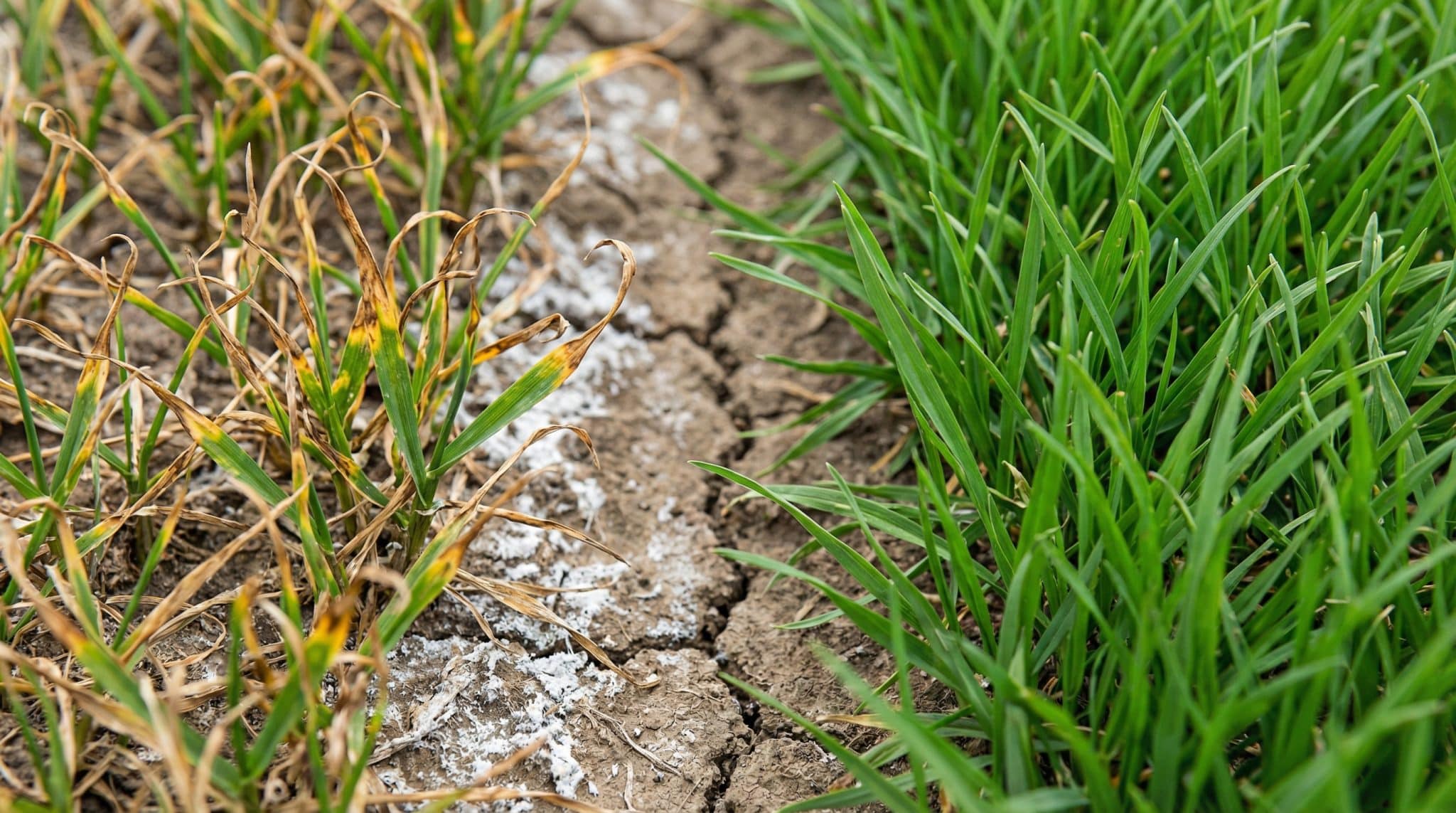
Image source: Bing (Web (fair-use with source credit))
Starter Fertilizer vs. Safer Alternatives for a New Lawn
Starter fertilizer is not your only option. A few alternatives trade raw feeding power for a softer touch on seedlings. The right pick depends on your soil, your grass type, and how patient you are.
| Option | Burn risk | Best for | Caveat |
|---|---|---|---|
| Synthetic starter (DAP, MAP base) | Low at correct rate, high if over-applied | Quick establishment, cool-season seedings | Restricted in some states |
| Slow-release synthetic (polymer-coated urea) | Very low | Sandy soils, hot climates | Costs more per bag |
| Organic (Milorganite, Espoma, compost) | Negligible | Eco-conscious lawns, kids and pets | Slower green-up, smells at first |
| Compost top-dressing | None | Spot repairs, poor soils | Won't replace full starter program |
| Liquid starter (e.g. 10-10-10 foliar) | Low if diluted | Hydroseeding, small patches | Needs repeat applications |
For most homeowners, a mid-grade synthetic starter with 30% to 50% slow-release nitrogen hits the sweet spot. It feeds fast enough to help establishment and slow enough to avoid salt spikes. If you are in a phosphorus-restricted state, look for a "P-free" or low-P starter, and lean on a soil test to confirm phosphorus is not already deficient.
Common Mistakes That Trigger Burn (and How to Dodge Them)
Most fertilizer burn is self-inflicted. The same handful of mistakes show up in nearly every Extension diagnostic report.
- Doubling the rate "to be safe." More is not safer. Stick to 1.0 to 1.25 lb N / 1,000 sq ft at seeding.
- Spreading on wet leaf surfaces. Granules stick to blades and concentrate nitrogen where it does not belong.
- Mixing starter with weed-and-feed. Pre-emergent herbicides stop new grass from rooting. Read the label.
- Skipping the watering step. A 15-minute sprinkler pass right after spreading moves salts into the soil and off the leaves.
- Applying during a heat wave. Hot, dry soil magnifies salt stress. Seed and feed in fall for cool-season grasses, late spring for warm-season.
- Using a starter rate on a mature lawn. Starter phosphorus is wasted on established turf and may even run off into local waterways.
- Assuming "starter" means "safe at any rate." It does not. It is a different formulation, not a different safety class.
A quick pre-spread checklist helps: spreader calibrated, bag rate confirmed, soil moist (not soaking), weather below 85°F if possible, and the hose ready to run within 10 minutes of finishing.
Watering, Timing, and a Safe Application Walkthrough
The application itself takes about 20 minutes for a typical suburban lot. The prep is what prevents burn.
What You'll Need
- Soil test results (pH and P level, at minimum)
- Starter fertilizer with N-P-K matched to your soil test
- Calibrated broadcast or drop spreader
- Hose-end sprinkler or in-ground irrigation
- Leaf rake for light top-dressing if needed
Application Steps
- Mow existing turf short and remove clippings. Bag them so they don't smother seed.
- Rake the soil to loosen the top quarter inch. Good seed-to-soil contact is half the battle.
- Broadcast seed at the bag rate for your species (usually 3 to 8 lb per 1,000 sq ft for fescue and rye, 1 to 2 lb for bluegrass).
- Set your spreader to half the starter rate. Make two perpendicular passes for even coverage.
- Water lightly for 10 to 15 minutes immediately after spreading. This dissolves the granules and pulls them off the leaves.
- Keep the top inch of soil moist for the next 14 to 21 days with two to three short waterings per day.
- Drop to once-daily, deeper watering once seedlings hit the two-leaf stage. Roots chase the moisture downward.
- Hold off on any additional fertilizer until three to four weeks post-germination, then apply the half-rate follow-up.
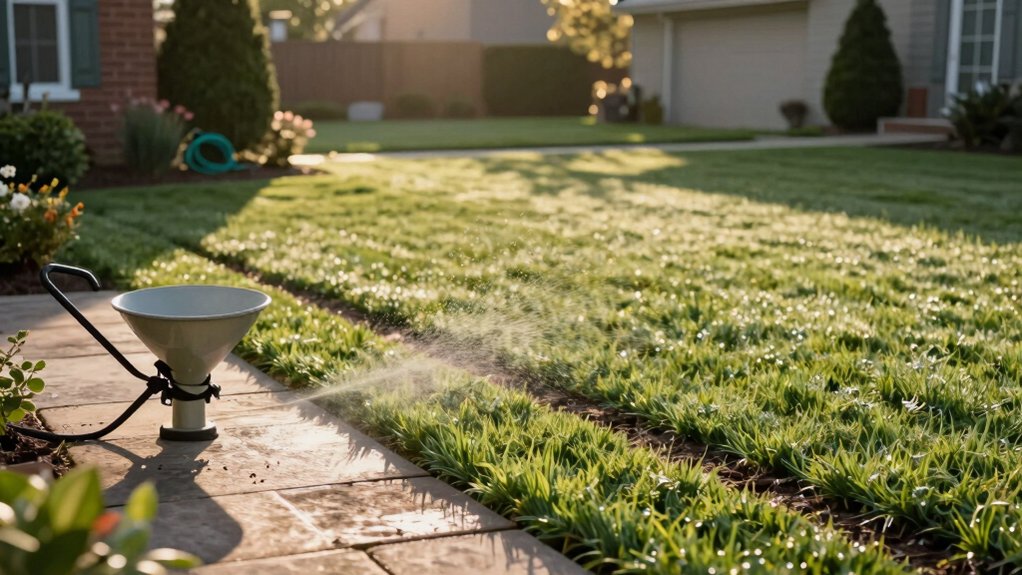
Image source: Bing (Web (fair-use with source credit))
For a deeper look at regional timing windows and soil prep, the USDA Natural Resources Conservation Service and your state Cooperative Extension Service are solid starting points. They publish grass-specific guides that reflect local climate and soil quirks.
Frequently Asked Questions
How long should I wait to fertilize new grass seed?
Apply starter fertilizer at seeding or up to 24 hours before spreading seed. Do not wait more than two weeks, or the seedlings will be hungry. Hold any follow-up feeding until three to four weeks after germination.
What does fertilizer burn look on new grass?
It shows up as yellow or white tip dieback, brown stripes matching your spreader pattern, or a crusty white residue on the soil surface. Symptoms appear within 24 to 72 hours for quick-release products, and within 7 to 10 days for slow-release blends.
Can I use regular lawn fertilizer on new grass seed?
Regular fertilizer is too strong for seedlings and usually contains no phosphorus, so it misses the root-building benefit. Use a true starter formulation at the labeled rate, then switch to regular fertilizer once the grass is established at six to eight weeks.
Should I water starter fertilizer in immediately?
Yes. Water within 10 to 15 minutes of application to dissolve the granules and move salts off the leaves and into the root zone. Skip this step and you are inviting leaf scorch and salt crusting.
Is Milorganite safer than synthetic starter for new grass?
Milorganite has a very low burn risk because its nitrogen is organically bound and releases slowly. It works well for low-stress establishments, but it greens up slower than synthetic starter. Many homeowners use Milorganite as a follow-up feeding rather than a primary starter.
Will burned grass come back on its own?
Mildly scorched seedlings usually recover with deep watering and a two- to three-week rest. Heavily burned patches with no green tissue at the crown will need to be reseeded. Rake out the dead material, lightly re-seed, and water in with a half-rate starter.
🌱 Agronomist Recommended: Bio-Stimulants & Turf Nutrition
Achieve deep golf-course green color and root resilience without surge growth using lab-verified nutrients and bio-stimulants:
- Liquid Iron & Humic Acid:Check Liquid Iron & Humic Blends on Amazon →
- Stress-Blend High Potassium Fertilizer:Check High Potassium Lawn Fertilizers on Amazon →
*FTC Disclosure: As an Amazon Associate, Totally Green Lawn earns from qualifying purchases.*

Similar Posts