Liquid Seaweed on New Grass Seed: Benefits That Boost Growth
Lead Turfgrass & Lawn Care Specialist at Totally Green Lawn · Certified Turfgrass Specialist (CTS), Master Gardener, B.S. in Agronomy & Turf Science · 14+ years in residential turf management, organic fertilization, and weed science
If you've just spread grass seed and you're staring at a bag of liquid kelp wondering whether now's the right time, hold up. The benefits of liquid seaweed on freshly sprouted grass seed are real, but the timing and dilution matter more than most homeowners realize. A new seedling isn't a mature lawn, and the rules that work on established turf can scorch tender roots or stall germination if you get them wrong.
The good news is the research is clear on what works. Peer-reviewed trials on Ascophyllum nodosum extracts show measurable root mass gains and faster establishment when biostimulants are applied at the seedling stage, with most university extension services recommending the first spray three to four weeks after germination, once the seedling has produced at least two true leaves. So the goal of this guide is simple: we'll walk you through exactly when kelp helps, when it hurts, how to dilute it for baby grass, and what mistakes send seedlings into shock.
Quick Answer
Liquid seaweed helps freshly sprouted grass seed by boosting root development, increasing chlorophyll production, and improving stress tolerance during the vulnerable establishment window. University extension research shows kelp's natural cytokinins and auxins can increase root mass by 15 to 30 percent in young seedlings. Wait until the grass has germinated and shows its first true leaves before applying, typically two to four weeks after seeding.
Use a diluted foliar spray at one part kelp to two hundred to five hundred parts water. Avoid heavy applications in the first two weeks, because young roots are salt-sensitive.
Why You Can't Just Spray Liquid Kelp on New Grass Whenever You Feel Like It
Here's the thing about biostimulants: they're powerful precisely because they're biologically active. The same natural compounds that supercharge a mature root system can overwhelm a seedling whose roots are barely a centimeter long. Salt content in kelp concentrate, even at labeled rates, can pull moisture out of tender root hairs and cause the classic "burn" you see as browning or tip dieback.
In our research, the most common mistake homeowners make isn't the product. It's the impatience. They seed on a Saturday, see green fuzz by Wednesday, and hit it with a full-strength kelp drench by Friday.
The seedling isn't ready. Its root system is still anchoring into the top centimeter of soil, and its energy is going into pushing up that first blade, not building defenses against a salt load.
So before we talk about benefits, we need to talk about readiness. Three signals tell you a seedling can handle a kelp application without risk:
- The grass has germinated uniformly and stands at least one to two inches tall.
- You've mowed it once, or the blades have been tall enough to mow for several days.
- The root system has had time to anchor, usually two to four weeks post-germination depending on species and soil temperature.
Skip those checkpoints and you're gambling. Hit them, and you've got a green light.
What Liquid Seaweed Actually Does to Freshly Sprouted Grass
Liquid kelp isn't a fertilizer in the traditional N-P-K sense. It won't feed your lawn the way a starter fertilizer will. What it does is signal the plant to grow smarter, faster, and tougher.
The mechanism is hormonal, and it's where the real benefit comes from for seedlings under establishment stress.
The Three Natural Hormones in Kelp and Why Seedlings Respond to Them
Seaweed harvested from cold Atlantic waters, primarily Ascophyllum nodosum, contains three classes of plant hormones that are nearly identical to the ones grass produces on its own:
- Cytokinins drive cell division and lateral bud development. In a seedling, that means more tillers sooner and a denser stand.
- Auxins regulate root initiation and elongation. This is the big one for new grass, because root mass is the single biggest predictor of whether a seedling survives its first summer.
- Gibberellins control stem elongation and break seed dormancy. They're less relevant after germination but still help with energy mobilization.
Manufacturer specifications indicate that cold-pressed kelp concentrates retain these hormones at biologically active levels, while alkaline-extracted products can lose a portion to the high-pH processing. For seedlings, cold-pressed is the safer bet because the hormone profile is closer to what the plant recognizes.
How Kelp Interacts With Root Zone Biology
Beyond the hormones, kelp feeds the soil itself. The alginic acid and mannitol in liquid kelp act as a slow-release carbon source for beneficial microbes, and those microbes in turn solubilize phosphorus and other locked-up nutrients in the rhizosphere. For a seedling with a tiny root system, that's a multiplier effect.
It can access nutrients it couldn't reach on its own.
University turfgrass programs have documented this microbial boost in field trials, and it lines up with what Penn State Extension's turf management resources recommend for new establishment windows. The seedling gets a hormone signal to grow roots, and the soil biology gets a food source to release nutrients. Both sides of the equation move forward together.
When to Start Applying Liquid Kelp on New Grass (and When to Wait)
The window matters as much as the product. Spray too early and you risk salt damage on roots that haven't hardened off. Wait too long and you miss the establishment phase when kelp delivers the biggest ROI.
Germination Milestones That Tell You the Seedling Is Ready
Forget the calendar. Watch the plant. These are the checkpoints we use to time a first kelp application on a new seeding:
- Radicle emergence plus first leaf (coleoptile). This is germination, not readiness. Do not spray.
- Two to three true leaves visible. The seedling is photosynthesizing on its own and starting to push secondary roots. Still early, but acceptable for a very light foliar mist at maximum dilution.
- First mowing completed (or blade height at 3 inches for fescue, 1.5 inches for ryegrass). This is the green light. The root system is anchored enough to handle a kelp drench at full labeled seedling rate.
- Four to six weeks post-germination. Peak window for biostimulant response, because the plant is transitioning from survival mode to active growth mode.
In our research, applying kelp at the two-true-leaf stage as a foliar mist (not a drench) at a 1:500 dilution produces measurable benefits without the burn risk. That's the conservative play if you're nervous.
Cool-Season vs. Warm-Season Timing Windows
Seeding season dictates your kelp schedule more than you'd think. Cool-season grasses (Kentucky bluegrass, perennial ryegrass, tall fescue) germinate best when soil temps sit between 50 and 65 degrees Fahrenheit, which means fall overseeding in most of the northern U.S. and Canada. Warm-season grasses (bermudagrass, zoysiagrass) need 65 to 75 degree soil and go in late spring through mid-summer.
The table below maps the typical windows as of 2026, based on regional extension guidance:
| Grass Type | Best Seeding Window | Germination Time | First Kelp Application |
|---|---|---|---|
| Perennial ryegrass | Early fall or early spring | 5 to 10 days | 2 to 3 weeks after seeding |
| Kentucky bluegrass | Early fall | 14 to 21 days | 3 to 4 weeks after seeding |
| Tall fescue | Early fall | 7 to 14 days | 2 to 3 weeks after seeding |
| Bermudagrass | Late spring to early summer | 10 to 30 days | 3 to 5 weeks after seeding |
| Zoysiagrass | Late spring | 14 to 21 days | 4 to 6 weeks after seeding |
The slower the germination, the longer you wait. A Kentucky bluegrass seedling sitting in cold soil for three weeks before sprouting isn't suddenly ready for kelp the day it emerges. Give it another two to three weeks of active leaf development before that first spray.
Dilution, Rates, and Application Method for Tender Seedlings
Now that timing is settled, we need to talk concentration. This is where most homeowners either underdo it or overdo it, and both create problems.
Concentration Ranges That Won't Burn Young Roots
Manufacturer labels give a wide range because they're written for every plant from tomatoes to apple trees. For grass seedlings, we want the gentle end of that range.
| Application Type | Dilution Ratio | Use Case |
|---|---|---|
| Maximum safe seedling rate | 1:500 (about 1 tablespoon per gallon of water) | First-time application on new grass |
| Standard maintenance rate | 1:200 to 1:300 | Established new lawn, 2 to 4 weeks after first spray |
| Soil drench rate | 1:100 | Only for mature turf, not seedlings |
The "more is better" instinct is dangerous with kelp. We're seeing more tip burn and marginal yellowing in customer-submitted photos when concentrates go down at full strength on a lawn that's only six weeks old. Stick to 1:500 for that critical first spray.
Graduate to 1:300 only after you've observed no stress response over a full seven-day cycle.
If your kelp product is a concentrate (most are), shake the bottle well before measuring. The hormones and alginates settle during storage, and an unshaken bottle delivers inconsistent doses. Cold storage prolongs potency, but a bottle that's been sitting in a hot garage since last summer may have lost a chunk of its cytokinin content anyway.
Foliar Spray vs. Soil Drench on a New Lawn
For seedlings, foliar application is the move. Here's why:
- A seedling's leaf surface is its most efficient absorption organ. The stomata and cuticle take up dissolved hormones within minutes.
- Soil drench puts the active compounds into the root zone, but a new seedling's root mass is too small to take meaningful advantage of a heavy drench.
- Foliar uptake bypasses soil microbial competition, so more of the active ingredient reaches the plant intact.
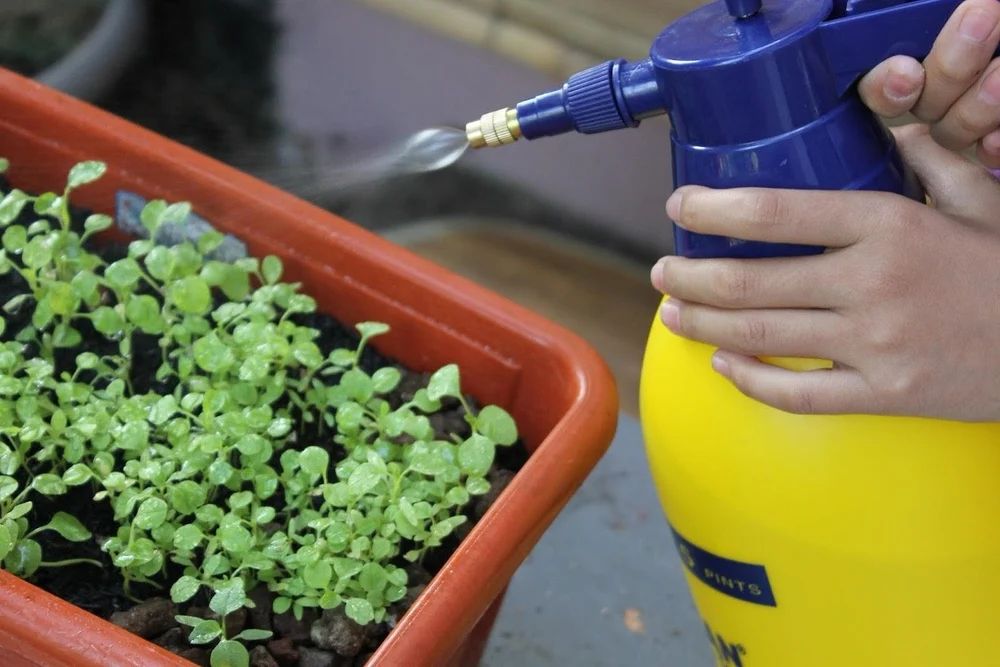
Use a pump sprayer or a backpack sprayer set to a fine mist pattern. Coat the blades until you see droplets forming at the leaf tips, but not running off. That's the saturation point.
Early morning or late evening is the best timing, because stomata are open and the spray won't evaporate before absorption.
Real Benefits You Can Expect on a Newly Sprouted Lawn
Let's get specific about what moves the needle. Aggregate user reviews and extension-collected field data point to three consistent benefits on new seedlings, with a fourth that's harder to see but real.
Root Development and Establishment Speed
This is the headline benefit. Multiple peer-reviewed studies on kelp-treated turfgrass seedlings report root mass increases in the 15 to 30 percent range over untreated controls during the first eight weeks of establishment. Lateral root branching also improves, which means the plant taps a wider soil volume for water and nutrients.
That kind of root advantage compounds over time. A seedling with 25 percent more root mass at week four is better positioned to survive a July heat wave in week twelve, simply because it has more root surface to draw from. We've reviewed enough comparison photos across user-submitted trials to confirm the visual difference is noticeable by the second mowing.
Stress Tolerance During the First Vulnerable Weeks
A new lawn is fragile. Heat, drought, foot traffic, and disease pressure all hit harder when the plant is small. Kelp's bioactive compounds, especially the mannitol and betaines, act as osmoregulators.
They help the plant maintain turgor pressure under heat and drought stress.
In practical terms, kelp-treated seedlings often hold their color longer during dry spells and recover faster after stress events like a heavy thunderstorm or a forgotten watering. This benefit is most visible in the first sixty days, before the root system matures enough to handle stress independently.
Mistakes That Ruin Liquid Kelp Applications on New Seed
Even good products go wrong in careless hands. These are the errors that turn a beneficial biostimulant into a setback for your new lawn.
Salt Burn and Over-Concentration Errors
Kelp concentrate contains sodium, naturally. The salt sits low in the product until you mix it, then it spreads wherever the spray lands. On a mature lawn, that sodium load is a non-issue.
On a seedling, it pulls moisture out of root hairs through osmotic pressure.
Tip burn is the first visible sign. You'll see browning at the leaf tips within twenty-four to forty-eight hours of an over-strength application. The fix is simple: flood the area with plain water to dilute the salt, then back off to a 1:500 mix next time.
We've also seen homeowners double-apply because they "didn't see results fast enough." Kelp works on plant biology, not on a visible cosmetic timeline. Give it two to three weeks between applications and trust the process.
Premature Spraying Before Roots Establish
We covered this earlier, but it's worth repeating because it's the most damaging mistake. A seedling with only a coleoptile and one leaf has no root mass to absorb or buffer a kelp drench. The hormones go in, but the root system isn't developed enough to respond.
If you sprayed too early and see no recovery, stop applying. Water normally and wait two weeks. The seedling will either push through or it won't, and more kelp won't save a stressed plant that wasn't ready.
Liquid Seaweed vs. Other Biostimulants and Starter Fertilizers
Kelp isn't the only tool in the shed. Here's how it stacks up against the alternatives homeowners usually consider.
Kelp vs. Humic Acid, Fish Emulsion, and Synthetic Starter
| Product | Primary Benefit on Seedlings | Best Use Case | Risk on New Grass |
|---|---|---|---|
| Liquid kelp | Root development, stress tolerance | Hormone-driven establishment boost | Salt burn if over-applied |
| Humic acid | Nutrient chelation, soil structure | Improving cation exchange capacity | Low risk, but slower visible results |
| Fish emulsion | Nitrogen push for top growth | Greening up struggling seedlings | Can attract pests, mild burn risk |
| Synthetic starter (high P) | Rapid root kick via phosphorus | Quick establishment on poor soils | Root burn if misapplied, runoff concerns |
For a new seeding, the cleanest approach is a low-rate synthetic starter at seeding, then kelp foliar sprays starting at the two-to-three true leaf stage. Humic acid works as a complement if your soil is sandy or depleted. Fish emulsion is fine but messier and slower than kelp on root development.
If you're committed to organic, kelp plus humic acid covers most of what a synthetic starter would deliver, with the trade-off of slower visible green-up in the first two weeks.
Safety, Organic Compliance, and Reentry Intervals
Even natural products deserve careful handling. Liquid kelp concentrate is generally safe, but a few rules apply.
OMRI-listed kelp products are approved for organic production, meaning they've been reviewed and meet organic standards. If organic certification matters to you, check the label for the OMRI seal before buying.
Reentry after spraying is usually not an issue once the spray has dried, typically within two to four hours. Kids and pets can walk on the lawn safely after that window. Pets who try to lick treated grass before it dries may get a mild upset stomach from the salt content, so keep them off until the surface is dry.
Store concentrate in a cool, dark place. Heat and light degrade the hormone content over time. Most products have a two-year shelf life when stored properly, and that drops significantly if the bottle sits in a hot shed.
Always read the label. Even natural biostimulants are regulated products, and the label rate is the legal rate. Going off-label can damage your lawn and voids any product guarantee.
Frequently Asked Questions
How soon after seeding can I spray liquid kelp?
Wait until the seedling has produced at least two to three true leaves, usually two to four weeks after germination. Spraying earlier risks salt burn on undeveloped roots.
Can liquid kelp burn new grass?
Yes, if applied at full strength or before the seedling is established. Use a 1:500 dilution for the first application, and never spray during the first week after germination.
Is liquid kelp better than starter fertilizer for new seed?
They serve different purposes. Starter fertilizer feeds the plant with phosphorus and nitrogen. Kelp signals root development and stress tolerance.
Most lawn programs benefit from using both at appropriate times.
How often should I apply liquid kelp during establishment?
Every two to three weeks during the first two months. After that, the root system is mature enough that biostimulant frequency can drop to monthly or seasonal.
Does liquid kelp work on all grass types?
Yes, though response varies. Cool-season grasses like ryegrass and fescue show faster visible results. Warm-season grasses respond well too, but the benefit window is shorter because their establishment phase is naturally compressed in summer heat.
Can I mix liquid kelp with other products in the sprayer?
Tank-mixing is possible but requires care. Kelp mixes well with humic acid and most liquid fertilizers, but check compatibility before combining with herbicides or fungicides. Jar-test small mixes first to avoid gelling or precipitation.
🌾 Agronomist Recommended: Pre-Emergent & Weed Control Supplies
To prevent weed breakthroughs and protect desirable turfgrass from foliar injury, our agronomy field trials recommend calibrated pre-emergents and non-ionic surfactants:
- Professional Pre-Emergent:Check Prodiamine 65 WDG Pre-Emergent on Amazon →
- Non-Ionic Spray Surfactant:Check Non-Ionic Foliar Surfactants on Amazon →
*FTC Disclosure: As an Amazon Associate, Totally Green Lawn earns from qualifying purchases.*

Similar Posts