How to Get Dark Green Grass Like a Golf Course
Lead Turfgrass & Lawn Care Specialist at Totally Green Lawn · Certified Turfgrass Specialist (CTS), Master Gardener, B.S. in Agronomy & Turf Science · 14+ years in residential turf management, organic fertilization, and weed science

If you've been wondering how to get dark green grass like a golf course, here's the honest truth: that deep emerald color isn't magic, and it isn't a single product. It's the result of a specific sequence. Soil first, then the right nitrogen, then iron, then sharp blades at the right height, then deep watering.
Golf course superintendents manage turf on a tight calendar. The United States Golf Association Green Section publishes detailed guidance on turf nutrition and mowing heights that most homeowners have never read. As of 2026, the same principles still apply at home, scaled to a residential lawn.
Follow the steps below in order, and the color follows.
Quick Answer
To get dark green grass like a golf course, start with a soil test. Then feed with the right nitrogen program, add iron for deeper color, mow at the correct height with sharp blades, and water deeply but less often. Healthy soil plus consistent iron and nitrogen produces that deep emerald tone.
Skip any step, and the color fades.
What "Golf Course Green" Actually Means (and Why Most Lawns Don't Look Like That)
Most home lawns look pale green at best. Golf course turf, especially on greens, looks almost black-green by comparison. The difference comes down to three things working together: grass species, nitrogen density, and iron.
Golf course greens are typically planted with creeping bentgrass or hybrid bermudagrass, both chosen for tight growth and fine leaf texture. They are mowed at 0.1 to 0.15 inches on championship greens, which forces dense, low growth and concentrates chlorophyll in a thin canopy. Your home lawn can't (and shouldn't) be mowed that short, but you can mimic the color.
Here's the real secret: golf course color is mostly chlorophyll concentration, and chlorophyll is mostly a function of nitrogen availability in the soil. Nitrogen is the building block of chlorophyll molecules. When nitrogen is steady and adequate, blades stay dark.
When it's lacking, blades yellow. Iron is the second player. It doesn't build chlorophyll, but it boosts its density and deepens the green pigment, even without extra nitrogen.
So the "golf course look" is really a chemistry problem disguised as a mowing problem. You don't need special grass. You need the right soil conditions, the right food, and a maintenance rhythm that keeps both stable.
| Factor | Golf Course Green | Typical Home Lawn |
|---|---|---|
| Mowing height | 0.1–0.15 in | 2.5–4 in |
| Grass type | Bentgrass, hybrid bermuda | Bluegrass, fescue, St. Augustine |
| Nitrogen source | Spoon-fed, frequent | 2–4 seasonal apps |
| Iron supplementation | Regular | Rare or accidental |
| Soil pH | 6.0–6.5 | Variable, often off |
Step 1: Identify Your Grass Type and Climate Zone
Before you buy a single bag of fertilizer, you need to know what you're growing. The "best" program for a Kentucky bluegrass lawn in Michigan is the wrong program for a St. Augustine lawn in Florida.
This is the single biggest branching point in the whole process.
Cool-season grasses (Kentucky bluegrass, perennial ryegrass, tall fescue, fine fescues) thrive where average summer temps stay below 85°F. They grow most actively in spring and fall. Their peak color window is late September through early November, when nights cool and nitrogen uptake spikes.
Per the USDA Plant Hardiness Zone map, most of the northern U.S. and upper transition zone falls into cool-season territory.
Warm-season grasses (bermudagrass, zoysiagrass, St. Augustine, centipede, bahiagrass) thrive where summers run hot. They go fully dormant and turn tan in winter.
Their peak color runs from late May through early October. The southern U.S., from the lower transition zone southward, is warm-season country.
There's a tricky middle ground called the transition zone, roughly covering parts of Virginia, Kentucky, Tennessee, the Carolinas, and into Arkansas and Oklahoma. Homeowners there often struggle because neither cool- nor warm-season grasses are perfectly adapted. Tall fescue is the most common compromise for transition zone lawns because it tolerates heat better than other cool-season types.
If you don't know what you have, look at the grass blades up close. Fine, soft blades with a boat-shaped tip usually mean Kentucky bluegrass or perennial ryegrass. Wider, coarser blades with prominent veins often mean fescue or St.
Augustine. Stoloniferous spreaders like St. Augustine send out thick above-ground runners.
Bermudagrass and zoysia spread through both stolons and rhizomes and feel wiry.
This identification step drives every decision that follows: timing, fertilizer ratio, mowing height, even whether overseeding is even possible. Skip it, and you'll fight your lawn for years.
Step 2: Test and Fix Your Soil Before You Do Anything Else
This is the step most homeowners skip, and it's the reason most home lawns never look like a golf course. A superintendent wouldn't apply a single pound of fertilizer without a recent soil test. You shouldn't either.
A basic soil test measures pH, phosphorus (P), potassium (K), and often micronutrients like iron, manganese, and sulfur. Most state university extension services offer soil test kits for $15 to $40. The University of Massachusetts, Penn State, Michigan State, and Texas A&M all run well-known labs.
The University of Massachusetts Center for Agriculture, Food and the Environment is one of the most widely used soil testing services in the country.
The pH reading is the most important number. Most turfgrasses want a soil pH between 6.0 and 7.0. Inside that range, nitrogen, iron, and other nutrients stay available to roots.
Below 6.0 (acidic), iron gets locked up and you'll see yellowing even when iron is technically present in the soil. Above 7.2 (alkaline), the same thing happens, especially with iron and manganese. If your pH is off, no amount of fertilizer will give you that deep green.
To lower pH, apply elemental sulfur. To raise pH, apply pelletized lime. Both work slowly, over weeks to months, so test in early fall or early spring and apply the correction at the same time you fertilize.
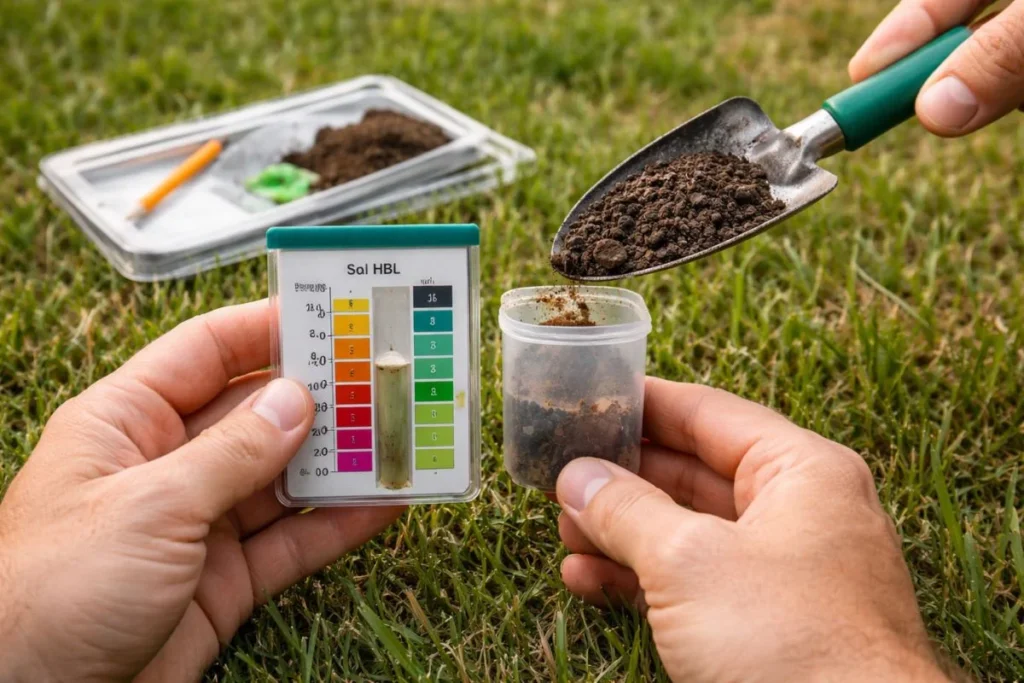
Beyond pH, watch for compaction. Golf course greens are aerated multiple times per year. Compacted soil starves roots of oxygen and water.
If your lawn sees foot traffic, kids, or heavy equipment, core aeration once a year (fall for cool-season, late spring for warm-season) is essential. Pull 2- to 3-inch cores, leave them on the surface, and let them break down naturally.
Finally, check your thatch layer. Thatch is the spongy mat of dead roots and stems between the soil and the grass blades. A thin layer (under 0.5 inch) is fine and even helpful.
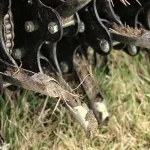
Over half an inch and it blocks water and nutrients from reaching roots. Dethatch with a vertical mower or power rake if thatch exceeds that threshold.
| Soil Issue | Symptom | Fix |
|---|---|---|
| pH below 6.0 | Yellowing, weak color | Apply elemental sulfur |
| pH above 7.2 | Iron chlorosis, pale blades | Apply pelletized lime |
| Compaction | Water pools, thin growth | Core aerate annually |
| Thatch over 0.5 in | Spongy feel, disease | Dethatch in growing season |
| Low phosphorus | Purplish tint, weak roots | Apply P per soil test |
Step 3: Build the Right Fertilization Schedule
Once your soil is right, you can actually feed the lawn with purpose. Fertilizer is where most homeowners either under-do it or overdo it, and both produce weak color. The golf course approach is steady, measured feeding, not heavy seasonal dumping.
Cool-season lawns (bluegrass, ryegrass, fescue) want their heaviest feeding in fall. Apply 2 to 3 pounds of actual nitrogen per 1,000 square feet split across September, October, and late November. Spring feeding is light, no more than 0.5 to 1 pound of N per 1,000 square feet in early May.
Summer? Skip it or you'll push top growth when the grass is already heat-stressed.
Warm-season lawns (bermuda, zoysia, St. Augustine, centipede) want feeding in late spring through summer. Apply 3 to 5 pounds of N per 1,000 square feet split across May, July, and early September.
Stop feeding 4 to 6 weeks before first frost so the grass hardens off properly.
The form of nitrogen matters too. Quick-release urea gives a fast green-up but burns easily and fades in 2 to 3 weeks. Slow-release nitrogen (methylene urea, sulfur-coated urea, polymer-coated) feeds steadily over 6 to 12 weeks and produces the consistent, dark color golf courses are known for.
Look for a bag where at least 50% of the nitrogen is slow-release.
NPK ratios tell you the percentage of nitrogen, phosphorus, and potassium by weight. A 24-0-12 or 32-0-10 with high slow-release N works well for established lawns once P is adequate per your soil test. Skip phosphorus unless the test says you need it, since P runoff is a real water quality issue.
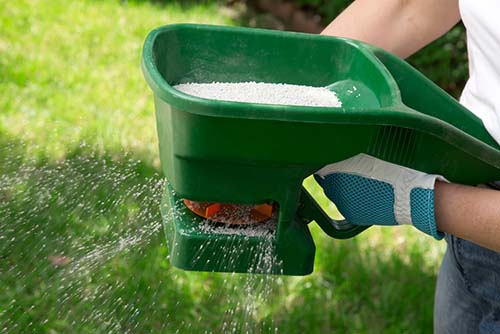
Now for the color booster: iron. Iron doesn't grow grass, but it darkens existing blades fast. Apply chelated iron or ferrous sulfate at 0.5 to 1 pound of actual iron per acre for turf, or follow the product label for home rates.
Liquid iron sprayed on the leaves greens up the lawn in 24 to 48 hours and lasts 3 to 4 weeks. Granular iron works too, but slower. Watch out for iron staining on driveways, sidewalks, and any concrete.
Sweep or blow it off hard surfaces before watering in.
| Grass Type | Total Annual N (per 1,000 sq ft) | Best Feeding Window | Top Slow-Release Source |
|---|---|---|---|
| Kentucky bluegrass | 2.5–4 lb | Sep–Nov | Methylene urea |
| Tall fescue | 2–3.5 lb | Sep–Nov | Polymer-coated |
| Perennial ryegrass | 2–3 lb | Sep–Nov | Sulfur-coated urea |
| Bermudagrass | 3–5 lb | May–Sep | Methylene urea |
| Zoysiagrass | 2–4 lb | May–Sep | Polymer-coated |
| St. Augustine | 3–4 lb | Apr–Sep | Slow-release blend |
| Centipede | 1–2 lb | May–Aug | Low-N blend, minimal feeding |
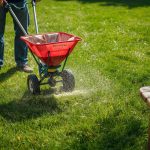
Apply with a calibrated spreader, not by eye. Overlap patterns by 50% and apply half the rate in two directions for even coverage. Water in within 24 hours to move nitrogen off the blades and into the root zone.
Step 4: Mow, Water, and Maintain Like a Superintendent
Even perfect fertilizer won't save you if you mow wrong. Mowing is the most frequent maintenance task, and small mistakes compound fast. Sharpen the blade.
A dull blade shreds grass tips, turning them white or brown within 24 hours. The lawn looks pale and sick even when it's healthy underneath. Sharpen or replace your mower blade at least twice per season, more if you mow sandy or rocky soil.
Mow at the right height for your grass. This is the second biggest mistake people make. Cutting too short shocks the grass, exposes soil to sunlight, and invites weeds.
Tall fescue likes 3 to 4 inches. Kentucky bluegrass likes 2.5 to 3.5 inches. Bermudagrass can go down to 1 to 2 inches.
St. Augustine prefers 3 to 4 inches. Never remove more than one-third of the blade at once.
If your lawn gets tall, mow twice over two days rather than scalping it.
Mulch clippings back into the lawn when possible. Clippings return nitrogen to the soil and reduce fertilizer needs by up to 25% over a season. Bag only when the clippings clump or when you've let the lawn grow too long.
Watering is where most people go wrong with frequency. Golf courses water deeply and infrequently to drive roots down. Shallow daily watering keeps roots near the surface and weakens the plant.
Give your lawn 1 to 1.5 inches of water per week, delivered in one or two sessions, early in the morning (before 10 a.m.). Watering in the evening invites fungal disease. Use a rain gauge or empty tuna can to measure actual output from your sprinkler.
| Grass Type | Mowing Height | Mowing Frequency (peak) | Weekly Water |
|---|---|---|---|
| Kentucky bluegrass | 2.5–3.5 in | Every 5–7 days | 1–1.5 in |
| Tall fescue | 3–4 in | Every 6–8 days | 1–1.25 in |
| Perennial ryegrass | 2.5–3 in | Every 5–7 days | 1–1.5 in |
| Bermudagrass | 1–2 in | Every 3–5 days | 1–1.5 in |
| Zoysiagrass | 1.5–2.5 in | Every 5–7 days | 1–1.25 in |
| St. Augustine | 3–4 in | Every 7 days | 1–1.5 in |
| Centipede | 1.5–2 in | Every 7–10 days | 0.75–1 in |
Striping, the bright-dark pattern you see on televised golf courses, comes from bending grass blades in different directions with a roller or rear roller mower. It's purely cosmetic and doesn't change grass health, but it does require sharp blades and a reel mower for the cleanest look.
Step 5: Troubleshooting, Mistakes, and Long-Term Maintenance
Even when you follow the steps, things go sideways. Here's how to read what your lawn is telling you.
If the lawn is yellowing in patches, check for grubs. Pull back a square foot of sod in late summer. More than 5 to 10 grubs per square foot means treat with a grub control product.
If the yellowing is uniform and the soil pH is fine, you're likely low on nitrogen or iron. A liquid iron spray will tell you quickly. If the grass greens up within days, iron was the issue.
If not, it's nitrogen.
If you see brown rings or circles, that's often brown patch or dollar spot, fungal diseases that love excess nitrogen and wet nights. Reduce nitrogen, water in the morning only, and improve airflow. Severe cases need a fungicide labeled for the specific disease.
If weeds are taking over, your lawn is thin. Thick turf is the best weed control. Mow high, fertilize properly, and overseed thin spots in fall (cool-season) or late spring (warm-season).
Pre-emergent herbicides like prodiamine or dithiopyr stop crabgrass before it germinates, but timing matters. Apply when soil temps hit 55°F for several days in spring.
Watch for fertilizer burn. Yellow or brown stripes after fertilizing usually mean overlap or a heavy quick-release dose. Water heavily for a few days to dilute the salts, then resume normal watering.
The lawn usually recovers within 2 to 3 weeks.
Long-term, build a calendar and stick to it. Soil test every 2 to 3 years. Aerate annually.
Dethatch as needed. Sharpen blades on schedule. Fertilize on the right dates for your grass and zone.
Within two seasons of consistent care, most lawns darken noticeably, and by year three, you can hit that deep emerald tone that looks like a fairway.
Golf Course Lawn FAQ
How long does it take to get golf course green grass?
Most homeowners see meaningful darkening within one full growing season (6 to 9 months) of proper feeding and mowing. A full golf-course look, dense, even, deep emerald, usually takes 2 to 3 years of consistent care.
What fertilizer makes grass dark green the fastest?
A liquid iron spray darkens grass within 24 to 48 hours without pushing growth. For longer-lasting color, a slow-release nitrogen fertilizer with a small percentage of quick-release N gives both fast green-up and steady feeding.
Can I just paint my lawn green?
Yes, lawn paint products exist and are used on golf tournaments. They wash off in 2 to 4 weeks and don't help the plant. They are a temporary cosmetic fix, not a substitute for proper care.
How often do golf courses mow their greens?
Daily during peak growing season, sometimes twice per day for tournament prep. Homeowners don't need that frequency, but mowing often enough to never remove more than one-third of the blade is the same principle.
Will iron hurt my dog or kids?
Most chelated iron products are safe once dried, typically 24 to 48 hours after application. Keep pets and children off the lawn until the spray has dried and been watered in. Check the specific product label for exact re-entry times.
Do I need a reel mower for golf course stripes?
Not strictly. A rotary mower with a rear roller can produce visible stripes. A reel mower gives the cleanest cut and tightest pattern, but it's expensive and requires more maintenance.
Your Golf Course Lawn Decision Guide
If you remember nothing else, remember this. Soil test first, feed on a schedule, mow high and sharp, water deep but rare, and add iron for color. Match every step to your grass type and climate zone, and the dark green shows up on its own.
Skip steps, and you'll keep chasing products instead of results. Golf course superintendents win with systems, not secrets, and so will you.
🚜 Agronomist Recommended: Dethatching & Disease Management Tools
Combat thatch suffocating your turf and stop rapid fungal spread with tested maintenance equipment and systemic fungicides:
- Electric Power Dethatcher & Scarifier:Check Electric Dethatchers & Scarifiers on Amazon →
- Broad-Spectrum Systemic Fungicide:Check Scotts DiseaseEx Lawn Fungicide on Amazon →
*FTC Disclosure: As an Amazon Associate, Totally Green Lawn earns from qualifying purchases.*

Similar Posts