Topdress Lawn with Biochar and Compost: A Complete Guide
Lead Turfgrass & Lawn Care Specialist at Totally Green Lawn · Certified Turfgrass Specialist (CTS), Master Gardener, B.S. in Agronomy & Turf Science · 14+ years in residential turf management, organic fertilization, and weed science
Most lawns that look tired aren't actually dying. They're compacted, starved, and sitting on a thatch layer that water and roots can't push through. Topdressing with biochar and compost is one of the few fixes that tackles all three at once, and it works whether you're nursing a patchy fescue yard or rebuilding a beat-up Bermuda lawn from scratch.
The standard target is a 1/4-inch layer of a screened compost and biochar blend, which works out to roughly 0.77 cubic yards per 1,000 square feet. University extension guidance and International Biochar Initiative (IBI) certified product specs (as of 2026) both point to that depth as the sweet spot: thick enough to feed the soil, thin enough that the grass blades push through without smothering. Let's walk through what to do, in what order, and what to skip.
Quick Answer
Topdress a lawn with biochar and compost by spreading a 1/4-inch layer of screened compost blended with 10, 20% biochar by volume. Mow low, dethatch if thatch is over 1/2 inch, and core-aerate first. Spread with a shovel and rake, water it in, and repeat once a year.
What Topdressing With Biochar and Compost Actually Does to Your Lawn
Topdressing is just the act of spreading a thin layer of material over the surface of your lawn and letting the grass grow up through it. The two ingredients here do very different jobs, and that's the whole point of pairing them.
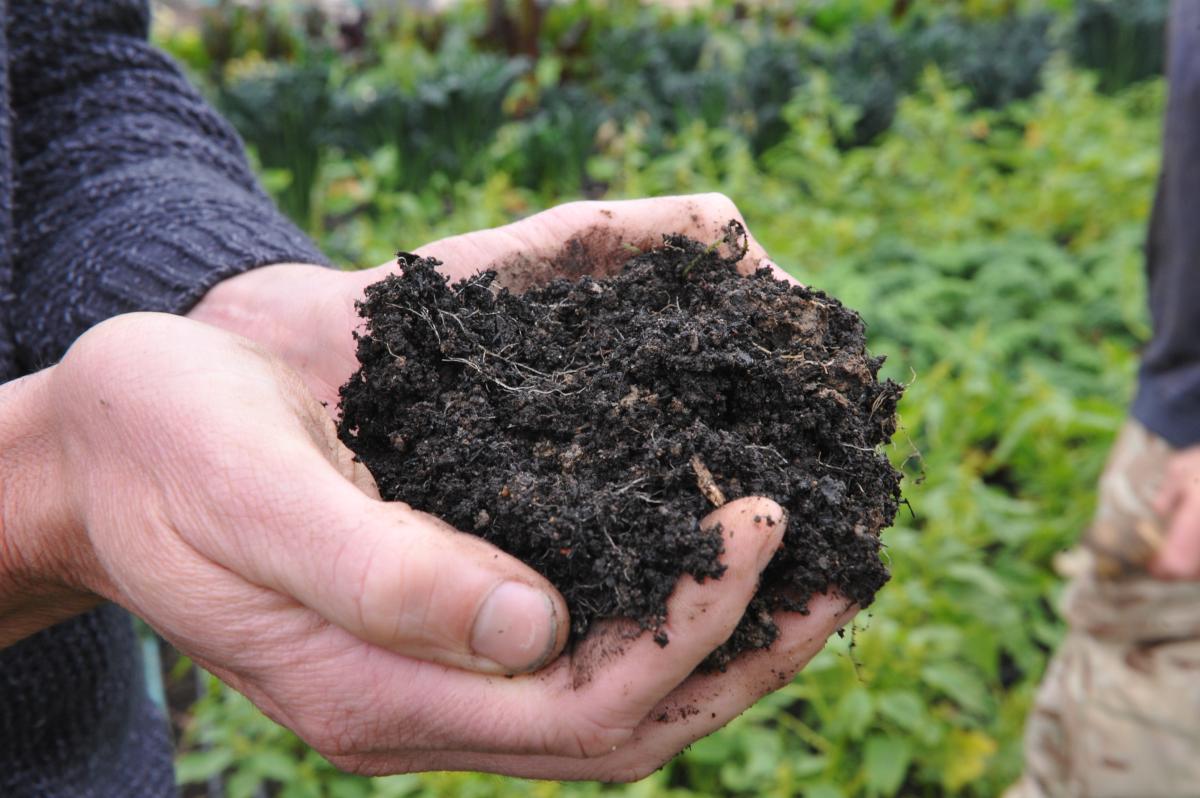
Compost is the food. Finished, screened compost (under 3/8-inch particle size) carries organic matter, a slow-release nitrogen-phosphorus-potassium profile, and a living population of microbes. It feeds the soil biology that feeds the grass.
Per university extension recommendations, compost with a carbon-to-nitrogen ratio around 10:1 to 20:1 is ideal for turf because it breaks down at a rate the roots can actually use.
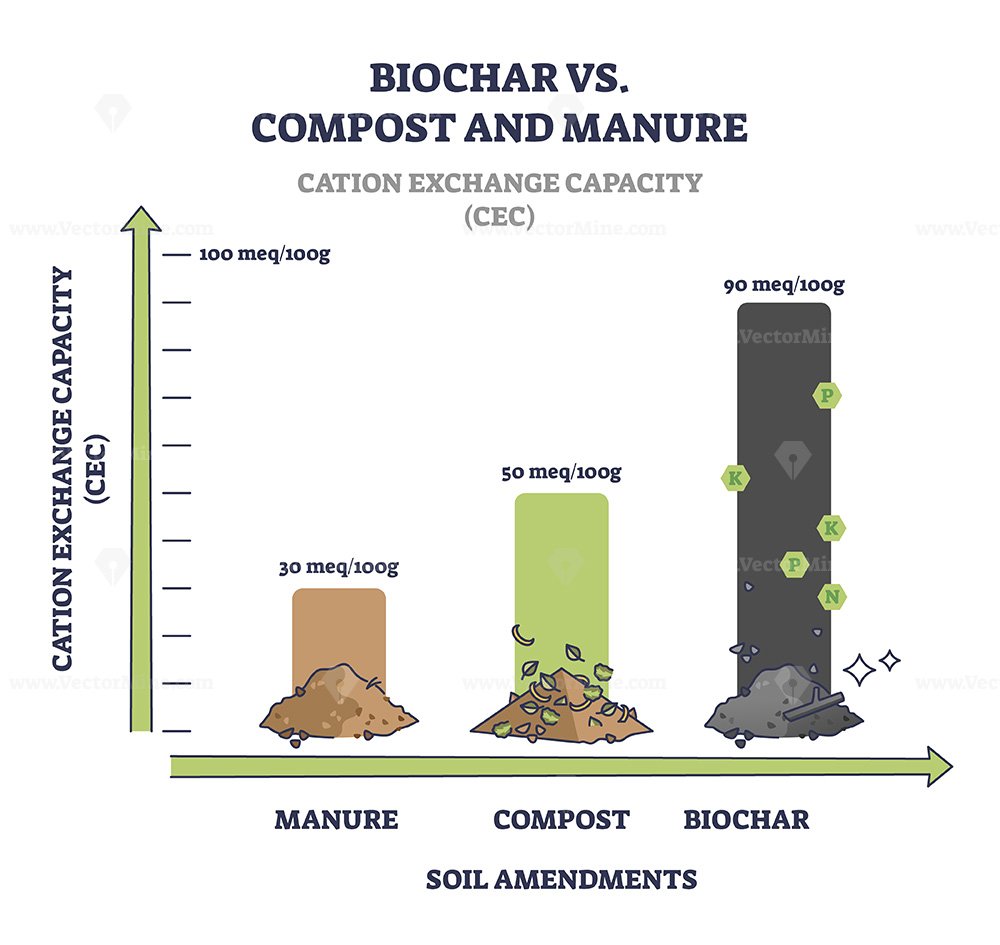
Biochar is the scaffolding. It's a stable, porous form of carbon made by pyrolyzing biomass at high temperature with limited oxygen. Horticultural-grade biochar (pH 6.5 to 8.0, IBI certified) has a massive internal surface area that holds water, holds onto nutrients, and gives beneficial microbes a place to colonize.
Unlike compost, biochar doesn't break down quickly. It sticks around for decades, which is why researchers often call it a soil amendment rather than a fertilizer.
When you blend them, the compost feeds the biochar (biochar straight out of the bag can actually pull nitrogen out of the soil until it gets "charged"), and the biochar holds onto what the compost would otherwise leach away. You get faster results from the compost and longer-term structural benefits from the biochar.
What you'll notice in the first season is better water retention and a darker green color. What you'll notice over two to three seasons is deeper roots, less runoff, and soil that doesn't crust over after a heavy rain. If your lawn is on heavy clay or sand, the difference is dramatic.
If you've already got decent loam, it's more of a slow tune-up.
How Much Biochar and Compost You Actually Need (and the Right Mix Ratio)
Get the math wrong and you'll either smother the grass or waste material. The math is actually pretty simple.
Step 1: Measure your lawn.
Walk it off or use a mapping tool. You need the square footage, not the lot size. A typical suburban yard is 5,000 to 8,000 square feet of actual turf, after subtracting the house, driveway, and beds.
Step 2: Decide your layer depth.
A 1/4-inch layer is the standard recommendation for a routine annual topdressing on established turf. Go to 1/2 inch if you're rehabilitating a really beat-up lawn and you've already aerated it. Anything over 1/2 inch risks smothering the crowns, especially on warm-season grasses during green-up.
Step 3: Convert depth to volume.
This is the conversion people get wrong. At 1/4 inch deep:
| Lawn Size (sq ft) | Compost + Biochar Needed (cubic yards) | At 1/2 inch depth |
|---|---|---|
| 1,000 | 0.77 cu yd | 1.54 cu yd |
| 5,000 | 3.86 cu yd | 7.72 cu yd |
| 8,000 | 6.17 cu yd | 12.34 cu yd |
One cubic yard equals 27 cubic feet, and one cubic yard spread 1/4 inch thick covers about 1,296 square feet.
Step 4: Pick your biochar ratio.
For most home lawns, a 10, 20% biochar blend by volume works well. That means 1 part biochar to 4 or 9 parts compost. Aggregate extension research and IBI product guidelines both point to this range.
If you're new to biochar, start on the low end (10%). You can always add more next round.
Step 5: Pre-mix the blend.
Don't dump biochar and compost on the lawn separately. Pre-wet the biochar in a wheelbarrow or mixing tub (it floats when dry and makes a mess), then fold it into the compost until the color is uniform. The biochar will look like black specks throughout the dark brown compost.
Uniform color = uniform spread.
A 10% biochar blend for a 5,000-square-foot lawn at 1/4 inch deep means roughly 0.4 cubic yards of biochar and 3.5 cubic yards of compost. At $25 to $60 per cubic yard for compost and $100 to $400 per cubic yard for IBI-certified horticultural biochar (as of 2026), the material alone runs $400 to $1,800 depending on region and quality.
Prepping the Lawn: Mow, Dethatch, and Aerate the Right Way
Topdressing onto an unprepared lawn is the most common reason the job looks bad afterward. The material can't reach the soil if the grass is too tall, and it sits on top of thatch instead of filtering down. Here's the order that matters.
Mow low, but not scalped.
Drop your mower to about 1.5 inches for cool-season grasses or 1 inch for warm-season grasses. Bag the clippings. You want short grass blades so the topdressing reaches the soil surface, not the leaf canopy.
Don't go so low you expose bare dirt. Per Penn State Extension guidance, mowing too short before topdressing can stress the turf and slow recovery.
Test for thatch.
Stick a finger into the lawn and peel back a section. Thatch is the spongy brown layer between the green grass and the soil. If it's over 1/2 inch thick, dethatch first.
A power rake or vertical mower set to slice into the thatch (not the soil) will pull up a lot of debris. Bag it and remove it. If thatch is under 1/2 inch, skip dethatching.
You'll just tear up good grass for no benefit.
Core aerate, especially on compacted soil.
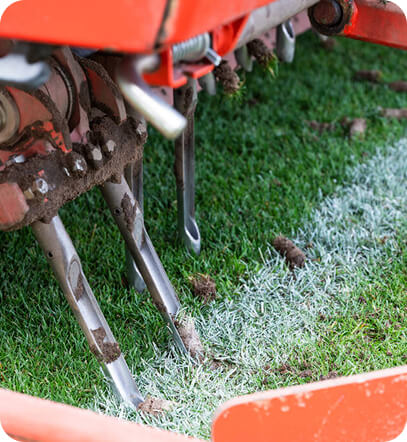
A core aerator pulls 2- to 3-inch plugs out of the lawn and drops them on the surface. This is the single biggest prep step for a successful topdressing. The holes let the compost-biochar blend fall directly into the root zone instead of sitting on top.
For cool-season lawns, fall aeration is the gold standard. For warm-season lawns, late spring to early summer, when the grass is actively growing and can recover fast.
Water the day before.
Lightly water the lawn 12 to 24 hours before topdressing. You want the soil slightly moist, not soggy. Dry soil repels the topdressing.
Wet soil smears and compacts. Moist is the target.
Skip pre-emergent herbicide.
If you've applied a pre-emergent crabgrass control in the last 6 to 8 weeks, topdressing on top of it can lock the herbicide barrier in place and stop the grass from spreading. Plan your topdressing for fall (cool-season) or late spring (warm-season) so you're outside the pre-emergent window. University turfgrass programs consistently flag this as the top reason a topdressing job "didn't work."
The Step-by-Step Topdressing Process (With Visual Cues to Watch For)
This is the part where most people either rush or get sloppy. The actual spreading isn't hard, but the visual feedback during the work tells you whether you're on track.
Step 1: Load up in manageable batches.
Don't try to wheelbarrow 4 cubic yards at once. Work in batches that cover about 500 to 1,000 square feet each. Dump each batch in a few small piles across the section, not one big pile.
Big piles get stepped on and compressed into the grass.
Step 2: Spread with the back of a rake or a drag mat.
A standard landscape rake flipped upside down works well. A drag mat (a piece of chain-link fencing weighted with a board) is faster on big lawns. You're looking for the material to disappear into the grass canopy, with maybe 10 to 20% of the blade tips still visible.
If you can see brown material sitting on top of the grass everywhere, it's too thick. If you can barely see any material at all, you're not applying enough.
Step 3: Work in overlapping passes.
Spread each batch in a pattern, then cross over it at a 90-degree angle. Think of it like mowing in a checkerboard. This prevents stripes of thick and thin coverage, which show up weeks later as uneven color.
Step 4: Knock the material off the crowns.
After spreading, take the flat edge of a rake and gently sweep any clumps off the tops of grass crowns, especially on Bermuda, Zoysia, and other warm-season grasses. Piled compost on a crown can rot the growing point.
Step 5: Water it in lightly.
A short, gentle watering (10 to 15 minutes) settles the material into the canopy and into the aeration holes. Don't blast it with a strong stream. You'll wash the biochar off into the street, and biochar is light.
You want rain-like coverage.
Step 6: Leave the cores if you aerated.
If you used a core aerator, leave the soil plugs on the surface. They'll break down naturally over the next two to three waterings and add back to the topdressing layer. Raking them up defeats half the purpose.
Visual cues to watch for during the work:
- Black specks visible across the lawn = biochar is mixed in correctly.
- Uniform dark brown color with grass tips showing = correct depth.
- White or gray fuzzy material = unfinished compost, stop and source better material.
- Material sliding off the lawn onto the driveway = too dry, pre-wet the next batch more.
- Big clumps that won't break apart = compost wasn't screened well enough, screen it or switch suppliers.
Step 7: Hold off on mowing for 3 to 5 days.
Let the grass push up through the layer before you mow again. Set the mower to its normal height, not lower. You're letting the new topdressing settle into the soil profile.
Per the USDA Natural Resources Conservation Service soil health guidance, repeated disturbance right after amendment application reduces the biological benefits you're trying to capture.
Mistakes That Ruin a Biochar-Compost Topdressing Job
Most topdressing failures trace back to one of these issues. None of them are hard to avoid once you know what to look for.
Smothering the grass.
Layer too thick, or worse, applied to a lawn that wasn't mowed. The grass yellows, thins, and sometimes dies in patches. Stick to 1/4 inch for routine work, 1/2 inch only after aeration on a lawn that needs serious rehab.
Using unfinished compost.
If compost is still hot, smells like ammonia, or has visible feedstock pieces that haven't broken down, don't use it. Hot compost will burn turf and rob nitrogen as it continues to break down. Finished compost should smell earthy, be dark and crumbly, and have a uniform texture.
Aggregate user feedback and extension service compost guidance both emphasize maturity over feedstock type.
Dry biochar handling.
Dry biochar is dusty, light, and blows away. Always pre-wet it before mixing or spreading. A dust mask (N95) is worth wearing during the pre-wet step.
Wet biochar is heavier, easier to spread, and less likely to drift into unwanted places like your neighbor's yard.
Topdressing at the wrong time.
Cool-season lawns (Kentucky bluegrass, fescue, ryegrass) do best with topdressing in early fall, when soil is warm but air is cool and weeds are fading. Warm-season lawns (Bermuda, Zoysia, St. Augustine, Centipede) do best in late spring through early summer, when they're in active growth.
Topdressing during dormancy or heat stress sets the lawn back instead of helping it.
Ignoring soil pH.
Biochar often has a pH between 7 and 10 depending on feedstock. On already-alkaline soils (common in the arid Southwest and parts of the Plains), this can push pH above the 6.0 to 7.0 range most turfgrasses prefer. Get a soil test first.
Cooperative extension offices offer this for $10 to $25, and the results tell you whether to use biochar at all, and at what rate.
Topdressing over herbicide residue.
Manure-based compost, especially from horse farms on pasture treated with aminopyralid or other persistent herbicides, can carry residue that kills grass and broadleaf plants. The EPA and extension services have documented this repeatedly. Source compost from suppliers who test for herbicide residue, or stick to plant-based composts (leaf mold, yard waste compost, food waste compost).
Forgetting to overseed if needed.
If your lawn is thin, topdressing alone won't fill it in. Pair topdressing with overseeding in the same week. The topdressing gives the seed perfect seed-to-soil contact.
Skipping the seed means you're feeding bare soil for weeds to colonize.
Best Timing, Frequency, and Long-Term Results by Climate
Timing is the difference between a topdressing that takes and one that wastes your weekend. Cool-season and warm-season grasses have opposite windows, and getting the wrong one sets you back a full growing season.
Cool-season regions (Northeast, Upper Midwest, Pacific Northwest, UK, Northern Europe) target early fall, roughly mid-September through mid-October. Soil is still warm enough for root growth, air is cool enough to avoid heat stress, and weed pressure is dropping fast. Spring works as a backup, but you'll fight crabgrass germination.
Warm-season regions (Southeast, Gulf Coast, Southern California, Transition Zone) target late spring through early summer, once the grass has fully greened up and is in active growth. Topdressing during spring green-up smothers the new growth. Topdressing during summer dormancy wastes the application.
| Region Type | Best Window | Second-Choice Window | Skip If |
|---|---|---|---|
| Cool-season (fescue, bluegrass, rye) | Early fall | Early spring | Mid-summer heat |
| Warm-season (Bermuda, Zoysia) | Late spring / early summer | Early fall (overseeded rye) | Dormancy or green-up |
| Arid Southwest | Fall, before winter rains | Early spring | Peak summer heat |
| Transition Zone | Either, but lean warm-season timing | Fall, for overseeding | Drought or frost |
Frequency matters too. Once a year is the standard recommendation for routine topdressing. Twice a year (spring and fall) makes sense only if you're rebuilding a really thin lawn, and even then, back-to-back applications need to be lighter, around 1/8 inch each pass, not full 1/4 inch layers stacked.
Long-term results show up in stages. The first season delivers better water retention and a visible color bump from the compost. By year two, root depth increases and thatch starts breaking down faster.
By year three, soil organic matter climbs measurably. Aggregate research from the US Composting Council suggests routine topdressing over three to five years can shift soil organic matter by 1 to 2 percentage points, which is meaningful in sandy or depleted soils.
Cost Breakdown and Sourcing the Right Materials
Material costs dominate the budget here, and the spread between cheap and quality is huge. Knowing what you're paying for prevents overpaying for composted bark and underpaying for actual biochar.
Compost pricing runs $25 to $60 per cubic yard for bulk, screened, plant-based compost from municipal or commercial facilities. Bagged compost at garden centers is convenient but more expensive per cubic yard, often $5 to $8 per cubic foot equivalent, or $135 to $216 per cubic yard. For a 5,000-square-foot lawn at 1/4 inch depth, you need about 3.86 cubic yards.
Bulk is the only sensible option for anything over 1,000 square feet.
Biochar pricing runs $100 to $400 per cubic yard for IBI-certified horticultural biochar. Cheaper biochar products exist, but they often have higher dust content, variable pH, or questionable feedstock sourcing. Bagged biochar at retail runs $15 to $40 for a 1- to 2-cubic-foot bag, which works for small yards or a 10% blend on a 1,000-square-foot lawn.
Material cost for a typical 5,000 sq ft lawn (1/4 inch, 10% biochar blend):
| Material | Quantity Needed | Cost Range (Bulk) |
|---|---|---|
| Screened compost | 3.5 cu yd | $90 to $210 |
| Biochar (10% blend) | 0.4 cu yd | $40 to $160 |
| Total materials | — | $130 to $370 |
Add delivery fees ($50 to $150 depending on distance) if you can't pick up in a pickup truck or trailer.
Sourcing rules of thumb. Municipal compost from a local yard waste facility is often the cheapest screened compost available, and quality is generally reliable. Manure-based compost is fine if the supplier can document herbicide testing. Avoid compost with visible plastic, glass, or un-broken-down wood chunks larger than 3/8 inch.
For biochar, IBI certification is the most reliable quality signal. Feedstock matters too. Hardwood biochar tends to have a more neutral pH than softwood or grass-based biochar.
If you're in a region with no bulk compost suppliers, bagged screened compost still works, just expect the project to cost two to three times more per square foot.
Frequently Asked Questions
How often should I topdress my lawn with biochar and compost?
Once a year is the standard recommendation. Apply in early fall for cool-season grasses, late spring for warm-season. Twice a year is fine for rebuilding a thin lawn, but cut each pass to 1/8 inch instead of 1/4 inch.
Can I just throw biochar on my lawn without compost?
You can, but the results are weaker. Dry, uncharged biochar pulls nitrogen from the soil for the first few weeks, which can yellow the grass. Blending it with compost pre-charges the biochar and delivers the nitrogen back.
The blend also spreads more evenly than dry biochar alone.
Will biochar raise my soil pH too much?
It can, especially on already-alkaline soils. Most IBI-certified horticultural biochar has a pH between 7 and 10. Get a soil test before applying.
If your pH is already 7.0 or above, lower the biochar ratio to 5% or skip it and use compost only.
How long does it take to see results from biochar topdressing?
Visible color and water-retention improvements show up within 4 to 6 weeks. Root depth and soil structure changes take a full growing season. Long-term carbon and microbial benefits build over 2 to 3 years of annual applications.
Is biochar safe for pets and kids on the lawn?
Yes, once it's been pre-wetted and worked into the soil. Dry biochar dust is a respiratory irritant, so keep pets and kids off the lawn during application and initial watering. After the first rain or watering settles the material, it's safe to walk on.
🌱 Agronomist Recommended: Bio-Stimulants & Turf Nutrition
Achieve deep golf-course green color and root resilience without surge growth using lab-verified nutrients and bio-stimulants:
- Liquid Iron & Humic Acid:Check Liquid Iron & Humic Blends on Amazon →
- Stress-Blend High Potassium Fertilizer:Check High Potassium Lawn Fertilizers on Amazon →
*FTC Disclosure: As an Amazon Associate, Totally Green Lawn earns from qualifying purchases.*

Similar Posts