When to Apply Winterizer Fertilizer Before the Ground
Lead Turfgrass & Lawn Care Specialist at Totally Green Lawn · Certified Turfgrass Specialist (CTS), Master Gardener, B.S. in Agronomy & Turf Science · 14+ years in residential turf management, organic fertilization, and weed science
When to apply late fall winterizer fertilizer before ground freezes comes down to a soil temperature trigger, not a calendar date. Most lawns need the application when soil temps at the 2 to 4 inch depth drop into the 50 to 55°F range and are still falling, typically 2 to 3 weeks before your area's first hard freeze.
The USDA Plant Hardiness Zone Map and university extension services across the Midwest and Northeast have pushed that threshold for years. The logic is simple: cool-season grasses keep growing roots until the soil hits roughly 40°F, so a winterizer lands during the final stretch of underground activity. Get the timing right, and the potassium and nitrogen go into the crown and root system, not into blade growth that winter kill will just take out.
As of 2026, the soil-temp-first method is still the standard most turf researchers recommend over old "Labor Day" or "Thanksgiving" rules of thumb.
Quick Answer
Apply late fall winterizer when soil temperature at 2 to 4 inches deep reads 50 to 55°F and falling. Target 2 to 3 weeks before your average first hard freeze. Stop when the ground freezes solid, since frozen soil can't absorb nutrients.
The Real Answer: It's About Soil Temperature, Not the Calendar

Image source: Bing (Web (fair-use with source credit))
Most homeowners guess by the date on the wall calendar. That's the single biggest reason winterizer applications fail. The right window is a moving target that shifts by 3 to 4 weeks every year, depending on how warm fall runs and when your first real cold snap lands.
Here's the core idea, stated plainly: grass roots don't care what month it is. They respond to soil temperature. Kentucky bluegrass, tall fescue, perennial ryegrass, and the fine fescues all keep pushing roots into winter as long as the soil above them stays above about 40°F.
The trick is feeding the plant while the roots are still active, but after top growth has slowed enough that the fertilizer won't trigger a flush of tender new blades.
If you go too early, the nitrogen feeds top growth and late-season weeds. The grass wastes energy pushing leaves that the first hard frost will scorch. If you go too late, the product sits on frozen ground, gets washed away in spring snowmelt, or never breaks down enough to feed the roots.
The two practical triggers we look for:
- Soil temperature at 2 to 4 inches deep is 50 to 55°F and dropping for several days in a row
- Your 7 to 14 day local forecast shows nighttime lows consistently in the upper 20s or low 30s°F
A simple soil thermometer (the probe kind, not the cheap dial ones) is the most accurate way to read this. Stick it about 3 inches down in a shaded patch of the lawn, mid-morning, for a few days in a row. When you see a steady downward trend through 55°F, you're in the window.
Air temperature alone is a rough shortcut. Once daytime highs stop climbing back above 55°F for a full week, you're usually close. But the soil thermometer removes the guesswork, and they're under $15 at any garden center.
What "Winterizer" Actually Does to Your Lawn
A true winterizer isn't just "fall fertilizer." It's a specific blend designed for the final root-storage push of the season. The exact N-P-K ratio varies by brand, but the working formula is consistent: moderate to low nitrogen, very little or no phosphorus, and a higher potassium number.
Here's the role each nutrient plays in this late window:
- Nitrogen (N): drives root growth and carbohydrate storage in the crown. The plant loads up these reserves over winter, then uses them to power fast spring green-up. Too much, though, and you'll trigger top growth that gets zapped by frost.
- Potassium (K): this is the cold tolerance mineral. It thickens cell walls, improves freeze resistance, and helps the grass handle winter desiccation (the browning you see in late winter when dry winds pull moisture from frozen blades).
- Phosphorus (P): most established lawns already have plenty. New seedings or severely damaged turf benefit from a little, but on a mature lawn it's often skipped or limited by state regulation.
Common N-P-K ratios you'll see in late fall winterizers include 24-0-10, 32-0-10, 10-0-20, and 18-0-12. The pattern holds: nitrogen at moderate levels, phosphorus at or near zero, potassium noticeably higher than the N.
One more thing worth understanding. The nitrogen source matters more in fall than in spring. Quick-release urea gives a fast root response but can burn if over-applied.
Slow-release options like sulfur-coated or poly-coated urea feed the plant over a longer stretch, which reduces burn risk and matches the gradual root-storage process. Most university extension services we reviewed lean toward a 30 to 50% quick-release / 50 to 70% slow-release split for late fall.
Your Condition Variables: The 4 Things That Decide Your Window
There's no universal "best date." Your window is shaped by four specific variables, and each one pushes the timing earlier or later.
Grass Type
Cool-season grasses (bluegrass, fescue, ryegrass) respond best to a true late-fall winterizer, because they stay semi-active through winter and benefit most from root-zone feeding. Warm-season grasses (Bermuda, Zoysia, St. Augustine, centipede) go fully dormant once soil temps drop into the 50s, so a winterizer is usually wasted.
They get a final feeding in early fall, then nothing until they break dormancy in late spring.
Geographic Zone and Climate
Your USDA Hardiness Zone and local climate pattern set the outer boundaries. A Zone 4 lawn in Minnesota might have a window from mid-September to early October. A Zone 7 lawn in Virginia could run from late October through mid-November.
Coastal Pacific Northwest lawns, where air and soil temps lag behind inland areas, often push into early December.
First Hard Freeze vs. First Frost
Light frosts in the 30 to 35°F range don't end the window. A hard freeze (28°F or below for several hours) is what freezes the top layer of soil. You want your application down 2 to 3 weeks before that hard freeze hits, not before the first light frost.
Many homeowners quit too early because they see one cold morning.
Local Weather Pattern in 2026
This is the variable people forget. Some years, fall stays warm into November (pushing the window later). Other years, an early cold snap in October closes the window fast.
NOAA's long-range forecast and your state climate office can give you a 2 to 4 week heads-up. If a warm pattern is forecast, you can wait. If an arctic front is looming, you need to move now.
The Decision Tree: When to Apply Based on Your Zone and Grass Type
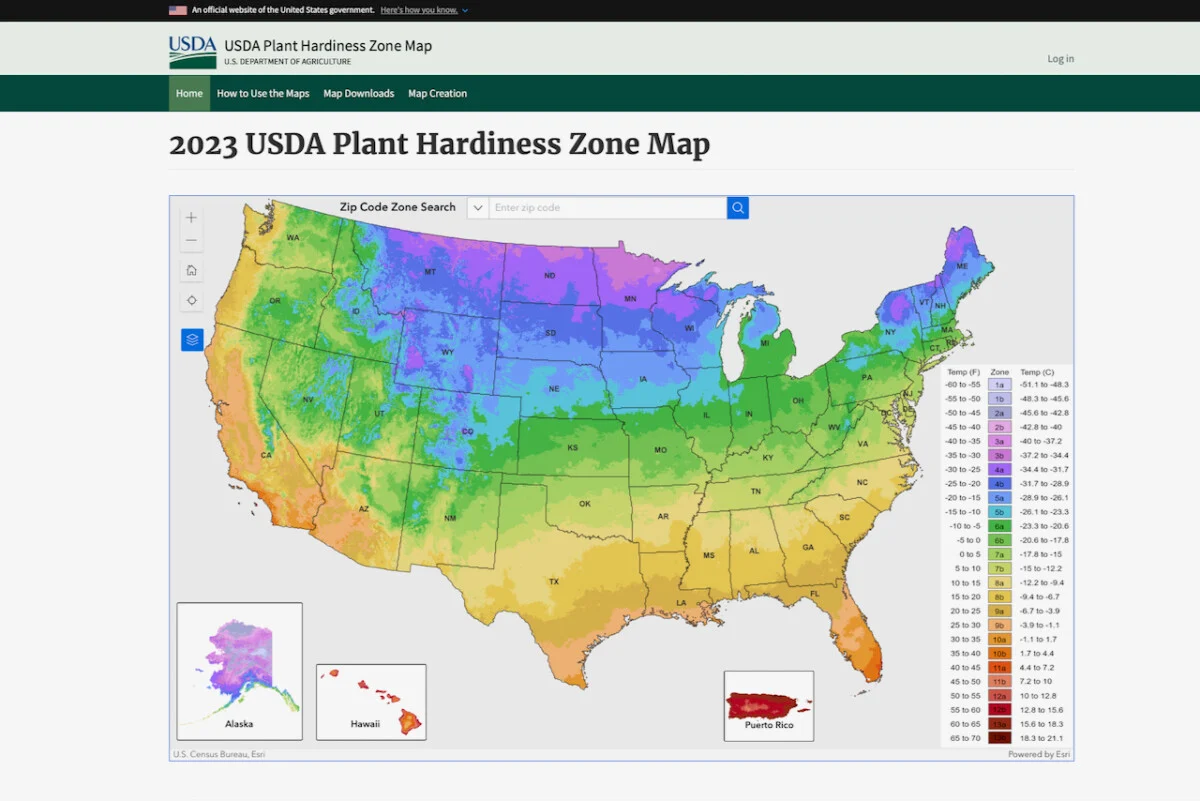
Image source: Bing (Web (fair-use with source credit))
Here's the workflow we use when readers ask "when exactly do I do this?" It works for any cool-season lawn in the continental US, as of 2026.
Step 1: Identify your grass type and zone.
If you have cool-season grass (bluegrass, fescue, ryegrass) and live anywhere from Zone 3 through Zone 7, proceed. If you have warm-season grass (Bermuda, Zoysia, St. Augustine, centipede) and live in Zone 8 or warmer, you can usually skip winterizer and instead do a final fertilizer 6 to 8 weeks before your expected first frost.
Step 2: Find your average first hard freeze date.
Your state climate office or university extension service publishes this. For example, much of Maryland and Virginia runs late October to early November, while most of Iowa and Illinois lands in mid to late October. Cross-check with NOAA's frost/freeze climatology for your county.
Step 3: Count back 2 to 3 weeks from that date.
That gives you your target window. If your average first hard freeze is October 25, your window is roughly October 4 to October 11.
Step 4: Verify with soil temperature.
Buy or borrow a soil thermometer. Check at 2 to 4 inches deep, mid-morning, in a shaded spot, for 3 to 5 days running. When you see 50 to 55°F and a steady downward trend, you're in the window.
If the soil is still reading 58°F, wait. If it's already at 48°F and falling fast, you may need to apply now even if the calendar says it's a bit early.
Step 5: Check your local fertilizer regulations.
Some states and counties restrict fall nitrogen applications or ban phosphorus on established lawns. We'll cover the most common ones in a later section. Don't skip this step.
Step 6: Apply and water in.
More on that in the next section.
Here's a quick reference table for the major cool-season regions:
| Region / Zone | Typical Window | Soil Temp Trigger | Notes |
|---|---|---|---|
| Northern Plains, Upper Midwest (Zones 3-4) | Mid-Sept to early Oct | 50-55°F | Tight window, soil freezes fast |
| Great Lakes, Northeast (Zones 5-6) | Early Oct to early Nov | 50-55°F | Most flexible window |
| Mid-Atlantic, Ohio Valley, Transition (Zones 6-7) | Late Oct to mid-Nov | 50-55°F | Watch for warm spells that push the window later |
| Pacific Northwest maritime (Zones 7-8) | Mid-Nov to early Dec | 50-55°F | Soil temps lag air temps by 2-3 weeks |
| Warm-season South (Zones 8-10) | Skip or dormant feed | N/A | Final feed in early fall only |
If you're past the window and the ground is already frozen, do not apply. Wait until early spring and do a standard pre-green-up application once the soil thaws.
How to Apply It Right (Without Wasting Product or Burning the Lawn)
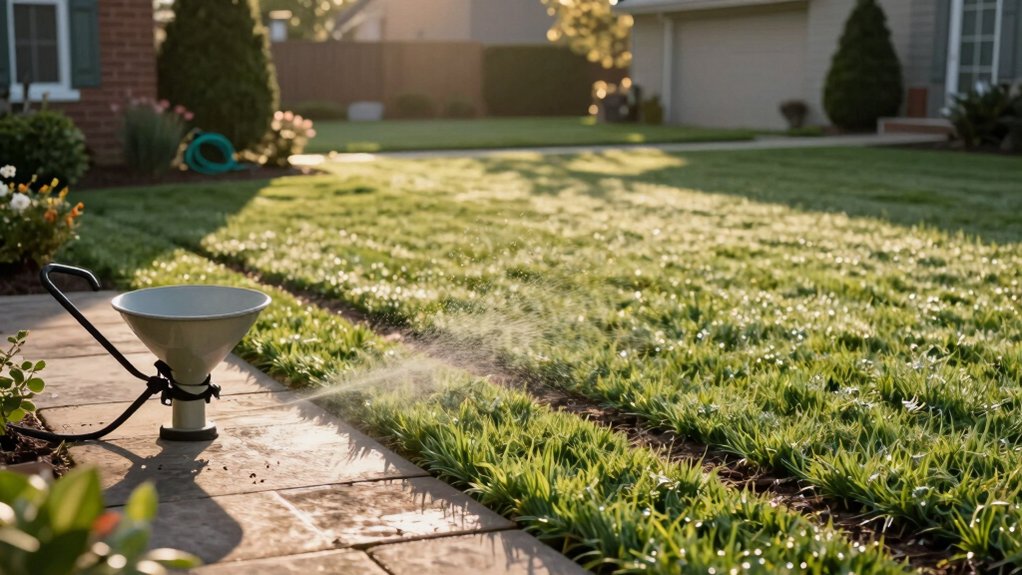
Image source: Bing (Web (fair-use with source credit))
Getting the timing right is only half the job. A sloppy application can waste the whole window. Here's the workflow that consistently gives a clean, even feed.
Step 1: Mow first, but lower than your summer height.
Drop the blade to about 2 to 2.5 inches for cool-season lawns. Shorter grass means the granules reach the soil surface instead of getting trapped in the canopy. Don't scalp it.
Just give it a clean, even cut a day or two before you plan to fertilize.
Step 2: Calibrate your spreader.
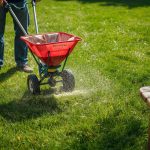
This is the step most people skip, and it's why some lawns come out striped or burned. Read the bag's recommended setting for your spreader brand (Scotts, Lesco, Earthway, Andersons, etc.). Set it there, then do a test pass on your driveway with the spreader closed.
Open it while walking at your normal pace, and check the spread pattern. Adjust until you're getting even coverage with minimal throw into the street or garden beds.
Step 3: Apply at the right rate.
Most late fall winterizers call for 0.5 to 1.0 lb of actual nitrogen per 1,000 sq ft. Read the bag. A 24-0-10 product at that rate means roughly 2 to 4 lbs of product per 1,000 sq ft, depending on the formulation.
Over-applying is the fastest way to burn the crown or trigger snow mold.
Step 4: Use the two-pass method.
Apply half the rate in one direction (north-south), then the other half perpendicular to it (east-west). This cuts striping and gives uniform coverage even if your spreader pattern is slightly uneven.
Step 5: Water it in within 24 hours.
A half inch of water from rainfall or irrigation moves the granules off the blades and into the root zone where they belong. Without watering, the fertilizer can sit on the leaf surface and burn the tissue, or get eaten by birds. If no rain is forecast and you can't irrigate, this isn't the right day to apply.
Step 6: Keep traffic off for a day or two.
Let the granules settle and start breaking down. Foot traffic, dog runs, and mower passes right after application can move product into concentrated piles that burn the turf.
Mistakes That Cost You the Whole Application
Even with good timing, a few common errors can turn a winterizer into a waste of money. These are the ones we see in our research year after year.
Applying based on the calendar, not the soil.
We covered this earlier, but it's worth repeating. The "first week of November" rule fails every warm fall and burns every cool-season lawn that got an early arctic blast. Soil temperature is the only reliable trigger.
Confusing fall fertilizer with winterizer.
Early fall fertilizer (applied in September in most zones) is a balanced feed designed to recover from summer stress. Late fall winterizer is a root-storage feed with different N-P-K ratios. Using the wrong one at the wrong time is a real problem.
Early fall products pushed too late can cause snow mold and fusarium patch. Winterizers pushed too early feed top growth that gets frosted.
Over-applying "for good measure."
More nitrogen does not mean more winter hardiness. Past 1.0 lb of N per 1,000 sq ft, you're feeding disease, not roots. Snow mold pressure spikes with excess late-season nitrogen.
Skipping the watering step.
Granular fertilizer that sits on the lawn without water for a week is doing nothing. It's also attracting birds and staining concrete. Water it in, or wait for rain in the forecast.
Applying to frozen or saturated ground.
If the ground is frozen solid or so wet it puddles, the product won't reach the root zone. It'll run off when things thaw. Wait for soil that's firm but not frozen, and dry enough to walk on without sinking.
Ignoring phosphorus bans.
Many states restrict or ban phosphorus on established lawns. If your winterizer contains P and you're in a restricted state, you may be breaking the law, even with the best intentions. We'll cover that in the next section.
Forgetting to clean the spreader.
Leftover granular fertilizer in a wet spreader clumps, corrodes metal parts, and throws your calibration off next time. Empty it, rinse it, dry it, store it indoors.
Local Rules, Blackout Dates, and Legal Gotchas to Know First
Before you buy a bag or set a date, check your local regulations. Fertilizer laws have tightened significantly in the last decade, and fall is when most of them activate.
Several states and counties enforce winter fertilizer blackout dates, usually from late November through February or March. The idea is to prevent nitrogen and phosphorus runoff into waterways during the wet winter months when nothing is actively growing to absorb it. The blackout windows vary by jurisdiction, but common patterns include:
- Florida: bans nitrogen and phosphorus application from June through September in many counties, and restricts winter feeding on warm-season turf.
- New Jersey: statewide ban on nitrogen application between November 15 and March 1, with phosphorus limits year-round.
- Maryland: restrictions on phosphorus and nitrogen timing, especially in the Chesapeake Bay watershed.
- Virginia: phosphorus restrictions on established lawns statewide, plus local nitrogen blackouts in some counties.
- New York: statewide phosphorus ban on lawns, plus local blackouts in the Long Island Sound watershed.
Your local university extension service or state department of agriculture publishes the specific rules for your county. The EPA's nutrient pollution program also maintains a national overview of state fertilizer laws, and the USDA's Natural Resources Conservation Service publishes guidance on nutrient management that many state rules reference.
Beyond blackouts, a few other rules catch homeowners off guard:
- Buffer zones: most jurisdictions require you to skip a strip of 10 to 25 feet next to waterways, storm drains, and wells. Check the bag for the exact distance.
- Phosphorus restrictions: many states ban P on established turf unless you can document a soil test showing a deficiency. The lawn care industry has largely phased P out of routine blends because of runoff concerns.
- Application records: some commercial applicators are required to log dates, rates, and products. Even if you're a homeowner, keeping a one-line note in your phone (date, product, rate, weather) is smart practice.
If you live in a restricted area and your window closes before the blackout starts, you have two options: apply early in the legal window, or wait and do a pre-spring green-up feeding once the blackout lifts. Don't violate the local rules. The fines are real, and the runoff issue is real too.
Quick Answers to the Questions Everyone Asks
Can I apply winterizer after the first frost but before the ground freezes?
Yes, that's often the actual sweet spot. The first light frost (32 to 35°F) doesn't end the root-growing window. The hard freeze (28°F or below for several hours) does.
Aim for the stretch between the first frost and the first hard freeze, with soil temps still 50 to 55°F and falling.
What if I missed the window and the ground is already frozen?
Wait for an early spring application. Once the soil thaws and grass starts breaking dormancy, do a standard pre-green-up feeding at half the typical rate. Skipping the late fall window is not a disaster.
A spring application covers most of the same benefits, just with a slower start.
Is a "dormant feeding" the same as a winterizer?
No. Dormant feeding is a late-winter or very-early-spring application (often February through early March in warmer zones) when the grass is still brown but starting to wake up. A winterizer is a late-fall application before dormancy.
Different timing, different purpose.
Can I use a regular all-purpose lawn fertilizer instead of a winterizer?
You can, but you're leaving benefits on the table. All-purpose blends are usually higher in nitrogen and lower in potassium. They feed top growth, which is the opposite of what you want in late fall.
A true winterizer has the right ratio for root storage and cold tolerance.
Does winterizer work on warm-season grass like Bermuda or Zoysia?
Mostly no. Warm-season grasses go fully dormant when soil temps drop into the 50s, so a winterizer applied to dormant Bermuda or Zoysia just sits there until spring rains wash it away. The exception is overseeded ryegrass on top of a warm-season lawn.
In that case, the rye is the active plant and benefits from a fall feed. Otherwise, give warm-season turf its final feeding in early fall and let it rest.
How do I measure soil temperature accurately?
A stainless steel soil probe thermometer, inserted 2 to 4 inches deep in a shaded patch of lawn, mid-morning, for several days. Digital probe thermometers designed for soil or compost work well and usually read in 10 to 30 seconds. Avoid dial-type compost thermometers.
They're slow and less accurate at shallow depths.
🌱 Agronomist Recommended: Bio-Stimulants & Turf Nutrition
Achieve deep golf-course green color and root resilience without surge growth using lab-verified nutrients and bio-stimulants:
- Liquid Iron & Humic Acid:Check Liquid Iron & Humic Blends on Amazon →
- Stress-Blend High Potassium Fertilizer:Check High Potassium Lawn Fertilizers on Amazon →
*FTC Disclosure: As an Amazon Associate, Totally Green Lawn earns from qualifying purchases.*

Similar Posts