Garden Hose Diameter Guide: 1/2 vs 5/8 vs 3/4 Inch
Lead Turfgrass & Lawn Care Specialist at Totally Green Lawn · Certified Turfgrass Specialist (CTS), Master Gardener, B.S. in Agronomy & Turf Science · 14+ years in residential turf management, organic fertilization, and weed science
Most people grab whatever hose is on the shelf, then wonder why the sprinkler barely trickles or the pressure washer sputters halfway down the driveway. Diameter is the hidden variable behind almost every "weak hose" complaint. Picking the right one starts with your water pressure, your flow rate, and what you're actually hooking up at the end of the line.
Standard residential spigots in the US deliver around 40 to 60 PSI, but the gallons per minute available at the hose bib is what really matters. A 5/8 inch hose is the most common, yet it isn't always the right pick, especially if you run a long hose, split water to multiple zones, or feed a pressure washer that demands high flow.
Quick Answer
The right garden hose diameter depends on your water flow, pressure, and use case. 1/2 inch suits light hand watering and short runs. 5/8 inch fits most homes as a balanced all-rounder. 3/4 inch delivers the highest flow for long runs, sprinklers, and pressure washers. Match diameter to flow demand, not just hose length.
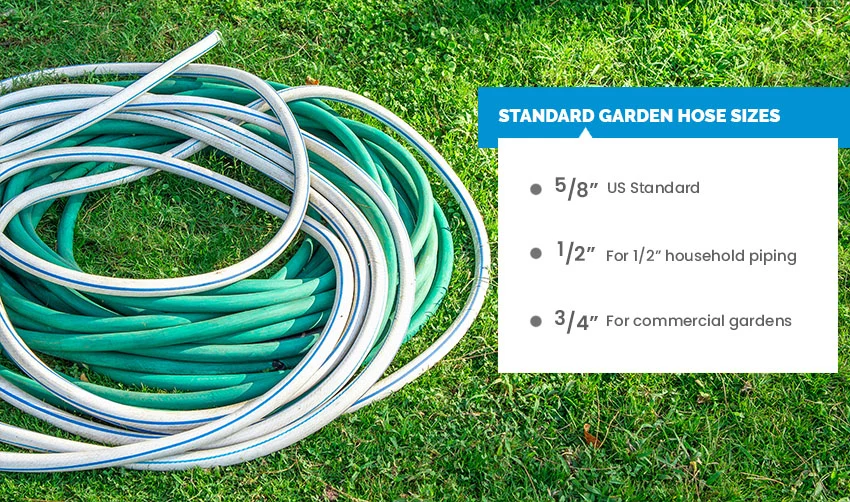
Image source: Bing (Web (fair-use with source credit))
What Hose Diameter Actually Controls (And Why Most People Get It Wrong)
Diameter is the inside width of the hose, the actual channel water flows through. Outer width includes the wall material, so two hoses can look the same from the outside and behave very differently. A larger inner diameter moves more water per minute, and crucially, it loses less pressure over distance.
The physics here are simple but stubborn. Water rubbing against the inside of the hose creates friction, and friction builds with distance. Run a 1/2 inch hose 100 feet and you can lose a third of your pressure before the water reaches the nozzle.
Step up to 5/8 inch and that loss drops noticeably. Go to 3/4 inch and pressure loss over the same run is minor.
Most of the frustration we see in user reviews traces back to two recurring mistakes:
- Buying the lightest, cheapest hose without checking the actual inner diameter
- Using a 1/2 inch hose to feed a high-demand tool like a sprinkler system or pressure washer
A 5/8 inch hose is the de facto residential standard for good reason. It balances flow, weight, and storage size. But "standard" doesn't mean "right for you." Your water pressure, hose length, and end use all shift the answer.
The Three Conditions That Decide 1/2 vs 5/8 vs 3/4 Inch
Before you pick a hose, figure out where you fall on three variables. They drive the entire decision.
1. Available Flow at the Spigot (GPM)
Gallons per minute is the real currency here. A typical US home gets 6 to 12 GPM at the outdoor spigot. If you're on a low-pressure well or a rural line, you might be limited to 4 to 6 GPM.
No hose diameter can create more water than your spigot delivers, but the wrong diameter can waste what you have.
The quick test: time how long it takes to fill a 5-gallon bucket from the spigot with the hose fully open.
| Fill Time | Approx. GPM |
|---|---|
| Under 25 seconds | 12+ GPM (strong) |
| 25 to 50 seconds | 6 to 12 GPM (typical) |
| Over 50 seconds | Under 6 GPM (low) |
If you're in the low range, a 3/4 inch hose won't help much, because the spigot is the bottleneck. If you're in the strong range, a 1/2 inch hose will throttle you.
2. Hose Run Length
Length magnifies every weakness. The longer the hose, the more friction loss piles up, and the smaller the original diameter, the worse that loss gets.
A rough rule of thumb for residential pressure:
- Under 25 feet: any diameter works for hand watering
- 25 to 50 feet: 1/2 inch starts to struggle with sprinklers
- 50 to 100 feet: 5/8 inch is the safe minimum
- Over 100 feet: 3/4 inch preserves usable pressure
Manufacturer specs confirm that friction loss in a 1/2 inch hose can exceed 15 PSI over 100 feet at 6 GPM. A 3/4 inch hose under the same conditions loses closer to 2 PSI.
3. What's Connected at the End
The end use sets the flow demand. A watering wand barely needs 2 GPM. A rotary sprinkler wants 4 to 8 GPM.
A pressure washer can demand 4 to 10 GPM depending on the model. Drip irrigation runs on less than 1 GPM per zone but suffers badly from pressure drop.
| End Use | Typical GPM Demand | Best Diameter |
|---|---|---|
| Hand watering / watering wand | 1 to 3 GPM | 1/2 or 5/8 inch |
| Oscillating or rotary sprinkler | 4 to 8 GPM | 5/8 or 3/4 inch |
| Drip irrigation | Under 2 GPM | 5/8 inch (main line) |
| Pressure washer (light duty) | 3 to 5 GPM | 5/8 inch |
| Pressure washer (heavy duty) | 6 to 10 GPM | 3/4 inch |
| Filling pools or tanks | High volume | 3/4 inch |
How to Measure Your Real Flow and Pressure at the Spigot
Guessing leads to the wrong hose. Spend five minutes testing, and you'll know exactly which diameter fits. Here's the workflow our research has found to be the most reliable, and the one most university extension services recommend for irrigation planning.
Step 1: Do the Bucket Test for GPM
You need a 5-gallon bucket and a stopwatch.
- Make sure no other water is running in the house.
- Open the outdoor spigot fully with no hose attached.
- Place the bucket under the flow and start timing the moment water hits the bucket.
- Stop timing the moment the bucket fills.
- Divide 300 (seconds in 5 minutes) by your fill time in seconds. That's your GPM.
Example: 40 seconds to fill 5 gallons = 300 / 40 = 7.5 GPM.
This is the single most useful number in the whole process. Anything downstream of the spigot cannot exceed it.
Step 2: Check Static Pressure
Static pressure is the pressure in your line when no water is moving.
- Borrow or buy an inexpensive pressure gauge that screws onto a hose bib.
- Screw it on with no water running anywhere.
- Open the spigot fully and read the gauge.
Most homes land between 40 and 60 PSI. Below 40 PSI is considered low, and any hose diameter will feel weak. Above 60 PSI is strong, and you'll benefit more from a larger hose because you'll have the pressure to push water through it.
The University of Minnesota Extension notes that outdoor spigot pressure is often 10 to 20 PSI lower than indoor fixtures because of elevation and pipe run length. Worth knowing if your indoor reading is borderline.
Step 3: Estimate Friction Loss for Your Planned Run
Once you know GPM and hose length, you can estimate pressure loss for each diameter. The numbers below are drawn from standard fluid dynamics tables used in irrigation design.
| Diameter | 50 ft, 6 GPM | 100 ft, 6 GPM | 100 ft, 10 GPM |
|---|---|---|---|
| 1/2 inch | ~8 PSI loss | ~16 PSI loss | ~40+ PSI loss |
| 5/8 inch | ~3 PSI loss | ~6 PSI loss | ~15 PSI loss |
| 3/4 inch | ~1 PSI loss | ~2 PSI loss | ~5 PSI loss |
If your static pressure is 50 PSI and you're losing 16 PSI through a 100-foot 1/2 inch hose, you're delivering roughly 34 PSI to the nozzle. Most sprinklers want at least 30 PSI to throw properly. You're right on the edge.
A 5/8 inch hose under the same conditions delivers around 44 PSI, well within the working range.
Image source: Bing (Web (fair-use with source credit))
Decision Branch: Which Diameter Fits Your Situation
Here's the decision logic, in plain if/then form. Start at the top and work down.
If your spigot delivers under 5 GPM
You're flow-limited, and no hose diameter will fix that. A 5/8 inch hose gives you the best balance of pressure retention and weight. Skip the 3/4 inch.
The extra width won't create water that isn't there.
If your spigot delivers 5 to 10 GPM (most homes)
This is where the choice actually matters. Ask two follow-up questions:
Is your longest run under 50 feet?
- Yes, and you're mostly hand watering: 1/2 inch is fine. It's lighter, cheaper, and easier to coil.
- Yes, but you run sprinklers regularly: go 5/8 inch for the extra flow headroom.
Is your longest run 50 feet or more?
- Yes, and you run one tool at a time: 5/8 inch still works for most setups.
- Yes, and you split to two or more zones with a manifold: step up to 3/4 inch. Splitters multiply friction loss because you're pushing the same water through more openings.
If your spigot delivers 10+ GPM
You have strong supply. A 1/2 inch hose is now actively working against you, throttling flow and pressure at every joint. Go 5/8 inch as a minimum, and 3/4 inch if you have long runs or high-demand tools.
If you own a pressure washer
Check the manual. Most residential electric pressure washers want at least 5/8 inch supply, and gas-powered units over 3,000 PSI typically spec a 3/4 inch inlet hose. Undersizing here is a common cause of pump cavitation, which is where the washer pulses and loses pressure because it can't draw water fast enough.
Manufacturer documentation for major pressure washer brands consistently flags hose diameter as a warranty-relevant spec, as of 2026.
If you water a large yard (1 acre or more)
You're likely running multiple sprinkler zones, long hose runs, or both. Aggregate user feedback and extension service guidance point to 3/4 inch as the practical minimum for properties this size, especially if you use a traveling sprinkler or a high-flow impact sprinkler.
Matching Diameter to What You're Running (Sprinklers, Pressure Washer, Drip, Hand Watering)
The tool at the end of the hose sets the floor for what diameter you need. Going below that floor means weak performance, no matter how good your water pressure is.
Sprinklers
Oscillating and impact sprinklers want 4 to 8 GPM and at least 30 PSI at the head to throw properly. A 5/8 inch hose handles a single sprinkler on a 50-foot run in most homes. If you run two sprinklers off a splitter, the math shifts fast.
Two zones pulling 5 GPM each means 10 GPM through a 5/8 inch hose, and friction loss spikes. A 3/4 inch hose keeps both zones fed without one starving the other.
Traveling sprinklers are the hungriest residential option. They routinely need 8+ GPM and long runs, so 3/4 inch is the practical pick.
Pressure Washers
Pressure washers are flow-sensitive in a way most people underestimate. The pump needs a certain GPM to feed the nozzle, and if the supply hose can't deliver it, the pump cavitates. That's the pulsing, pressure-loss symptom that wears out seals over time.
Most electric pressure washers (around 1,800 to 2,200 PSI) spec a 5/8 inch inlet hose minimum. Gas-powered units above 3,000 PSI almost always want 3/4 inch. Manufacturer documentation for these machines calls out the required supply hose diameter explicitly, because warranty claims tied to cavitation damage are common.
As of 2026, this guidance hasn't changed across the major brands.
Drip Irrigation
Drip systems run on low flow, often under 1 GPM per zone. Diameter matters less for the drip tubing itself and more for the main supply line. A 5/8 inch hose works fine as a feed to a drip manifold, even on a long run, because the flow demand is so low.
A pressure regulator at the manifold does the real work.
Hand Watering and Watering Wands
A watering wand or a trigger nozzle barely uses 2 GPM. Here, a 1/2 inch hose is genuinely enough, and the weight savings matter if you're carrying it around the yard. The catch: if you ever want to swap that wand for a sprinkler without changing hoses, you'll be disappointed.
Pick the diameter for the most demanding tool you expect to use, not the lightest one.
Manifolds and Splitters
A 4-way manifold splits one spigot into four outlets, but the total flow is still capped by what comes out of the spigot. A 1/2 inch hose feeding the manifold becomes the choke point. Use a 3/4 inch supply hose to the manifold, then step down to 5/8 inch for individual runs if you want.
Mistakes That Wreck Performance Even With the Right Diameter
Picking the right diameter is only half the battle. A few recurring mistakes can undo the benefit entirely.
Mistake 1: Trusting the Label Without Checking the Spec
Some hoses labeled "5/8 inch" actually measure closer to 1/2 inch inside. This is a known issue flagged in aggregate user reviews. The outer diameter is consistent, but the wall thickness eats into the inner channel.
Always check the manufacturer's published spec sheet, not the box.
Mistake 2: Using Old, Kinked Hose Sections
A hose that kinks repeatedly has internal damage. The inner wall deforms and narrows the channel. A kinked 5/8 inch hose behaves like a restricted 1/2 inch.
Replace it, or cut out the damaged section with a repair coupling.
Mistake 3: Mixing Diameters Without Adapters
Coupling a 3/4 inch hose to a 1/2 inch hose without a proper adapter creates a flow bottleneck at the joint. The water squeezes through the smaller fitting and loses pressure right there. If you need to mix diameters, use a stepped adapter and keep the larger hose on the supply side.
Mistake 4: Ignoring Washers and Couplings
A worn rubber washer at the spigot can leak enough pressure to mimic an undersized hose. Swap the washer (a 50-cent part) before you replace the hose. The same goes for cracked plastic couplings that leak under pressure.
Mistake 5: Running a Hose Through Full Sun Without Checking Pressure
Water temperature inside a black hose sitting in the sun can climb 20 to 30 degrees above ambient. Hot water is less dense and slightly slower-moving, but more importantly, it expands the hose wall very slightly and changes the pressure reading. If your pressure feels off in midday, test again in the morning before you blame the diameter.
Mistake 6: Buying Diameter You Don't Need
A 3/4 inch hose on a 25-foot run for hand watering is overkill. It's heavier, stiffer, and harder to coil. The extra flow doesn't help when the nozzle is the throttle.
Match the hose to the task, not to the biggest possible spec.
Quick-Reference: At-a-Glance Diameter and Flow Specs
Here's a tight reference table for the numbers you'll use most often. Manufacturer specs and standard fluid dynamics tables both confirm these ranges.
| Diameter | Typical Flow Capacity | Best For | Avoid If |
|---|---|---|---|
| 1/2 inch | 6 to 9 GPM | Hand watering, short runs, light use | Long runs, sprinklers, pressure washers |
| 5/8 inch | 10 to 14 GPM | Most homes, single-zone sprinklers, electric pressure washers | High-demand tools, manifolds with 3+ zones |
| 3/4 inch | 15 to 20+ GPM | Large yards, gas pressure washers, multi-zone manifolds, long runs | Low-flow situations where weight becomes a burden |
Friction loss at 6 GPM over 100 feet, summarized:
- 1/2 inch: roughly 16 PSI lost
- 5/8 inch: roughly 6 PSI lost
- 3/4 inch: roughly 2 PSI lost
If your spigot reads 50 PSI static, a 100-foot 1/2 inch hose delivers about 34 PSI to the nozzle. A 5/8 inch under the same conditions delivers 44 PSI. A 3/4 inch delivers 48 PSI.
That gap is the difference between a sprinkler that throws 20 feet and one that throws 35.
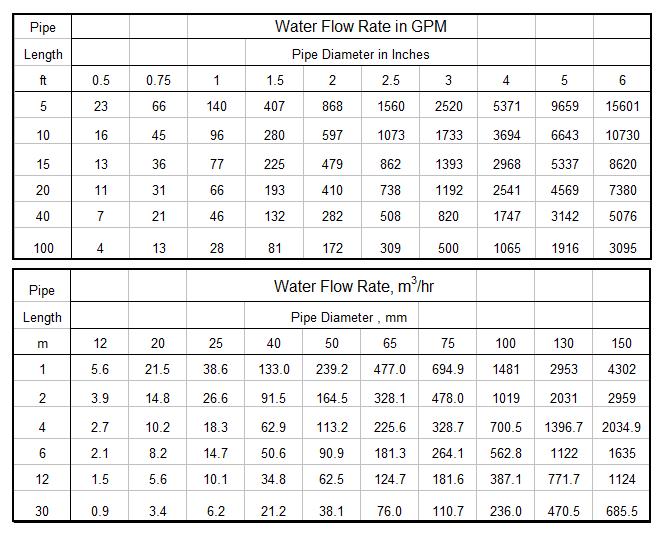
Image source: Bing (Web (fair-use with source credit))
Frequently Asked Questions
Does a bigger garden hose diameter increase water pressure?
No, diameter doesn't create pressure. It preserves it. Pressure is set by your home's supply.
A larger hose reduces friction loss over distance, so more of your original pressure reaches the nozzle, but the spigot pressure stays the same.
What size garden hose do I need for a pressure washer?
Most electric pressure washers up to 2,200 PSI work with a 5/8 inch hose. Gas-powered units over 3,000 PSI typically need 3/4 inch. Check the washer's manual, because undersizing the supply hose can cause pump cavitation and long-term damage.
Is 5/8 inch hose enough for a sprinkler?
For a single sprinkler on a run under 75 feet, yes. Beyond that, or with two sprinklers on a splitter, step up to 3/4 inch to avoid pressure drop that cuts throw distance.
Can I connect a 1/2 inch hose to a 3/4 inch spigot?
Yes, with a standard reducing adapter. The adapter is usually brass and screws onto the spigot. Just know that the smaller hose becomes the bottleneck downstream of the adapter.
Why does my hose have low pressure even with a new nozzle?
The most common cause is undersized diameter for the run length, especially with 1/2 inch hose past 50 feet. The second most common cause is a worn spigot washer. Check that first, since it's a 50-cent fix.
How do I know my hose's true inner diameter?
Measure the opening at the coupling with calipers, or check the manufacturer's spec sheet. The label on the box usually reflects inner diameter, but quality variation means measuring is worth the minute it takes.

Similar Posts