How to Identify Dollar Spot in Fescue Grass
Lead Turfgrass & Lawn Care Specialist at Totally Green Lawn · Certified Turfgrass Specialist (CTS), Master Gardener, B.S. in Agronomy & Turf Science · 14+ years in residential turf management, organic fertilization, and weed science
If you're staring at small straw-colored patches in your fescue lawn and wondering what's going on, the answer is probably right under your feet. The exact steps for how to identify dollar spot in fescue grass come down to three checks: look at single blades for bleached lesions, look for cobweb-like mycelium at dawn, and rule out look-alike diseases before treating. Most homeowners miss it at first because it mimics drought stress or fertilizer burn.
Dollar spot thrives when nighttime temps stay between 60 and 85°F and leaf wetness stretches past 10 to 12 hours, which lines up with late spring through early fall in the transition zone. As of 2026, university extension services still flag it as the most common disease of cool-season turf, including tall and fine fescues. Once you know the signs, the whole lawn tells the story.
Quick Answer
Dollar spot in fescue shows up as straw-colored, hourglass-shaped lesions on individual grass blades. Small sunken patches, usually 1 to 2 inches wide, dot the lawn before merging into larger bleached areas. White cobweb-like mycelium appears in the early morning.
Disease pressure peaks between 60 and 85°F with extended leaf wetness.
What Dollar Spot Actually Looks Like in Fescue (And Why It's Easy to Misread)
Dollar spot is sneaky because it doesn't start as a disaster. It shows up as tiny, pale dots scattered across an otherwise healthy-looking fescue lawn. Many homeowners walk past it for weeks, assuming it's just dry weather or a dog spot.
The disease is caused by the fungus Clarireedia jacksonii (formerly called Sclerotinia homoeocarpa). It infects the leaf tissue of cool-season grasses, and fescue, especially tall fescue and certain fine fescues, sits high on the menu. The fungus doesn't kill the crown or roots right away, which is why the lawn looks half-okay even as damage spreads.
Why it's so often misread: the early symptoms look like ten other things at once. A light nitrogen deficiency. A dry patch.
A chemical spill. Even grub or mole cricket damage. Without a closer look at the blades themselves, you'll guess wrong more often than not.
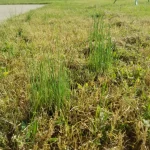
Here's a photo of what dollar spot looks like on a fescue-type turf, for reference:
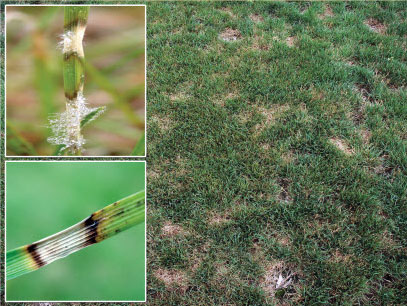
The thing that trips most people up is scale. Dollar spot starts small. A 1-inch wide straw-colored circle barely registers when you're mowing.
By the time patches merge into 6-inch or larger bleached areas, the disease has usually been active for two or three weeks.
The Key Visual Cues: Blades, Patches, and the Telltale Mycelium
You don't need a lab to confirm dollar spot. You need decent eyes, a little patience, and the right timing. Three visual cues do almost all the diagnostic heavy lifting: blade lesions, patch shape, and early-morning mycelium.
Blade Lesions: The Hourglass Tell
Get down low and pinch a few suspect blades. Healthy fescue blades are uniformly green. Dollar spot blades tell a different story: they develop straw-colored or bleached lesions that wrap around the blade in a distinctive hourglass or bow-tie shape.
The borders of these lesions are often reddish-brown, almost rust-toned.
In fescue, the lesion usually starts near the leaf tip and works downward. The upper portion of the blade turns tan or white while the lower portion stays green, which gives the patch a "frosted" look from a few feet back. Per university extension research, individual lesions run about 1/8 to 1/4 inch wide, but they often run the full length of the blade.
Here's a close-up of those lesions on infected grass:
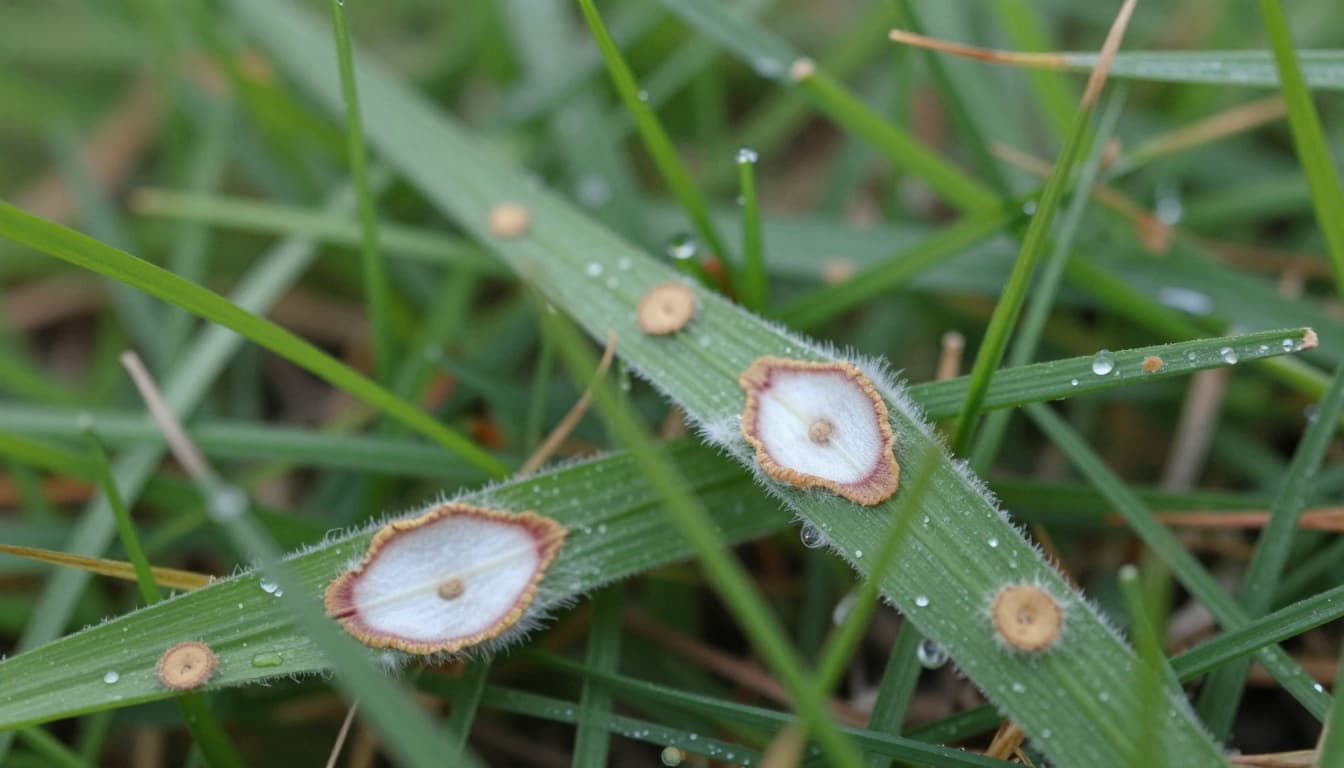
This blade-level check is the single most reliable way to separate dollar spot from drought stress, which turns whole blades uniformly brown without that sharp lesion border.
Patch Shape and Size: Small, Sunken, Scattered
Look down at the lawn from a standing position. Dollar spot patches are:
- Small and roughly circular, 1 to 2 inches across at first
- Slightly sunken or "scalped" compared to surrounding turf
- Scattered across the lawn like a coin was tossed in the grass
- Tan, white, or straw-colored, never dark brown or black
As the disease progresses, those tiny circles merge. Coalesced patches can stretch 6 inches or more and take on irregular, blotchy shapes. The bleached color stays light.
If you see dark brown or greasy-looking patches, you're probably looking at brown patch or Pythium instead.
The fescue within an active patch often has a "spider-web" appearance before sunrise. That's the mycelium, and it's the next big clue.
The Dawn Mycelium Check
This is the cue most people miss because they aren't out in the yard at 5:30 a.m. When dew forms and the air is still, the dollar spot fungus pushes cottony white mycelium up through the infected blades. It looks a bit like spider silk lying across the grass.
Walk the lawn at first light with a flashlight. If you see that web-like growth, the disease is active right now, not just a leftover scar from earlier in the season. The mycelium disappears within an hour or two after the sun hits it, so timing matters.
A midday check will turn up nothing even when disease pressure is severe.
If you see no mycelium but still suspect dollar spot, sample a few infected blades, place them in a plastic bag with a damp paper towel, and leave the bag at room temperature for 24 to 48 hours. Active Clarireedia jacksonii will often produce visible mycelium inside the bag. University turfgrass programs still use this "incubation test" as a low-cost confirmation method.
| Visual Cue | What You See | Why It Matters |
|---|---|---|
| Blade lesion | Hourglass bleached area, reddish-brown margins | Confirms fungal infection, not drought |
| Patch size | 1–2 inch circles, then coalescing | Distinguishes from large patch diseases |
| Patch color | Straw, tan, or white | Rules out brown patch (dark) and Pythium (greasy) |
| Mycelium | White cobweb at dawn | Proves active infection right now |
| Patch depth | Slightly sunken | Sets it apart from surface-only stress |
How to Tell Dollar Spot Apart From Brown Patch, Pythium, and Drought Stress
This is where most identification attempts fall apart. The four most common "things wrong with fescue in summer" all produce brown patches. The differences are in the details, and those details decide what you do next.
Here's a side-by-side comparison to keep handy while you scout:
| Disease or Stress | Patch Color | Patch Size | Blade Symptoms | Mycelium |
|---|---|---|---|---|
| Dollar spot | Straw / white / tan | 1–2 in, then merged | Hourglass lesions, red-brown borders | White cobweb at dawn |
| Brown patch | Dark brown to smoky | 6 in to several feet | Tan lesions with dark borders, no hourglass | Grayish ring at edge in morning |
| Pythium blight | Greasy, dark, water-soaked | Rapid, irregular streaks | Matting, slimy collapse | White cottony in high humidity |
| Drought stress | Uniform tan, no spots | Whole lawn or dry areas | Whole blade brown, no lesion pattern | None |
| Rust | Orange powder on blades | Diffuse yellowing | Orange pustules rub off on shoes | None |
Per university extension diagnostics, the three most useful separators are:
- Patch color: dollar spot is light and bleached. Brown patch is dark and smoky. Pythium looks wet and greasy.
- Blade pattern: only dollar spot gives you that hourglass lesion with red-brown borders. Other diseases either coat the whole blade or create different lesion shapes.
- Mycelium timing: dollar spot mycelium appears at dawn and burns off. Brown patch mycelium appears as a grayish "smoke ring" at the patch edge. Pythium mycelium shows up later in the day under hot, humid conditions.
For a quick visual comparison, here's a reference image showing the differences:
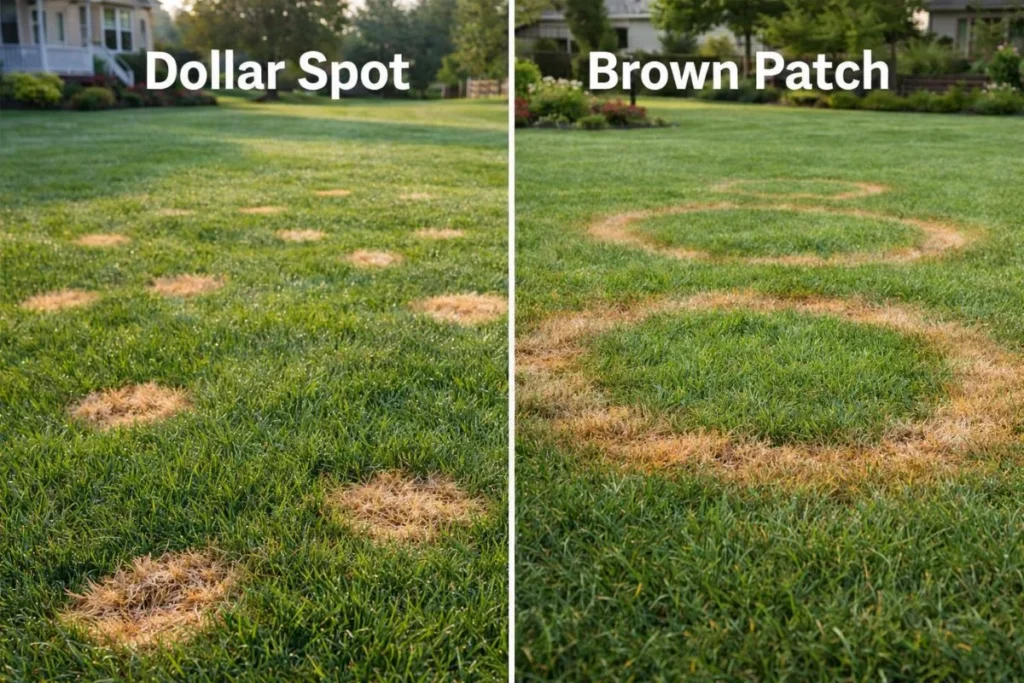
If you're still unsure after the field check, the bag incubation test I mentioned earlier is a strong tiebreaker. Active Clarireedia jacksonii will push out mycelium within a day or two. Brown patch and Pythium need different conditions and usually don't show up the same way in a bag test.
When and Where Dollar Spot Hits Fescue Hardest
Identification is easier when you know the disease is even on the table. Dollar spot isn't a year-round threat. It follows weather, and it loves specific lawn conditions.
Temperature and Moisture
The fungus activates when nighttime temps stay above 50°F and peaks between 60 and 85°F. That window lines up with late spring, summer, and early fall across most of the transition zone, basically the Mid-Atlantic, Southeast, and lower Midwest where fescue is the go-to cool-season lawn.
Moisture is the other trigger. Dollar spot needs leaf wetness for 10 to 12+ continuous hours to infect new tissue. Long nights, heavy dew, late-afternoon thunderstorms, and frequent irrigation all feed it.
Lawns that get watered every evening are rolling out the red carpet.
Fescue-Specific Risk Factors
Within fescue lawns, a few conditions crank up disease pressure:
- Low nitrogen fertility: dollar spot thrives in underfed turf. The classic symptom is a lawn that greened up nicely in spring but ran out of nitrogen by midsummer.
- Compact soil and thatch over 1/2 inch: both hold moisture against the leaf, extending leaf wetness hours.
- Mowing too short: anything under 2.5 inches in summer stresses fescue and slows recovery.
- Poor air movement: lawns surrounded by fences, hedges, or buildings stay humid longer.
- Shaded pockets: dew lingers in the shade long after sunny areas dry out.
In our research on university extension guidance from schools like NC State, Penn State, and Purdue, the same pattern keeps showing up: dollar spot pressure is heaviest in the first three to five days after a stretch of humid nights, especially on lawns that are dry, low on nitrogen, and mowed tight.
Step-by-Step: How to Scout Your Fescue Lawn and Confirm Dollar Spot
Now that you know what dollar spot looks like, the next step is a clean, repeatable scouting routine. Set aside 15 to 20 minutes. Pick a window with extended leaf wetness in the forecast for the best results.
Step 1: Scout at First Light
Get out before the sun climbs above the trees. Walk a slow zigzag pattern across the lawn, stopping every 10 to 15 feet. Look down for pale, sunken spots.
Look across the lawn for bleached patches that stand out from the surrounding green. Bring a flashlight and a small hand lens if you have one.
If you have time, photograph any suspect patches from standing height and again at ground level. That second image is what helps with blade-level ID later.
Step 2: Check the Blades
Drop to one knee at the edge of a suspect patch. Pinch a few infected blades and pull them free. Healthy fescue blades should be uniformly green.
Dollar spot blades show the hourglass lesion, with bleached centers and reddish-brown borders. The infected blade may be tan from the tip partway down, with a sharp line where the green healthy tissue begins.
If you don't see lesions but the patch is clearly bleached, sample anyway. Sometimes the lesions have merged into a fully tan blade as the disease advanced.
Step 3: Look for Mycelium
While you're still on the ground, tilt your head and look across the patch from a low angle. The mycelium is easier to see that way, especially with morning sun behind you. Look for fine white threads between blades, like a thin spider web.
If the sun is already up and the dew is gone, the mycelium may have burned off. Move to step 4.
Step 4: Run the Incubation Test (Optional but Strong)
Grab 5 to 10 infected blades. Place them in a sealable plastic bag with a damp paper towel. Seal the bag and leave it at room temperature, somewhere between 65 and 75°F.
Check at 24 and 48 hours.
If Clarireedia jacksonii is active, you'll see fuzzy white mycelium growing on the blades. This is the same diagnostic technique turfgrass pathologists use when they need a quick confirmation without a microscope.
Step 5: Map and Document
Mark the affected areas on a quick sketch of your lawn. Note the approximate patch size, the date, and recent weather. If the disease shows up in the same spots year after year, you'll have a head start on next season's prevention.
A simple table for your records might look like this:
| Date | Patch Location | Patch Size | Blade Lesions? | Mycelium? | Weather Last 3 Days |
|---|---|---|---|---|---|
| 7/14 | Back yard, near oak | 4 spots, 1–2 in | Yes, hourglass | Yes, 6 a.m. | Humid nights, 68°F low |
| 7/22 | Front, east side | 6 spots, merged | Yes | No, sun already up | Heavy dew, 72°F low |
This kind of record makes future scouting faster and helps you decide whether cultural changes are working.
What to Do (and Not Do) Once You've Identified Dollar Spot
Once you've confirmed dollar spot, the goal shifts from identifying to interrupting. The pathogen survives in thatch and soil, so the fastest way to slow it down is to change the conditions that let it thrive. Cultural changes come first, fungicides come second.
Start with nitrogen. Dollar spot pressure is tightly linked to low fertility. A light feeding of 0.5 to 1.0 pound of nitrogen per 1,000 square feet, using a quick-release source, often greens the lawn up enough that the fungus loses ground.
Many extension trials show visible recovery within 10 to 14 days once nitrogen is back in play.
Next, reset your irrigation. Water deeply but infrequently, and time it for early morning, before sunrise. The goal is to finish irrigation well before dusk so leaf wetness doesn't stretch past 10 hours overnight.
Avoid the classic mistake of light, daily evening watering. That's an open door for Clarireedia jacksonii.
Mow at the high end of the fescue range, around 3 to 3.5 inches during summer. Taller grass shades the soil, slows dew formation, and recovers faster from infection. Sharpen the blade.
Torn leaf tips take longer to heal and give the fungus more entry points.
If the disease is widespread or weather stays humid for another week or more, a fungicide may be the right call. Products containing iprodione, propiconazole, or fluxapyroxad are commonly used on residential fescue. Per EPA registration labels, always follow the rate, reentry interval, and any pet or child safety notes on the label.
For commercial applicators, state pesticide licensing rules apply.
A few things to avoid once you've identified dollar spot:
- Don't keep mowing short to "clean up" the patches. It stresses the grass and spreads the fungus.
- Don't water in the evening, even if the lawn looks dry.
- Don't bag and compost infected clippings. Bag and dispose of them, or mow when dry so clippings blow off the patch.
A practical decision flow looks like this:
| Situation | First Action | Add If Needed |
|---|---|---|
| A few small spots, lawn otherwise healthy | Light nitrogen + reset irrigation | Spot fungicide if spreading |
| Many spots, lawn already thin | Nitrogen + irrigation + mowing height | Full fungicide application |
| Outbreak during extended humid stretch | All cultural fixes at once | Preventive fungicide program |
| Recurring every summer in same spots | Annual nitrogen plan + thatch reduction | Preventive fungicide in late spring |
Frequently Asked Questions
How early can you spot dollar spot in fescue?
You can usually catch it within a few days of infection, but only if you're scouting at the right time. The first reliable sign is the dawn mycelium, followed quickly by 1-inch straw-colored circles. By the time patches are obvious from across the lawn, the disease has often been active for two to three weeks.
Can dollar spot kill fescue permanently?
It can thin the lawn badly, but it usually does not kill the crown or roots. Fescue can recover in a single growing season with the right nitrogen, mowing, and irrigation changes. Severe, repeated outbreaks without intervention can leave thin patches that invite weeds or require overseeding to fill back in.
Is the white stuff on my fescue in the morning always dollar spot?
No. Other fungi, including Pythium species and some harmless saprophytes, can also produce visible mycelium at dawn. The combination of mycelium plus the hourglass blade lesion plus the small sunken patch is what locks in dollar spot.
Mycelium alone is a clue, not a confirmation.
What's the fastest way to tell dollar spot from brown patch in fescue?
Check the patch color and the blade lesions. Dollar spot is straw-colored with hourglass lesions and reddish-brown borders. Brown patch is dark brown or smoky, with lesions that have dark borders but no hourglass shape.
Brown patch patches also start much larger, often 6 inches or more across on day one.
Does dollar spot come back in the same spots every year?
Often yes. The fungus survives in thatch and soil, and the same microclimate, low spots, shaded corners, or compacted zones, will flare up year after year. That's why mapping the affected areas in your scouting notes pays off.
You can target those spots with preventive nitrogen and mowing changes before next season's humidity arrives.
🚜 Agronomist Recommended: Dethatching & Disease Management Tools
Combat thatch suffocating your turf and stop rapid fungal spread with tested maintenance equipment and systemic fungicides:
- Electric Power Dethatcher & Scarifier:Check Electric Dethatchers & Scarifiers on Amazon →
- Broad-Spectrum Systemic Fungicide:Check Scotts DiseaseEx Lawn Fungicide on Amazon →
*FTC Disclosure: As an Amazon Associate, Totally Green Lawn earns from qualifying purchases.*

Similar Posts