Kill Creeping Charlie Without Harming Your Lawn
Lead Turfgrass & Lawn Care Specialist at Totally Green Lawn · Certified Turfgrass Specialist (CTS), Master Gardener, B.S. in Agronomy & Turf Science · 14+ years in residential turf management, organic fertilization, and weed science
Learning how to kill creeping charlie without killing grass comes down to matching your control method to your grass type, timing the treatment right, and fixing the conditions that let it take hold in the first place. Most homeowners lose this battle because they grab the wrong product, spray at the wrong time of year, or never address the thin, shady lawn that invited the weed in the first place. Get those three pieces right and you can wipe out creeping charlie while your turf stays green.
The species you're fighting is Glechoma hederacea, a perennial in the mint family that spreads by creeping stolons and shallow rhizomes. Fall is the single best window for chemical control, because the plant translocates herbicides down into its root system when soil temps sit between 50 and 60°F. We'll walk through how to pick the right approach for your lawn, when to spray, and what to do afterward so creeping charlie doesn't come back next spring.
As of 2026, university extension services across the Upper Midwest and Northeast still recommend the same core strategy, so you're working with a well-tested playbook.
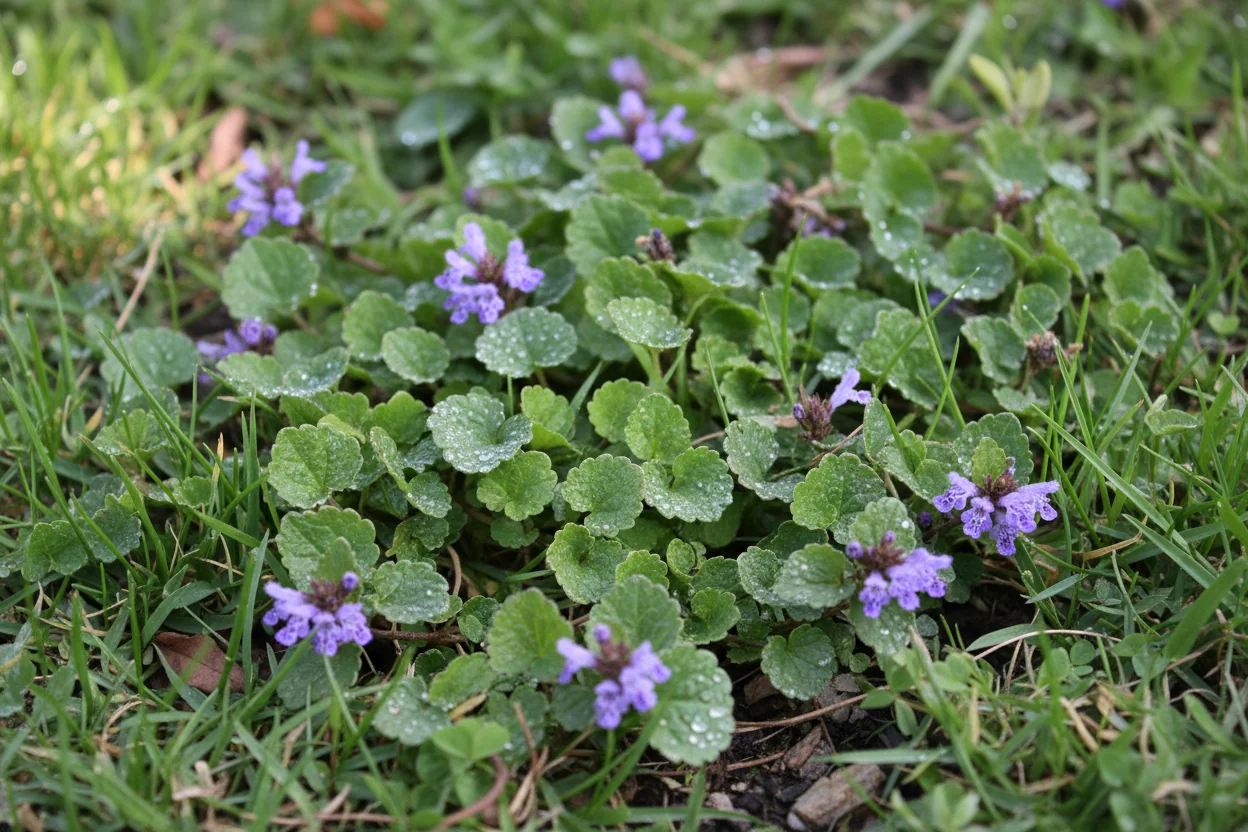
Image source: Bing (Web (fair-use with source credit))
Quick Answer
Kill creeping charlie without harming your grass by using a selective broadleaf herbicide. Triclopyr is the most grass-safe active ingredient. Apply in fall when soil temps hit 50 to 60°F.
Spot-treat, don't broadcast. Then thicken your turf to prevent regrowth.
First, Figure Out What You're Dealing With (and Why It's There)
Before you spray anything, confirm the plant is actually creeping charlie. It has scalloped, kidney-shaped leaves with rounded toothed edges, square stems (a giveaway that it's in the mint family), and small purple-blue funnel-shaped flowers that show up in spring. It hugs the ground in dense mats and throws a distinctive minty smell when you mow or crush the leaves.
Creeping charlie spreads two ways: by seed and by creeping stolons that root at every node. A single broken stem fragment left in the soil can restart a patch, which is why half-measures usually fail. It also thrives where grass struggles: shaded spots, compacted soil, low-mowed turf, and lawns with poor fertility.
Ask yourself three questions before picking a method:
- How big is the infestation? A few small patches need a different plan than a yard-wide takeover.
- What's your grass type? Cool-season grasses like Kentucky bluegrass, perennial ryegrass, and fescue tolerate most selective herbicides. Warm-season grasses like Bermuda and zoysia are more sensitive.
- How much shade and compaction do you have? These are the underlying conditions you'll need to fix or the weed returns.
If you skip this step, you'll spend money on the wrong product, at the wrong time, on the wrong grass. That's the most common reason DIY control fails.
Your Grass Type Changes Everything
This is the decision branch most guides skip, and it's the one that decides whether your lawn survives. Selective broadleaf herbicides target dicots (broadleaf weeds) and spare monocots (grasses), but tolerance levels vary by species and by active ingredient.
Cool-season grasses (Kentucky bluegrass, perennial ryegrass, tall fescue, fine fescues) handle the standard selective herbicides well. Triclopyr, dicamba, and 2,4-D are all options here, and a three-way blend containing all three is the most common retail formulation. University extension services like the University of Minnesota Extension consistently recommend triclopyr as the go-to for creeping charlie because it translocates into the rhizomes more effectively than 2,4-D alone.
Warm-season grasses (Bermuda, zoysia, St. Augustine, centipede) need more caution. Some selective herbicides, especially dicamba, can yellow or thin Bermuda and zoysia.
If you're in the transition zone or South, spot-treat with triclopyr only, lower the rate, and avoid spraying during peak summer heat when warm-season turf is already stressed.
| Grass Type | Safe Selective Options | Caution |
|---|---|---|
| Kentucky bluegrass | Triclopyr, 2,4-D, dicamba, three-way blends | Lowest risk, most flexible |
| Perennial ryegrass | Triclopyr, 2,4-D, dicamba | Tolerates all standard selective herbicides |
| Tall fescue | Triclopyr, 2,4-D, dicamba | Generally safe at label rates |
| Fine fescue | Triclopyr at reduced rate | More sensitive, spot-treat only |
| Bermuda | Triclopyr only, low rate | Avoid dicamba, avoid heat |
| Zoysia | Triclopyr at reduced rate | Spot-treat, watch for yellowing |
| St. Augustine | Avoid most selective herbicides | Use targeted triclopyr only, test first |
If you don't know your grass type, take a close-up photo and compare it to extension-service identification guides, or contact your local cooperative extension office for help. Mislabelling your turf is how you end up with dead patches where your lawn used to be.
Pick the Right Method for Your Situation
The right method depends on your tolerance for chemicals, the size of the infestation, and how much lawn you have. Here's the decision branch:
If the infestation is small (under 10 sq ft) and you're patient: Hand-pull after a rain when soil is soft. Grab low at the base and pull slowly to bring up the rhizomes. You'll still miss fragments, so plan on repeat pulls every 2 to 3 weeks through the growing season.
This works best when you're also about to renovate the area with seed or sod.
If the infestation is moderate to large and you want a chemical-free approach: Smother it. Mow the area short, water it, then cover with heavy landscape fabric, black plastic, or thick cardboard topped with mulch. Leave it covered for one full growing season (spring through fall).
This kills top growth and most rhizomes, though deep fragments can survive.
If you want the most reliable chemical control: Spot-treat with a triclopyr-based selective herbicide. Use a pump sprayer for precision, or a foam applicator for individual stems in sensitive areas. Spray until leaves are wet but not dripping, and avoid runoff onto desirable plants.
If you want the fastest, most aggressive approach and you're okay with collateral damage: Spot-spray with a non-selective herbicide like glyphosate, accepting that you'll kill a circle of grass around each treatment. You'll need to reseed or sod those spots afterward. Use this only when the weed has overtaken the grass beyond saving.
If you have kids, pets, or pollinator concerns: Stick to spot treatments of selective herbicide, apply when bees aren't foraging (early morning or evening), and keep pets off the treated area until it dries. The label's re-entry interval is the legal minimum, not a suggestion.

Image source: Bing (Web (fair-use with source credit))
A common DIY mistake is using borax. Older sources recommend it, and you can still find articles claiming it works. The problem is that borax doesn't kill creeping charlie selectively.
At the rates that actually work on the weed, it also damages surrounding turf and lingers in the soil for years, creating a dead zone where nothing grows. University extension services now warn against borax for this reason. Skip it.
Step-by-Step: How to Kill Creeping Charlie Without Killing Your Grass
Here's the workflow, from prep to follow-up. The order matters, and so does the timing.
Step 1: Identify the weed and your grass type. Don't skip this. If you're not sure, contact your local cooperative extension office and ask. Most misapplications come from misidentification.
Step 2: Time the application for fall, after the first light frost. Soil temperatures between 50 and 60°F trigger creeping charlie to pull nutrients (and herbicide) down into its root system for winter. Spring is a secondary window, but you'll get partial kill because top growth dominates and translocation is weaker.
Step 3: Raise your mowing height to 3 to 3.5 inches before you spray. Taller grass shades the soil, outcompetes creeping charlie seedlings, and reduces stress on the turf. Mow 2 to 3 days before application so the weed has fresh leaf surface to absorb the herbicide.
Step 4: Mix and apply the selective herbicide per label directions. For triclopyr, you're typically looking at a foliar application at 0.5 to 1.0 lb acid equivalent per acre for spot treatments. Add a non-ionic surfactant (check the label) to help the herbicide penetrate the waxy leaf surface. Use a pump sprayer for precision, and spray until leaves glisten but don't drip.
Step 5: Avoid rain for 24 hours and don't mow for 2 to 3 days afterward. The herbicide needs time to translocate into the roots. Mowing too soon strips the treated leaves off before translocation completes.
Step 6: Wait 7 to 14 days for visible symptoms. Leaves will curl, yellow, and brown. Don't rush the second application.
Step 7: Spot-treat survivors 3 to 4 weeks after the first pass. Some patches will regrow from deep rhizomes you didn't kill the first time. Walk the lawn and hit only the green regrowth, not the whole area. A second broadcast application usually does more harm than good.
Step 8: Overseed thin or dead spots in early fall or early spring. Once the weed is controlled, bare soil is an open invitation for the next weed. Rake, seed at the recommended rate for your grass type (typically 4 to 6 lb per 1,000 sq ft for Kentucky bluegrass), and keep it moist until germination.
| Timing Factor | Target |
|---|---|
| Soil temperature | 50 to 60°F (fall) |
| Time of day | Early morning or late evening |
| Rain-free window | 24 hours after application |
| Mowing before | 2 to 3 days |
| Mowing after | Wait 2 to 3 days |
| Re-treatment interval | 3 to 4 weeks |
| Visible kill | 7 to 14 days |
If you follow this sequence in fall, you'll get 80 to 90% control. The remaining 10 to 20% gets handled by the cultural practices in the next section.
Mistakes That'll Wreck Your Lawn (and Bring Creeping Charlie Back)
Even with the right product and timing, a few common errors can ruin the whole job. Here are the ones our research shows trip people up most often.
Spraying in spring and expecting a full kill. Spring applications work, but only on top growth. The plant's energy is moving upward, not down into the rhizomes. You'll see leaves curl and brown, then the plant regenerates from the roots within weeks.
Fall is the only window that delivers consistent root kill.
Using a non-selective herbicide like glyphosate and hoping grass will fill back in. It won't, at least not before the creeping charlie does. Glyphosate kills everything green, and the bare soil left behind is a perfect seedbed for the next round of weeds, including more creeping charlie. If you go this route, plan to reseed or sod immediately.
Mowing too soon after application. Mowing within 48 hours of treatment strips the leaves before the herbicide translocates fully. You've basically wasted the spray.
Skipping the surfactant. Creeping charlie leaves are waxy. Without a surfactant, the herbicide beads up and rolls off. Check the product label, but most triclopyr applications benefit from a non-ionic surfactant at 0.25 to 0.5% of spray volume.
Treating in summer heat. Warm-season grasses are already stressed in July and August. Adding herbicide on top of heat stress yellows the turf and slows recovery. Fall timing avoids this entirely.
Ignoring the underlying conditions. If your lawn is thin, shady, and compacted, the creeping charlie will come back no matter how well you sprayed. The next section covers how to fix that.
Keeping Creeping Charlie Gone for Good
Killing the existing plants is only half the job. The other half is making your lawn the kind of place creeping charlie doesn't want to grow. This is where most homeowners give up too early, and it's why the same yards get reinfested year after year.
Mow High, Water Deep, Feed Smart
Creeping charlie thrives at low mowing heights because it gets more sunlight at the soil surface. Raise your mower to 3 to 3.5 inches for cool-season grasses. Taller grass blades shade the soil, cool the roots, and crowd out weed seedlings before they establish.
Watering matters just as much. Light, frequent watering trains grass roots to stay shallow, which weakens the turf. Switch to deep, infrequent watering, about 1 inch per week delivered in one or two sessions.
This forces grass roots to grow deep, where they outcompete creeping charlie's shallow rhizomes.
Fertilization should match your grass type and region. Cool-season grasses do best with fall nitrogen applications, around 2 to 3 lb of actual nitrogen per 1,000 sq ft split across September and November. Skip the heavy spring feeding, which pushes top growth at the expense of roots.
Fix Shade, Compaction, and Drainage
Creeping charlie is a shade indicator. If it's winning, your grass is losing the light battle. Prune tree canopies to let more sun through, or replace struggling grass in deep shade with shade-tolerant groundcovers or mulch beds.
Compacted soil is the second invitation. Aerate cool-season lawns in fall, either with a core aerator that pulls plugs or a spike aerator for lighter work. Core aeration is more effective.
Follow up with overseeding to fill the holes before weeds can.
Poor drainage creates the moist, low-oxygen conditions creeping charlie loves. If water puddles in spots, topdress with compost or regrade to move water away from problem areas.
Overseed to Fill the Gaps
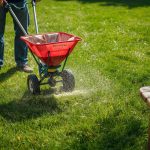
Bare soil is the enemy. After your fall herbicide treatment, overseed thin or dead spots within 2 to 3 weeks. Use a seed mix matched to your existing grass, and keep the area moist until germination.
A thick turf canopy is the single best long-term defense against creeping charlie and most other broadleaf weeds.
Image source: Bing (Web (fair-use with source credit))
A yearly walk-through in early fall to spot-treat any new creeping charlie plants keeps the population from rebuilding. One or two spot treatments a year is much easier than fighting a full invasion again.
Frequently Asked Questions
Will vinegar kill creeping charlie without harming grass?
Household vinegar (5% acetic acid) burns top growth but doesn't reach the rhizomes, so the plant regrows. Horticultural vinegar (20 to 30%) kills more彻底 but also damages grass and soil biology on contact. Neither gives selective control.
Use a triclopyr-based selective herbicide instead for grass-safe results.
How long does it take to completely kill creeping charlie?
Visible damage shows up in 7 to 14 days after a fall application. Full rhizome kill takes 2 to 4 weeks, and a second spot treatment at 3 to 4 weeks handles survivors. Plan on one full growing season to get a heavy infestation under control.
Is borax really effective against creeping charlie?
Older sources recommend it, but university extension services no longer endorse borax for creeping charlie control. The amount that kills the weed also damages surrounding turf and persists in soil for years. Stick with selective herbicides or manual and cultural methods.
Can I kill creeping charlie in spring instead of fall?
Yes, but expect partial control. Spring applications hit top growth when the plant's energy is moving upward, so rhizomes often survive. If you must spray in spring, do it early before flowering, and plan a follow-up fall application for full root kill.
Will creeping charlie come back after I kill it?
Almost always, unless you fix the conditions that let it in. Thin turf, shade, compaction, and low mowing heights all invite reinfestation. Mow high, overseed thin spots, aerate compacted areas, and spot-treat new plants each fall to keep it gone.
Is creeping charlie safe for pets to walk on after treatment?
The plant itself is non-toxic, but the herbicide requires a re-entry interval, typically 24 to 48 hours, until the spray dries. Check the product label for the specific interval and keep pets off treated areas until it's safe to walk on.
🚜 Agronomist Recommended: Dethatching & Disease Management Tools
Combat thatch suffocating your turf and stop rapid fungal spread with tested maintenance equipment and systemic fungicides:
- Electric Power Dethatcher & Scarifier:Check Electric Dethatchers & Scarifiers on Amazon →
- Broad-Spectrum Systemic Fungicide:Check Scotts DiseaseEx Lawn Fungicide on Amazon →
*FTC Disclosure: As an Amazon Associate, Totally Green Lawn earns from qualifying purchases.*

Similar Posts