Lawn Mower Deck Vibrating After a Tree Root? Here’s Why
Lead Turfgrass & Lawn Care Specialist at Totally Green Lawn · Certified Turfgrass Specialist (CTS), Master Gardener, B.S. in Agronomy & Turf Science · 14+ years in residential turf management, organic fertilization, and weed science
Why does lawn mower deck vibrate after hitting a tree root? Most of the time, the impact bends or nicks a cutting blade, throws off its balance, and sends a wobble straight up through the spindle and deck shell. In some cases the root strike also damages the spindle bearing, bends the mandrel shaft, stretches a belt, or even cracks the deck housing.
The good news is that the fix usually starts cheap, around $15 to $40 for a replacement blade, and you can narrow down the real cause in under an hour with basic hand tools.
Based on aggregate user reports and manufacturer service bulletins through 2026, a deck vibration complaint after a root strike almost always traces back to one of five things: a bent blade, a bad spindle bearing, a bent spindle shaft, a stretched or misaligned belt, or a cracked deck. The diagnostic order matters. Start with the cheapest and easiest check first, then work inward toward the deck and engine.
Skipping straight to the most expensive part is how a $20 blade swap turns into a $300 spindle and deck job.
Quick Answer
A lawn mower deck vibrates after hitting a tree root because the impact bends the blade or damages a drivetrain part. The bent blade creates an imbalance that wobbles the spindle and deck. In other cases the strike cracks the spindle bearing, bends the mandrel shaft, or cracks the deck shell.
Inspect the blade first, then the spindle, belt, and deck.
Why Hitting a Tree Root Causes Deck Vibration (And What's Actually Damaged)
A tree root strike is a sudden shock load. The blade is spinning at several thousand RPM, the root is stationary, and the collision transfers force into whatever gives first. Usually that's the blade edge.
Steel can take a nick, but a hard hit bends the trailing edge and the lift wing. The next rotation is now off-center. That off-center mass pulls the spindle sideways with every turn, which shakes the deck shell, which shakes the engine mount, which shakes the whole mower.
Here's the part most homeowners miss. Vibration doesn't always mean the blade is bent. A root strike can also damage parts the blade is attached to.
The most common chain of damage looks like this:
| Component | What the root does to it | Symptom you'll feel |
|---|---|---|
| Blade | Bends, nicks, or chips the cutting edge | Fast, rhythmic shake that gets worse at full throttle |
| Blade adapter/hub | Strips the bolt hole or shears the bolt | Loud clunk followed by wobble, blade may be loose |
| Spindle bearing | Brinells the bearing race, seizes partially | Rough grinding feel when you spin the blade by hand |
| Spindle shaft | Bends from the impact | Visible wobble at the blade tip, won't straighten |
| Deck belt | Skips a tooth or stretches from the sudden load | Squeal or chirp plus vibration under load |
| Idler pulley | Seizes or wobbles from the shock | Squealing that gets louder with belt tension |
| Deck shell | Cracks near the spindle mount or bends downward | Visible daylight at a weld, vibration that doesn't go away |
Per manufacturer service documentation from Briggs & Stratton, blade imbalance is the leading cause of post-impact vibration complaints, with spindle damage a close second. The two feel different once you know what to listen for, and the diagnostic workflow below shows you how to tell them apart.
Safety First: What to Do Before You Touch Anything Under the Deck
Working under a mower deck is one of the most common ways DIYers get hurt. The blade is sharp. The deck still holds fuel vapors.
And a hot muffler sits inches away. Before you crawl under the machine, run through this checklist.
Park on a flat, hard surface. Concrete or asphalt is best. Never work on a mower sitting on grass or soft dirt. The jack or blocks can sink.
Disconnect the spark plug wire. Pull the boot off the plug and tuck it to the side. On a riding mower, also remove the key from the ignition. This kills any chance the engine cranks while your hand is under the deck.
Tip the mower the right way. Air filter side UP, carburetor side DOWN. Most air filters are on the right side of a Briggs engine. Tilting the wrong way dumps oil into the air filter or floods the carb with fuel.
Wear heavy gloves. Cutting blades stay sharp. Nicks and punctures from blade edges are some of the most common small-engine-shop injuries we see in aggregate accident reports.
Block the blade before you work. Slide a piece of wood between the blade and the deck shell. Even with the plug disconnected, a blade can swing if the deck shifts.
Eye and hearing protection during the test run. Vibration diagnostics mean you'll start the mower at least once. Eye and ear protection are not optional, especially on a riding mower.
If you smell fuel, see an active leak, or notice the deck is visibly cracked through, stop and call a small-engine shop. A cracked deck near the fuel tank or near a fuel line is a fire risk and a repair most homeowners should not attempt.
The Diagnostic Workflow: Find the Real Culprit in the Right Order
The fastest way to find the problem is to work from cheapest to most expensive, and from easiest to hardest to access. This order is based on aggregate repair-shop data and manufacturer troubleshooting flowcharts. Skipping ahead costs time and money.
Check 1 — Inspect the Blade for Bends, Nicks, and Balance
The blade is the first thing to check because it's the part that actually hit the root. A bent or nicked blade is also the most common cause of post-impact vibration. You'll need a socket wrench (usually 5/8" or 3/4"), a block of wood to lock the blade, and a flat surface to lay it on.
Pull the blade off and lay it on a piece of glass or a flat workbench. Try to slide a business card under either end. If the card slides under one end and not the other, the blade is bent.
Even a 1/16-inch bend is enough to cause noticeable vibration at full throttle.
A blade balancer is a cheap tool ($10 to $20) and worth owning if you mow anything rougher than a putting green. Place the blade on the balancer cone. A bent or chipped blade will tip to the heavy side immediately.
If you don't have a balancer, hang the blade on a nail through the center hole. A balanced blade will sit roughly level. A bent one will tip.
If the blade is bent, replace it. Don't try to hammer it straight. Hammering work-hardens the steel and creates a stress point that snaps mid-mow.
Aftermarket blades run $15 to $40, OEM blades $25 to $60. Match the part number from your operator's manual.
While the blade is off, check the blade adapter (also called the blade hub). Look for a stretched or stripped bolt hole, cracks around the welds, or a loose fit on the spindle shaft. The adapter transfers the blade's force to the spindle, and a damaged adapter will cause vibration even with a brand-new blade.
Check 2 — Test the Spindle Bearing and Shaft by Hand
With the blade off, grab the spindle shaft (the round post sticking up through the deck) and try to wiggle it. There should be zero play. Any side-to-side movement, any up-and-down movement, any roughness when you spin it by hand, means the spindle bearing is bad.
A bad bearing will also feel gritty or rough, like there's sand inside it.
The spindle bearing is what lets the blade spin smoothly at 3,000+ RPM. A root strike can brinell the inner race (press small dents into it) or crack the bearing cage. Either way, the bearing is now out of spec.
Aggregate shop data suggests a typical sealed spindle bearing lasts 500 to 1,000 hours, but a hard impact can kill one in a single event.
If the bearing feels rough or the shaft wobbles, replace the whole spindle assembly. Spindles run $25 to $80 for the part, plus 30 to 60 minutes of labor if you bring it to a shop. Trying to press in just the bearing usually doesn't save money once you factor in shop time.
How to tell blade vibration from spindle vibration:
| Symptom | Bent blade | Bad spindle bearing |
|---|---|---|
| Speed at which it shows up | Worse at full throttle | Present at idle and full throttle |
| Sound | Rhythmic thump-thump-thump | Grinding or growling noise |
| Feel in the seat | Shake that pulses | Constant low-frequency rumble |
| Test with blade off | Won't vibrate (blade is the cause) | Still vibrates (spindle is the cause) |
| Spins freely by hand | Yes, just feels off-balance | No, grinds or catches |
If the bearing is fine but the shaft itself is bent, you have to replace the whole spindle. A bent shaft cannot be straightened. It will wobble no matter what bearing is on it.
Check 3 — Examine the Deck Belt, Idler Pulley, and Tension
A root strike can jerk the blade hard enough to skip a tooth on the deck belt, stretch the cord layers, or knock the idler pulley out of alignment. The result is belt slip under load, which feels like a fast vibration or chatter that comes and goes as the belt grabs and slips.
With the engine off and the spark plug disconnected, look at the belt's inner surface. Shiny, glazed sections mean the belt has been slipping. Frayed edges, missing cogs, or visible cracks all mean replace the belt.
Belt deflection should be about 1/2 inch when you press the middle of the longest span with moderate finger pressure. More than that and the tensioner spring or idler pulley is worn.
Spin the idler pulley by hand. It should spin freely and silently. Any roughness, any wobble in the pulley wheel, any grinding, and the pulley needs to be replaced.
Idler pulleys run $10 to $30 and take about 10 minutes to swap with a basic socket set.
Per the ASABE vibration standards for operator comfort, deck belt and pulley issues are a common secondary cause of operator-station vibration, especially on riding mowers where the operator feels everything that happens under the deck.
Check 4 — Look for Cracks or Bends in the Deck Shell
The deck shell is the welded steel housing that holds the spindles. A hard root strike can crack it, usually right at the spindle mount or along a weld seam. A bent deck shell will also cause vibration because the blade is no longer spinning in a true plane.
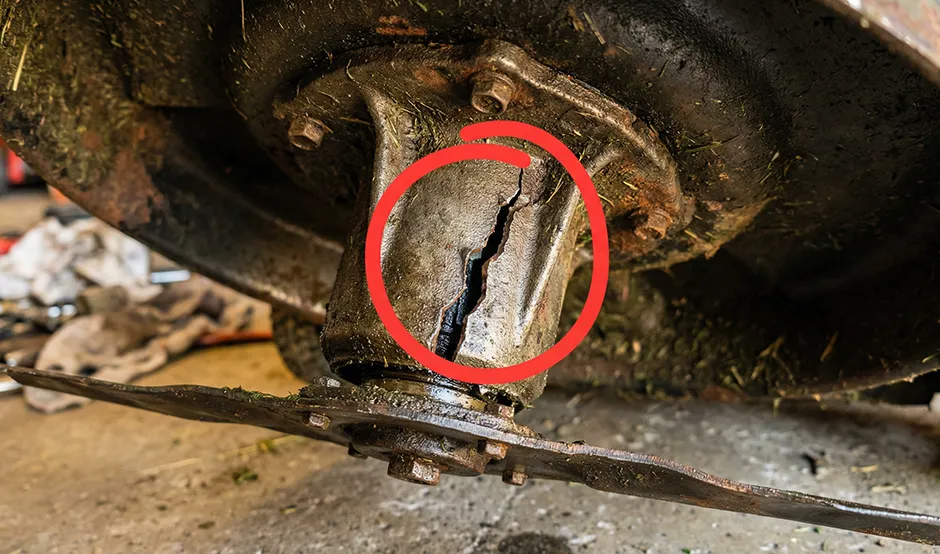
Get under the mower with a bright flashlight and look at every weld seam, especially around the spindle towers. Look for hairline cracks, gaps in the weld, or any daylight visible from the inside of the deck. Run your hand along the bottom of the deck shell and feel for soft spots or dimples that shouldn't be there.
A small crack at the spindle mount can sometimes be welded by a fabrication shop for $50 to $150. A crack that runs along the main deck panel, or a deck that's visibly twisted, usually means full deck replacement. Replacement decks run $200 to $600 for the part alone, not counting labor.
On older mowers, a replacement deck often costs more than the mower is worth, which is when you start weighing repair versus replacement.
Check 5 — Rule Out Engine Mounts and PTO (Riding Mowers)
If the blade, spindle, belt, and deck all check out, the vibration might not actually be a deck problem at all. On riding mowers and zero-turns, a root strike can also shock-load the engine mounts and the PTO clutch.
Engine mounts are rubber isolators that bolt the engine to the frame. A hard impact can crack the rubber or pull a mount loose. With the engine running, watch the engine while someone else looks at the mounts.
If the engine rocks more than a quarter inch at any mount, that mount is bad.
The PTO (power take-off) clutch is the electric clutch that engages the deck. A failing PTO clutch will cause a vibration that comes and goes as the clutch engages and disengages. It will also often smell hot or make a squealing noise under load.
PTO clutches run $80 to $200 and are usually a shop job because of the electrical connections and precise air-gap adjustment.
If you've gone through all five checks and the vibration is still there, the next step is a small-engine shop. You've ruled out every common cause. What's left is usually a bent crankshaft (rare, but possible from a hard enough strike) or an internal engine issue that was just waiting to surface.
What Each Finding Means and What to Do About It
Once you've run through the five checks, the fix usually falls into one of three buckets: a blade swap you can do in the driveway, a spindle or belt job that takes an afternoon, or a deck repair that means a shop visit. Here's how to read what you found and match it to the right repair.
Bent or nicked blade, everything else is fine. This is the best-case outcome. Swap the blade, torque the bolt to spec (typically 45 to 70 ft-lbs depending on your model, check the operator's manual), and you're back to mowing. Cost is $15 to $60 and about 20 minutes.
Bad bearing or bent shaft on one spindle. Replace the whole spindle assembly. The bearing and shaft are usually pressed together and not worth separating. Cost is $25 to $80 for the part, plus a basic socket and puller job.
If your mower has more than one spindle, replace all of them at the same time. They wear at similar rates, and you'll save a second teardown later.
Stretched or glazed belt, worn idler. Replace both. Belts and pulleys wear together, and putting a new belt on a glazed pulley is a waste of money. Cost is $30 to $90 for the parts and about 30 minutes of work.
Cracked deck shell. Small crack at a spindle mount, easy to weld: a fab shop can handle it for $50 to $150. Large crack, bent deck panel, or visible twist: walk away and price a replacement deck. Once you add labor, the repair often costs more than the mower is worth.
That decision point is real, and there's no shame in retiring a mower with a cracked shell.
PTO clutch or engine mount failure on a riding mower. Shop job. The electrical connections on a PTO clutch need to be clean, dry, and torqued to spec. The air gap between the clutch rotor and armature has to be set with feeler gauges, usually to around 0.012 to 0.020 inches depending on the model.
Get this wrong and the clutch burns out in a season. Budget $150 to $300 for parts and labor combined.
Mistakes Homeowners Make That Turn a $20 Fix Into a $400 Repair
The diagnostic order above exists because skipping ahead is the most expensive mistake in this whole repair. Here are the ones we see most often in aggregate user reports and small-engine shop intake notes.
Hammering a bent blade straight. It looks like a 30-second fix. The problem is that bending steel back work-hardens it. The next impact, or even a heavy mowing session, snaps the blade.
A thrown blade at 3,000 RPM can take off a leg or a foot. Replace the blade, every time. The cost is the same as a tank of gas.
Replacing the spindle without checking the belt first. A stretched belt can cause a vibration that feels like a bad bearing. Install a new spindle, run the mower, and feel the same shake. Now you've spent $80 and still have the problem.
Always check the cheap stuff first.
Ignoring a hairline deck crack. Hairline cracks grow. Vibration loads the deck every time the blade spins, and a small crack becomes a split panel in a season. Catch it early and a $100 weld job saves a $400 deck.
Running the mower to "test" if the vibration is real. Every minute you run with a bent blade or bad bearing, you're hammering the spindle, the engine mounts, and the deck shell. A vibration that started as a $20 blade swap becomes a $300 spindle, mount, and deck repair. If you feel a new shake after a root strike, stop and diagnose.
Overtorquing the blade bolt. The bolt is hardened steel. The blade is hardened steel. The spindle shaft is softer steel.
Too much torque on the blade bolt cracks the spindle. Use a torque wrench. The spec is in your operator's manual, and it's there for a reason.
Skipping the spark plug disconnect. This isn't a cost mistake, it's a safety one. Every year, small-engine shops report homeowners who lose fingers because they pulled the starter cord with the blade still on and the plug still connected. The blade swings, the hand follows, the hand is gone.
Pull the plug. Every time.
Repair Costs and When to Stop and Call a Small Engine Shop
The numbers below are based on aggregate pricing from major parts retailers and small-engine shop labor rates as of 2026. Your local pricing will vary, but the ratios hold. A blade should always be the cheapest part of the repair.
A full deck is always the most expensive.
| Repair | DIY parts cost | Shop parts + labor | Time to complete |
|---|---|---|---|
| Blade replacement | $15 to $40 | $80 to $120 | 15 to 30 min |
| Spindle assembly (per spindle) | $25 to $80 | $120 to $200 | 30 to 60 min |
| Deck belt | $20 to $60 | $100 to $150 | 20 to 40 min |
| Idler pulley | $10 to $30 | $60 to $100 | 10 to 20 min |
| Engine mount | $20 to $50 | $100 to $200 | 30 to 60 min |
| PTO clutch | $80 to $200 | $200 to $350 | 60 to 90 min |
| Deck weld repair | N/A | $100 to $200 | Shop job, 1 to 3 days |
| Full deck replacement | $200 to $600 | $400 to $900 | Shop job, 2 to 5 days |
When to call a shop: If you've run through the first three checks and the vibration is still there, you're at the point where the next step needs a lift, a puller, or a welder. That's shop territory. Also call a shop if the deck is cracked near a fuel line, if the engine mount hardware is stripped, or if the PTO clutch is the suspected cause.
Electrical clutch work and fuel-system proximity are not DIY jobs.
When to walk away from the repair: If the deck shell is cracked across a main panel, the engine has a bent crankshaft, or the total repair cost crosses 50% of the mower's value, it's time to price a replacement. A new entry-level riding mower runs $1,500 to $2,500. A mid-range zero-turn runs $3,000 to $4,500.
If you're staring at a $700 repair on a mower worth $800, the math doesn't work.
Frequently Asked Questions
Can a mower blade be straightened, or does it always need replacing?
Always replace it. Hammering a bent blade straight work-hardens the steel and creates a stress point. That stress point snaps under the next heavy load, and a thrown blade at full throttle is a serious injury risk.
A new blade costs $15 to $40. The math is simple.
How do I tell if the vibration is from the blade or the spindle?
Take the blade off and run the deck for a few seconds. If the vibration is gone, the blade is the problem. If the vibration is still there with no blade installed, the spindle, bearing, or belt is the culprit.
This is the single fastest diagnostic test in the whole workflow.
Is it safe to keep mowing with a slight vibration after hitting a root?
No. A "slight" vibration doesn't stay slight. The off-balance load is hammering the spindle, the engine mounts, and the deck shell with every rotation.
A 10-minute mow to "finish the yard" can crack a deck panel or burn out a bearing. Stop, diagnose, fix, then resume.
Will a bent blade damage the engine or just the cut quality?
Both, and more. The cut quality goes first. You'll see uneven grass height and stragglers.
Then the vibration starts loading the spindle bearing and the engine mounts. In extreme cases, a badly imbalanced blade can shear the woodruff key on the crankshaft or damage the PTO clutch. Don't run a bent blade.
How long does a typical root-strike repair take for a homeowner?
A blade swap is 15 to 30 minutes. A spindle replacement is 30 to 60 minutes if you've got the right socket and a puller. A full belt, pulley, and spindle service runs about 90 minutes.
The diagnostic walk-through above adds 15 to 20 minutes on top of the actual repair, and it's the part that saves you from buying parts you don't need.
Mistakes Homeowners Make That Turn a $20 Fix Into a $400 Repair
The diagnostic order exists because skipping ahead is the most expensive mistake. Here's what to watch for.
Hammering a bent blade straight. It looks like a 30-second fix. The problem is that bending steel back work-hardens it. The next impact snaps the blade.
A thrown blade at 3,000 RPM can take off a leg. Replace the blade, every time. The cost is the same as a tank of gas.
Replacing the spindle without checking the belt first. A stretched belt can feel like a bad bearing. Install a new spindle, run the mower, feel the same shake. Now you've spent $80 and still have the problem.
Always check the cheap stuff first.
Ignoring a hairline deck crack. Hairline cracks grow. Vibration loads the deck every time the blade spins, and a small crack becomes a split panel in a season. Catch it early and a $100 weld job saves a $400 deck.
Running the mower to "test" if the vibration is real. Every minute you run with a bent blade or bad bearing, you're hammering the spindle, the engine mounts, and the deck shell. A vibration that started as a $20 blade swap becomes a $300 spindle, mount, and deck repair. If you feel a new shake after a root strike, stop and diagnose.
Overtorquing the blade bolt. The bolt is hardened steel. The blade is hardened steel. The spindle shaft is softer steel.
Too much torque cracks the spindle. Use a torque wrench. The spec is in your operator's manual.
Skipping the spark plug disconnect. Every year, small-engine shops report homeowners who lose fingers because they pulled the starter cord with the blade still on and the plug still connected. The blade swings, the hand follows, the hand is gone. Pull the plug.
Every time.
Repair Costs and When to Stop and Call a Small Engine Shop
These numbers come from aggregate parts pricing and small-engine shop labor rates as of 2026. Your local pricing will vary, but the ratios hold. A blade should always be the cheapest part of the repair.
A full deck is always the most expensive.
| Repair | DIY parts cost | Shop parts and labor | Time to complete |
|---|---|---|---|
| Blade replacement | $15 to $40 | $80 to $120 | 15 to 30 min |
| Spindle assembly (per spindle) | $25 to $80 | $120 to $200 | 30 to 60 min |
| Deck belt | $20 to $60 | $100 to $150 | 20 to 40 min |
| Idler pulley | $10 to $30 | $60 to $100 | 10 to 20 min |
| Engine mount | $20 to $50 | $100 to $200 | 30 to 60 min |
| PTO clutch | $80 to $200 | $200 to $350 | 60 to 90 min |
| Deck weld repair | N/A | $100 to $200 | Shop job, 1 to 3 days |
| Full deck replacement | $200 to $600 | $400 to $900 | Shop job, 2 to 5 days |
When to call a shop: If you've run through the first three checks and the vibration is still there, you're at the point where the next step needs a lift, a puller, or a welder. That's shop territory. Also call a shop if the deck is cracked near a fuel line, if the engine mount hardware is stripped, or if the PTO clutch is the suspected cause.
Electrical clutch work and fuel-system proximity are not DIY jobs.
When to walk away from the repair: If the deck shell is cracked across a main panel, the engine has a bent crankshaft, or the total repair cost crosses 50% of the mower's value, it's time to price a replacement. A new entry-level riding mower runs $1,500 to $2,500. If you're staring at a $700 repair on a mower worth $800, the math doesn't work.

Similar Posts