Jump-Start a Dead Lawn Mower Battery With Jumper Cables
Lead Turfgrass & Lawn Care Specialist at Totally Green Lawn · Certified Turfgrass Specialist (CTS), Master Gardener, B.S. in Agronomy & Turf Science · 14+ years in residential turf management, organic fertilization, and weed science
A dead riding lawn mower battery can be a real headache, especially when you need to mow the lawn right now. Jump-starting with car jumper cables is one of the fastest ways to revive it, and yes, the same 12-volt system that powers your truck can also power a lawn tractor.
Most riding mowers use a 12V lead-acid battery rated between 150 and 350 cold cranking amps (CCA), which is well within what a standard car battery can supply. The key is matching the right steps to your specific situation. As of 2026, manufacturer guidance and Battery Council International (BCI) standards still support vehicle-to-mower jump-starting when the battery is healthy and the connections are correct.
Quick Answer
Yes, you can charge a dead riding lawn mower battery with car jumper cables. Park the car close without touching the mower. Connect red to the mower's positive (+) terminal.
? Agronomist & Shop Recommended: Battery Maintainers & Jumper Cables
To prevent dead cell sulfation and safely jump 12V lawn tractor batteries without starter solenoid arcing, use these calibrated electrical tools:
- Heavy-Duty Booster Cables:Check 10-Gauge Booster Jumper Cables on Amazon →
- Smart Battery Maintainer:Check 12V Smart Battery Trickle Chargers on Amazon →
*FTC Disclosure: As an Amazon Associate, Totally Green Lawn earns from qualifying purchases.*
Connect black to an unpainted metal ground on the mower. Idle the car for 2 to 5 minutes. Crank the mower in short bursts.
Disconnect in reverse order.
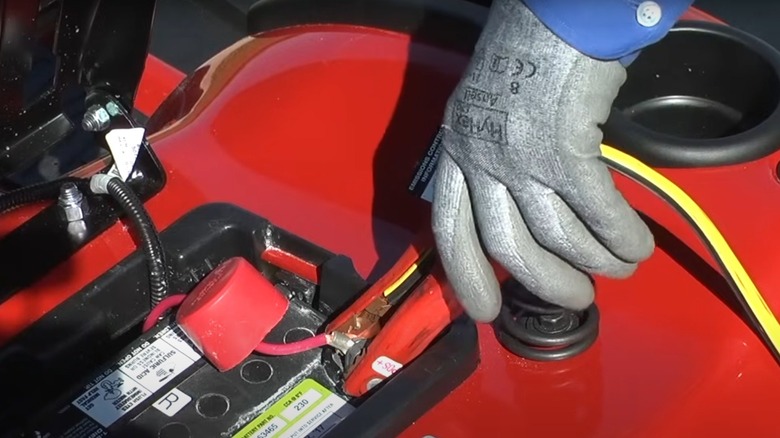
Image source: Bing (Web (fair-use with source credit))
Before You Touch the Cables: What Decides Whether This Will Work
Jump-starting a riding mower is not one-size-fits-all. The right move depends on the battery's condition, the mower's safety system, and the type of cables you have. Skip this quick check and you can waste time, fry electronics, or even crack a battery case.
Is the Battery Actually Dead, or Just Discharged?
There's a big difference between a battery that ran out of juice and one that's gone bad. A truly dead battery won't hold a charge no matter what you do. A deeply discharged one can come back fine after a jump.
Here's a quick way to tell:
| Symptom | Likely Cause | Can You Jump It? |
|---|---|---|
| Slow crank, lights dim | Deeply discharged | Yes, jump will work |
| Clicking sound, no crank | Severely discharged or bad solenoid | Try jump, then test battery |
| No response at all, clean terminals | Possible dead cell | Jump may fail |
| Cracked case, leaking acid, bulge | Physical damage | Do not jump, replace it |
| Frozen or swollen casing | Cold damage | Do not jump, replace it |
Check the Battery Condition First
Before grabbing the cables, look at the battery itself. A cracked case, white powdery corrosion, or a sulfur smell means trouble. Corrosion alone is fixable with a wire brush and baking soda.
A cracked case means stop and replace.
Voltage tells you a lot too. A healthy resting battery sits around 12.6 to 12.8 volts. Below 11.8 volts, it's deeply discharged.
Below 10.5 volts, you likely have a dead cell, and jumping will only give you a brief crank before it dies again.
Does Your Mower Have Safety Interlocks?
Most modern riding mowers won't crank unless certain conditions are met. The seat switch, brake pedal, and PTO (power take-off) lever all play a role. If any of these are failing, jumping won't help.
Our research shows that many "bad battery" complaints turn out to be bad safety switches. Wiggle the brake pedal, sit firmly, and make sure the PTO is off before assuming the battery is the problem.
What Cables Do You Need?
Standard 6-gauge or 4-gauge jumper cables work fine for most mowers. Lightweight 10-gauge cables can struggle because the resistance is too high. If your cables feel thin or the insulation is cracked, upgrade before you start.
A 12 to 20 foot length gives you enough reach to park the car without touching the mower. Mower seats, hoods, and fenders can scratch paint fast, so keep some distance.
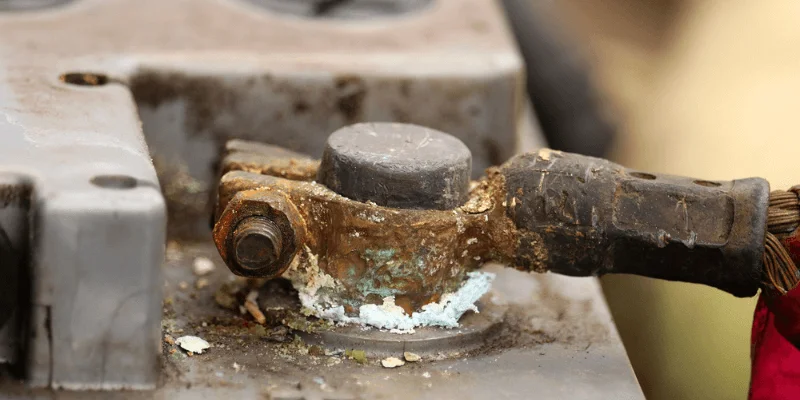
Image source: Bing (Web (fair-use with source credit))
The Step-by-Step Jump-Start Process (With Decision Branches)
This is where the actual work happens. Follow the order. Don't improvise.
Each step builds on the last, and a wrong move can cost you a battery, a cable, or a control module.
Step 1: Position the Vehicles
Park the donor car close enough that the cables reach, but never let the vehicles touch. Metal-to-metal contact can create a ground path that bypasses your cables and sends a surge through both electrical systems.
Turn off both engines. Remove the keys. Set the parking brake on the car.
Put the mower in neutral with the parking brake set.
Step 2: Identify the Terminals
Pop the mower's seat or hood to access the battery. Look for the (+) symbol or red cover on the positive terminal and the (-) symbol on the negative. If the labels are worn off, the positive post is usually slightly larger.
Wipe away any corrosion with a wire brush. Dirty terminals block current flow and make the whole process less effective.
Step 3: Make the Connections in the Right Order
This is the part most people get wrong. The order matters because it prevents sparks near battery gases.
- Red clamp to the mower's positive (+) terminal.
- Red clamp to the car's positive (+) terminal.
- Black clamp to the car's negative (-) terminal.
- Black clamp to an unpainted metal ground on the mower engine block, not the battery's negative post.
Manufacturer guidance from groups like BCI recommends grounding to the engine block because it keeps any spark away from battery gases. The hydrogen that lead-acid batteries release can ignite, and you don't want that happening next to an open cell.
Step 4: Charge Before You Crank
Start the donor car and let it idle for 2 to 5 minutes. This sends a gentle bulk charge into the mower battery through the alternator. Don't rev the engine high; a steady idle around 700 to 900 RPM is plenty.
If the mower battery is extremely low, give it the full 5 minutes. A short top-up won't build enough surface charge to crank the engine.
Step 5: Crank in Short Bursts
Turn the mower key to start for no more than 5 seconds. If it doesn't fire, wait 30 to 60 seconds and try again. Three or four attempts is the max before you risk overheating the starter.
If the engine turns over and starts, leave it running. Don't shut it off, or you may be stuck again with a battery that didn't get enough charge.
Step 6: Disconnect in Reverse Order
Once the mower is running, remove the cables in reverse:
- Black clamp from the mower ground.
- Black clamp from the car.
- Red clamp from the car.
- Red clamp from the mower.
Keep the clamps from touching each other or any metal surface during removal. A short here can blow a fuse or worse.
Decision Branch: What If It Still Won't Start?
If the mower clicks but doesn't crank, the battery is too weak or the terminals are still dirty. Try again after another minute of idle charging.
If you get nothing at all, check the ground clamp. A loose or painted connection won't carry current. Sand the contact point to bare metal.
If it still won't fire after three rounds of charging and cranking, the battery is likely done. Time for a replacement.
After the Mower Starts: Charging, Testing, and Knowing If the Battery Is Truly Dead
A successful jump is only half the job. Now you need to figure out whether the battery can hold a charge or if you're on borrowed time. Skipping this step means you might get stranded mid-mow next weekend.
Let the Mower Run to Top Off the Battery
Leave the mower running for at least 20 to 30 minutes. The mower's charging system, typically a 15 to 20 amp stator/alternator setup, will push current back into the battery. This isn't a full charge, but it builds enough reserve to start the engine again later.
Don't idle it in the garage. Lead-acid batteries off-gas hydrogen, and you want ventilation. Run it outside on the driveway.
Test the Resting Voltage
After shutting the mower off, wait 30 minutes for the surface charge to dissipate. Then check the voltage with a multimeter.
| Reading | What It Means |
|---|---|
| 12.6 to 12.8V | Fully charged, battery is healthy |
| 12.2 to 12.5V | Partially charged, may need more run time |
| 11.8 to 12.1V | Weak, likely won't hold a full charge |
| Below 11.8V | Battery is sulfated or has a dead cell |
What If the Voltage Drops Overnight?
This is the real test. A good battery holds its charge. A bad one loses 0.1 to 0.2 volts per day at most.
If your battery drops below 12.2 volts after sitting overnight, it's on its way out.
Sulfation is the most common killer of lead-acid batteries. It happens when a battery sits discharged for weeks or months, and crystals form on the plates. A slow trickle charge over 24 to 48 hours can sometimes reverse mild sulfation.
Severe cases need a new battery.
When to Replace Instead of Recharge
Replace the battery if you see any of these:
- Voltage below 12.0V after a full charge cycle.
- Visible bulging, cracking, or leaking.
- The mower struggles to crank even after 30 minutes of running.
- The battery is more than 4 to 5 years old.
AGM (absorbed glass mat) batteries are a common upgrade for riding mowers. They hold a charge longer, resist vibration better, and don't leak if tipped. Per most manufacturer specifications, they're a direct drop-in replacement for standard flooded lead-acid units.
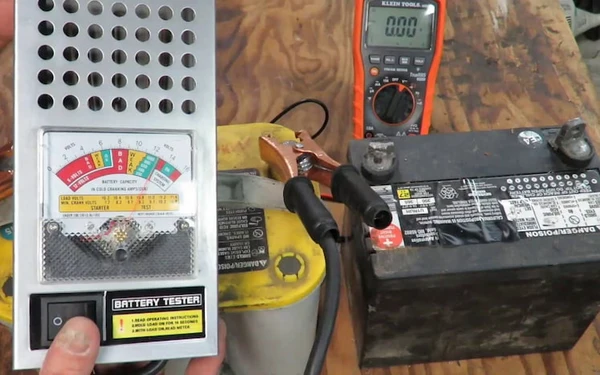
Image source: Bing (Web (fair-use with source credit))
Jump-Starting vs. The Alternatives: When a Car Is the Wrong Tool
Car jumper cables are fast, but they're not always the best choice. Depending on how dead the battery is and how much time you have, another method might serve you better.
Portable Jump Starters
A lithium jump starter pack is a popular alternative. These compact units hold enough charge to crank a small engine several times. They're safer than a car because there's no donor vehicle involved, and no risk of voltage spikes from a running alternator.
The downside is cost. A decent 1000-amp jump pack runs $60 to $120. For occasional use, that's a lot.
For frequent use, it's worth it.
Trickle Chargers
A 1 to 2 amp trickle charger is the gentlest way to revive a deeply discharged battery. It can take 24 to 48 hours, but it brings the battery back slowly and reduces the risk of overheating or warping the plates.
This is the best method if the battery was only mildly discharged and you have time. It's also better for battery longevity than a sudden jump.
Battery Maintainers
If your mower sits for months at a time, a battery maintainer (also called a float charger) is the smart long-term play. It monitors voltage and tops off the battery as needed without overcharging.
Per BCI maintenance guidelines, stored lead-acid batteries lose 1% to 5% of their charge per week. A maintainer prevents that slow drain and can extend battery life by years.
When to Skip the Jump Entirely
If the battery is frozen, cracked, or older than 5 years, don't bother jumping. A new battery runs $40 to $90 for most riding mowers, and installation takes about 10 minutes. That's cheaper than a service call and far less frustrating than repeated jump attempts.
For a broader look at small engine battery care, university extension services like University of Minnesota Extension offer solid, research-backed guidance on equipment storage and maintenance.
Mistakes That Fry Electronics, Blow Up Batteries, or Leave You Stranded
Most jump-start failures come from a handful of repeat mistakes. Skip these and the process goes smoothly. Make them and you can damage the mower, the car, or yourself.
Connecting in the Wrong Order
If you hook the negative clamp to the dead battery first, the last connection creates a spark right on top of the battery. Hydrogen gas loves sparks. The Battery Council International (BCI) and most owner manuals warn against this in plain language.
Always connect positive first, negative last. Disconnect in the reverse.
Using the Wrong Ground Point
Clamping the negative lead to the battery's negative post is the most common error. It works, sometimes, but it puts the spark hazard directly at the battery.
Move that black clamp to a clean, unpainted bolt on the engine block or mower frame. Same electrical effect, far less risk.
Cranking Too Long
Holding the key for 10 or 15 seconds floods the starter and overheats the windings. A brief 3 to 5 second crank with a 30 to 60 second rest is the safe pattern.
If it doesn't catch after four tries, stop. The battery or the starter is the real problem.
Skipping the Safety Gear
Battery acid burns skin. A shorted clamp arc can blind you. Safety glasses and nitrile gloves cost a few dollars and prevent the kind of injuries that end a Saturday fast.
Donor Car Mistakes
Don't rev the donor engine above 2000 RPM. The alternator pushes higher voltage at high RPM, which can spike the mower's electrical system. A steady idle is plenty.
Also, don't let the donor car sit connected for more than 10 minutes. Its battery can drain into a deeply discharged mower, leaving you with two dead vehicles.
Safety Rules You Don't Skip, Even If You're in a Hurry
Lead-acid batteries are simple chemistry, but that chemistry includes sulfuric acid and explosive hydrogen gas. Treat the battery with respect and you'll walk away with a running mower every time.
Ventilation Matters
Charging releases hydrogen, especially during a jump. An enclosed garage traps that gas. A single spark from a tool or a static charge can ignite it.
Work outside or in a well-ventilated open shed. Keep the area clear of gas cans, paint thinners, or anything flammable.
Watch for Heat and Swelling
If the battery gets hot to the touch, swells, or makes a hissing sound during the jump, stop immediately. These are signs of internal short or thermal runaway. Move the cables away and let the battery cool before you touch it.
Per OSHA general battery handling guidance, a bulging or hot battery is a disposal item, not a recovery item. Recycle it properly.
Keep Sparks Away
Don't lay the jumper cables across each other or on a metal surface while the other end is connected. A short circuit here is the same as sticking a screwdriver across the terminals.
Set the clamps on a clean rubber mat or a piece of cardboard while you work.
Disposal When the Battery Is Done
Lead-acid batteries are nearly 100% recyclable. Most auto parts stores, battery retailers, and even some mower dealers take old units for core credit. Per EPA battery recycling guidelines, never throw a lead-acid battery in the trash.
The lead, the plastic case, and the sulfuric acid all get reclaimed. It's one of the most recycled products in the U.S., with a return rate above 99% in regulated channels.
Frequently Asked Questions
Can a car battery damage a riding mower when jump-starting?
Yes, if you reverse the polarity. A standard car battery can push 400 to 800 amps, which will fry a mower's voltage regulator, solenoid, or stator in seconds if connected backward.
Always double-check the positive and negative markings before you clamp anything. A blown regulator runs $40 to $80, and that's the cheap failure mode.
How long should I let the donor car idle before trying to start the mower?
Two to five minutes is the standard window. This gives the mower battery enough surface charge to crank the starter motor.
In cold weather below freezing, give it the full five minutes. A cold battery accepts charge more slowly, and the engine oil is thicker, demanding more from the starter.
Will jump-starting a dead mower battery shorten its life?
A single jump won't kill a healthy battery. Repeated jump-starting a deeply discharged battery, however, accelerates sulfation and shortens lifespan.
If you find yourself jumping more than two or three times a season, the battery is failing. Replace it before it strands you mid-mow.
Can I jump-start a riding mower with a portable jump starter instead of a car?
Yes, and it's often the safer choice. A lithium jump pack rated at 1000 peak amps handles most riding mower batteries without any risk of voltage spikes from a running alternator.
The trade-off is upfront cost. A quality pack runs $60 to $120, but it pays for itself if you own more than one piece of battery-powered equipment.
What if the mower clicks but won't turn over after jumping?
A rapid clicking sound usually means the battery still doesn't have enough charge. Let the donor car idle for another 2 to 3 minutes, then try again.
If the clicking continues, check the ground connection. A loose or corroded ground clamp is the most common cause. Clean the contact point to bare metal and retry.
If it still clicks, the battery has a dead cell and needs replacement.
Is it safe to jump-start a frozen mower battery?
No. A frozen battery can crack internally, and charging it may cause it to explode. Bring it inside and let it thaw for 24 to 48 hours, then check for bulges or leaks.
If the case looks normal after thawing, test the voltage. Below 10.5 volts after thawing means the battery is damaged. Replace it.

Similar Posts